
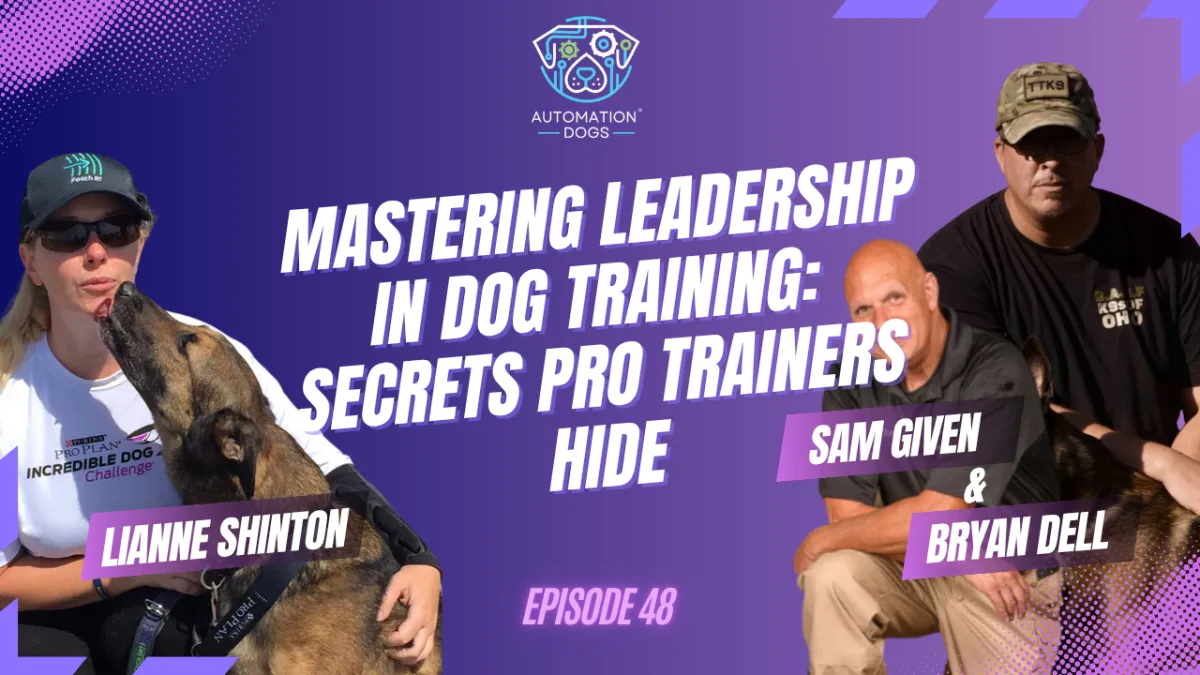
Mastering Leadership in Dog Training: Secrets Pro Trainers Hide
Sam Given & Bryan Dell
January 20, 2026
71 min
Automation Dogs Podcast
About this episode
In this conversation, Lianne Shinton, Sam Given, and Brian Dell discuss the essential aspects of leadership within the dog training industry. They explore the differences between leadership roles, the importance of understanding various leadership styles, and the significance of feedback and communication in fostering a positive work environment.
Let’s Build Your Growth Plan
Automation Dogs isn’t just software — it’s a sales growth system backed by strategy, coaching, and support.
On your free Strategy Call, we’ll:
Pinpoint where your leads are slipping through the cracks
Show you how to fix your follow-up and close more clients
Map out a simple, proven plan to grow your business
Every dog training business is different — this call ensures the strategy fits your business, not a generic template.
If it’s a fit, we’ll show you exactly how we’d implement this for you.
If not, you’ll still leave with clarity on what’s holding your sales back.
Full conversation
Transcript
Lianne Shinton (00:01)
Welcome everybody. So I'm Lianne Shinton from Automation Dogs. I do a CRM software for dog trainers, but also my podcast. We dive into having conversations with dog trainers to help pet owners in some cases and in other cases to help dog trainers. And today this focus is going to be to help dog trainers. And I have the amazing Sam Given and Brian Dell joining me. Welcome Sam and Brian.
Sam Given (00:29)
Good afternoon.
Triple (00:31)
How you doing?
Lianne Shinton (00:32)
Good, good, thank you. So Sam is from Professional Canine and Brian is from Triple Threat Canine, real badass name. And ⁓ Sam just created and hosted the first ever Professional Canine Development Conference in Ohio that Brian and I attended and it was outstanding. And we all kind of got to talking about leadership. And that is something that I...
Triple (00:41)
yes.
Lianne Shinton (01:00)
hear from dog trainers quite often. They're not sure when to hire, how to hire, and then how to lead a team. And the reason that I wanted Sam and Brian to join us today is because they actually have background in this, not necessarily from running a business and being a dog trainer, but from their military background, which is outstanding. And thank you both for your service, by the way.
Sam Given (01:26)
Thank you.
Triple (01:26)
Thank you.
Lianne Shinton (01:27)
Now, I feel that as like a girl running a business when I was 17, like it was a struggle, you I had to learn it. And a lot of times what I'll do is I will lean into watching someone that is bad ass at this. And so even though you might be a little softer like myself, this is the kind of stuff that I like to listen to and watch and learn from because
I'll start to mirror it and that helps me become more confident and smarter in whatever it is that I'm learning. And again, today we're on leadership. So ⁓ without further ado, maybe Sam, could you introduce yourself and a little bit about your background and then Brian.
Sam Given (02:18)
Sure. So some of you seen me on the podcast before. I'm Sam Given. I am a trainer with professional K9 out of Ohio. My background, I did 38 years in the military before I retired about four years ago. I started out as a United States Marine, transitioned over to the Air National Guard. During the Air National Guard time, I spent about 14 years with the active duty side of the Air Force. In my last 12 to 15 years was actually in all leadership roles.
So I really have a passion for this. And one of my degrees is in organizational leadership. So it's a great background to have when you're talking about new business owners, because we all get focused on our pets. We get focused on our clients, but we forget that we have our whole business side of things that we need to work on. So this has really been a passion for me, not only with dog training, but with just small companies and helping them out.
Triple (03:17)
So yeah, I'm Brian Dell from Triple Threat K9. So I'm also in central Ohio. Me and Sam aren't too far from each other. So that's awesome. Same thing, I'm retired military. So I retired from the United States Air Force in 2020, right around COVID timeframe. I was active duty Air Force. I served as a military police officer, was a K9 handler, eventually a K9 trainer and got promoted to become what's called a kennel master. So from there,
A lot of leadership opportunities I've had myself and my personnel have served across the globe on six out of the seven continents or however many there are nowadays. ⁓ But yeah, so long story short though, I've supervised both the K-9 world, also in our operational side of things as well. So we've had upwards of 225 personnel in our units. This is the largest unit that I was with at the last time in my career there. And again, supervising folks across the board.
So it's been kind of a passion of mine as well. So obviously in the military, we get thrown into it a lot sooner, a lot earlier than most in life. So Sam can attest once you're first put into the military, even a very low rank in the military, you get thrown into that role very quickly. So you have to adapt and learn pretty fast. Fortunately, we get a lot of training along the way. We get a lot of class, a lot of good instruction and a lot of men's worship. So yeah, but I'm looking forward to having this discussion with you guys today. Leadership is something I'm passionate about as well.
I still get calls regularly from guys I supervised 10 plus years ago that still tell me I was one of the best supervisors they ever had or they'll contact me for mentorship. So to this day, even though I'm a civilian now and a lot of my guys are getting close to retirement themselves, but yeah, that's a great topic. So I'm glad you had us on today.
Lianne Shinton (04:56)
Awesome. Now I know Sam, you have kind of some slides that you've already prepared and you've taught on. So I'd like to start with what you would like to share so we can have a conversation about that.
Sam Given (05:13)
Sure, think when we start talking about leadership, first we have to kind of figure out what is leadership, right? And a lot of times things get broken down into I'm a supervisor, I'm a manager. But we have to understand that those two titles, yes, they're leadership, but it doesn't necessarily mean they're a leader. They have a title, they're in charge of something.
but there's a difference in leadership itself. And the way I teach this to corporations and small businesses is supervisors tend to supervise people, the people. They take care of people's needs. They're the people that's overseeing the workforce's HR needs, their time off, their scheduling. They're really taking care of the people. Then you have your managers and it's a leadership role, but managers have a tendency to be more focused on the overall
organizations processes. They're managing programs. They're managing the day-to-day workflows and how those programs integrate with each other. Now they're both considered leadership, but they really don't define what a leader is. And the simplest way that I've ever heard leadership defined is a true leader or someone who is a leader of an organization is a person who can develop
and communicate the organization's vision. So for me, a good leader is someone who can create a vision for where they want the company to go, the organization to go, and then be able to communicate that in a simplified manner that's repeatable and that anyone who works with them or for them or outside their business understands exactly what the vision of that company is and the direction that they're going.
So that's kind of where we have to start that conversation, right? Is what is it we're truly looking for? And I think most small companies, especially in the dog training industry, you have one or two employees. ⁓ Our company has six of us. And we have a pretty defined vision as to what we want to do with our company. And it's directly in our name of professional K9. And you both attended a conference and stuff and we've done podcasts together.
Everything that we do, we try to do it on a very professional level. So for us, our vision is to be innovative. We want to be the trainers that other trainers want to collaborate with. And then we have an innovative nature to what we're doing. So that's a really repeatable vision for our leadership. So each small training group, if it's one person, two people, three, they need to be able to figure out, okay, what's my leadership style?
And then what's my vision for my company going to be? And Brian, you probably see that you have several employees that work for you and you started out as a small ⁓ training group, correct?
Triple (08:12)
Correct. Yeah. So for us, same thing. And I kind of want to touch on a little bit too. So Sam's given you kind of a, like, again, goes with our name professional and K9 has given you a very good professional breakdown there as far as like leadership goes. Something I just wanted to kind of start it off with too is one thing I've seen throughout my career in the military, I've seen a lot, even the civilian sector is there's a huge difference when it comes to when you talk to leadership.
A lot of times people think about leadership and they think like the boss, right? They think the head of the operation, head of the household, head of the business, whatever it is. ⁓ That being said, a lot of times people tend to think, hey, because I'm in a position of power, I'm a great leader or because I am a leader because of my position. So therefore you have to do it. say, you know, follow these instructions, follow the divisions. I've seen a lot in my career in Sam, I'm sure same with you in the military, really good leadership and really bad leadership, right?
Sam Given (09:03)
Oops.
Triple (09:06)
⁓ Some people are built for it, right? I definitely think some people are just naturally born good leaders. I think some people struggle with it. ⁓ My big piece when it comes to leadership and just something I wanted to put out there and have some discussion with you guys as well and your thoughts ⁓ is when it comes to leadership, sorry there, my your possible having a having that that relationship with your people is huge, right? So I think building the camaraderie with your team, team building is important to me, especially here at Triple Threat K9.
I want my team to feel like family. I want them to know that I have their back. And the big thing I have stressed in a leadership role is, you know, having that vision like Sam talked about, being able to, hey, this is the vision, this is the way ahead, but at the same time, also having it to where we have, you know, the ability to lead our folks down that path, but also have compassion, empathy, you know, make sure they're being taken care of at the same time and leading from the front. I'm a firm believer in that. I'm not going to do anything.
or ask my people to do anything that I wouldn't do myself. And I find a lot of times I can have people want to follow me and want to follow my vision much easier because they see I'm out there right next to them. I'm in the trenches with them doing the works day in and day out with them. So I think that's a huge piece of leadership too.
Sam Given (10:21)
Yeah, and know, Brian, you just keyed in on a really important function of leadership is a lot of times we get caught up in that who's the boss, who's the manager, who's the supervisor. That's a formal leader. And what I've found over my career is the most influential people in an organization, I should say, is the ⁓ informal leaders. That one or two people in every organization that
every other person looks to to go, is this a good idea or is this a bad idea? What's the boss really want us to do? And those informal leaders make or break an organization. They really do. And that was a great point that you were making on that.
Lianne Shinton (10:52)
Okay.
Triple (11:03)
Absolutely.
Lianne Shinton (11:07)
I'm just sitting back and you you guys are the experts on this. So, you know, if you want to share your next.
Sam Given (11:15)
We were just kind of waiting
to see what you're going throw out there next. ⁓
Lianne Shinton (11:20)
I know from being a business owner, dog training business owner, some things that come to mind are maybe some problems that I've seen with dog trainers, with their businesses or with my own business where maybe a staff member is getting ready to leave. And what should we do? What signs should we look for?
You know, why did that happen?
Sam Given (11:51)
So, know, I'm gonna throw some theory out there and Brian has created practical application to this and I'm a real deep theory guy, but I think what we have to start with is as leaders, as business owners, we have to have an understanding of what's our leadership style. And, you know, I'm a very formalized leadership style like.
I believe in you know, you got the democratic leadership, you got lazy fair leadership, transformational, transactional, servant leader. Most of the time, informal leaders are those charismatic leaders. And in the military, know, basically it's a dictatorship or a bureaucratic leadership style. But I think it's important for us as business owners and as trainers to understand what's our personal philosophy, what's our style.
And I think that evolves over time also. So for me, I'm a very trans ⁓ transformational leader. I want to be that person. It's always looking to innovate, to move forward. What's what, how do we grow? And more importantly, how do I set and develop goals for each one of my employees to achieve what their goal is? Because everybody has their own personal goals. And maybe it's not always with your company. Maybe as they grow, they want to go do something
that you don't offer. And I think as leaders, it's important that we help them get to that goal and then understand that, hey, if you leave me, it's okay. Let's part on good terms. Now on the opposite side of that, sometimes we have employees want to leave because of leadership conflicts. And those leadership conflicts really stem from one, leaders not knowing what their style is. they're
They're telling you that, I'm a very ⁓ transactional leader or I'm a lazy laissez faire leader. But their actions are as a dictator, as a bureaucrat. So their actions and their style don't match each other. And that first line supervisor, first line manager is the person that really determines how happy or unhappy an employee is.
So what I find with smaller companies is most of the time they don't really know what their leadership style is because they've never studied it or they haven't taken personality tests to understand that. And Brian Hittlert in his is, when he was talking about leadership, is understanding that natural born leader. And you hear that a lot, oh, that person's really a natural born leader. What that really means when you break that down, because leadership's about
emotional intelligence. And we can talk a little bit about what emotional intelligence is and how it works, but when someone says that that person's a natural born leader, really what it is, it's that individual has a really good grasp of emotional intelligence and they know how to meet you where you're at. And you'll hear, we talk about this a lot with our clients. We want to meet our clients where they're at and then figure out how do we move forward as a team from there.
⁓ So I think when we get into these minute ⁓ conflicts within a group, we have to look at is our training philosophy what we say it is, or is our actions dictating that it's actually something different? And as a leader, do I understand the emotional intelligence of the person I'm talking to? Because I'm a very dynamic person. I know that I have a very
I hate to say overbearing personality, but my personality can be very direct and kind of push people out sometimes. From an emotional intelligence standpoint, what I have to understand is, that person might be someone who learns on a softer level, that they're more compassionate, they have more empathy, and those are things that I know that are weak spots for me personally in leadership. So I have to...
talk to them in a different manner. I have to address conflict in a different manner because if I do it in a very direct manner like with Brian, because I know his background, I don't need to give him positives and, you these things right. He doesn't want to what he did right. Tell me what I'm doing wrong so we can get this fixed and move on, right? So I think that's kind where we start that conversation with the conflict management is what really you're talking about. And we can delve into it a little bit more. Brian, what do you have to add?
Triple (16:34)
Yeah, absolutely.
Lianne Shinton (16:35)
Hmm.
Triple (16:43)
Yeah,
yeah. So I like how you brought up the personality side of things because that's a huge thing as Sam mentioned. So in the military, we actually take personality trait tests and there's a lot of different ones out there on the internet you're able to do. So for me, every time I've ever taken a test throughout my career, I'm a dominant influencer, right? So two that you may not see together as often, but I have a very dominant A-type personality, again, being military police, being K-9, a lot of the folks in the law enforcement K-9 community.
are in that capacity. The influencer piece is what I find has helped me the most though. So again, I can lead with a heavy hand. I can lead because I'm in a position of authority. I could lead because I'm the boss, right? But what I find is the influencer side of me, I'm able to have the people work for me because they want to work for me. But again, it's because I take care of them. And Sam was mentioning different types of leadership. And I kind of want to touch base on this. I'm gonna look at my screen here a little bit. I have some notes as well. But so he mentioned a few different types of transformational leadership.
These are the three main types I find that I most like and again I'm kind of a blend. If you guys sat in my class with the tracking trailing, right again tracking and trailing to me are one and the same if you do it right. Same thing when it comes to leadership. You don't have to be one or the other in my opinion. You can kind of be both. So for me, transformation leadership is one of my big ones that I definitely feel that I fall within the realm of, right? And again, that's, you know, making sure that as far as a transformational leader, you're ⁓
Lianne Shinton (17:45)
you
Triple (18:09)
Getting that vision pushed out there, making sure folks are motivated and valued within your operation, whether it's your business, military, what have you. A servant leader, again, like I talked about, putting your people first because that's one thing I find a lot, right? So as a boss, as a leader, we feel, well, because I'm the boss and it's my company, you have to work for me very hard, right? And that's not always the case, right? You should be the hardest working employee of your company as the leader and as the boss, right? Set that example, how those people want to follow you.
Me and man, we had a conversation briefly at the end of one of our podcasts we did a couple of weeks ago. And that's how we kind of decided like, Hey, let's have this conversation on leadership. talked about some things, right? And one of the things we talked about is feedback, right? So feedback in the military, have a performance feedback form that we actually utilize. And on that form, it's a form that we hand to our personnel and we say, Hey, know, fill out all these boxes, right? And there's all kinds of different questions like, Hey, how do you feel that you fit into the overall mission or the overall vision of this company? You know,
How do you feel you're performing in these areas? And you can select all the different areas. It's something that I think all companies should do, right? And so they give themselves an honest feedback, right? So I would have them fill the form out and then they hand it back to us, right? As a supervisor. Once they give it back to us, we take time to review it. And then there are sections that we go over together. But we're not talking about just business. We're not talking about just main everyday, hey, work stuff. We're also talking about personal life, talking about professional development.
Right. So we want to know, like for me, I want to know my people's families, right? I want the families involved. I want to be able to have that, that down home feel with them. I don't want to just be like, it's business. And I don't care about your home life. Right. Cause if they have a bad home life going on, there's something going on at home. They're not going to be focused at work to get the job done. Right. So having that communication, communication is huge. Right. You have to talk to your people. You have to know your people, right? You have to be able to communicate. Like Sam said, the vision and the goals, but you also have to be able to communicate with them on a personal level.
and be able to have those in-depth conversations. He talked about professional development, right? Sometimes people want to leave because they want to do more than what you may have to offer. So again, promote that within your business. That's one thing I can't stress enough. not dog training related, but for example, in the military as a flight chief, so I had roughly about 80 people under me at this time.
And I was one of the only flight chiefs in my entire unit that was certifying some of the lowest ranking guys that are normally entry controllers working to main entry control points to a base. I was certifying them as patrolmen and they were seeing the road as police officers, right? Actually out serving on the road and all the other flight chiefs thought I was crazy. They're like, what are you doing? Like these kids are too young. They don't know. They don't have the background or whatever. like, well, you got to get them there. That's why we train. That's what we do. We teach them the ways we show them the way ahead.
And I was the only flight that had all of my A1Cs, which is Airman First Class, which is, they're pretty new still to the military, certified as patrolman. As soon as they got done with their certification as patrolman, next thing up is desk sergeant or dispatcher, right? So then we start right away, they enter training for that people are like, what are you doing, man? They don't do that until they're a staff sergeant or, know, tech sergeant. So I'm like, wrong, right? My guys are going to be trained because one that makes my company or my operation that much smoother. If somebody calls off, next man up, right? If somebody's missing, next man up.
Lianne Shinton (21:15)
Mm.
Triple (21:23)
Right. I'm able to fill those voids. And again, that
makes my people valued. Right. Because all the other people are like, no, you're not ready. You're not there. You're not capable. Right. That's the wrong answer. Right. If they have the drive, they have the passion. Or even if they don't communicate and talk to them and find out why they don't. Right. And find the reason as to why we need to motivate them. How do we motivate you? Right. What do you want to do? Because again, if you don't have that conversation, you're never going to know. So like back to your situation and that you asked about is if somebody's like, I'm leaving your company. Well,
Sam Given (21:27)
Absolutely.
Triple (21:52)
We should have known long before that I was coming based off discussions. Cause if we're having that honest feedback, it doesn't always have to be formal, right? It doesn't have to be, sit down, fill out this form. We're going to talk once a quarter, once every six months annually, whatever it is, right? Just having a simple conversation. Hey, what's up? How you doing today? Good. Good. Hey, how's, how's work and treating you? How's things going here at the shop? You know, what are you thinking about, you know, you want to do here in three months from now? You know, how can we help you grow? How can we help you be happy here at this place of business? I want you to be here. I want you to be happy. And I want you to work for me.
We talked a little bit about a story I was talking about where one of my personnel was asking me questions all the time. I'd be like, hey man, and again, I'm a fun believer in leading a couple of different ways. Like I said, the servant leadership is never peace transformation, also situational. So situational leadership, you have to know the people you're dealing with. So you have to know all the different personalities. So obviously in the military, we get a ton of different personalities, same thing in the civilian sector, ton of different personalities, different backgrounds, et cetera.
So anyways, for me, I've always been a leader that I kind of ask and make people feel like they have a say in things, right? So like for me in the military, if I'm like, hey, I need you to go wash their wash our canine cruisers. If they're like, but why, right? Okay, let me rephrase that go fucking wash the canine cruisers. Right? But a lot of times because I'm like, hey, would you mind doing this for me? They would want to do it for me because they knew I had their back. Right? So again, they don't really have a say at the end of the day, but they kind of feel they do because of the way I'd ask it. Whereas a lot of people when they're leaders, they're like, hey, go wash the cars.
Right now. Hey, would you mind knocking this out for me real quick? Can you help me out? Can you help me get this done? Right. And they'd be like, oh, yes, sir. I got you. Right. Like I'd tell you all the time, my troops sort of jumped off a bridge for me because I treated them fair. I treated them with respect and we had open communication. Right. They knew they could come to me with problems. would help them in any way I could. Right. And that gained their trust and their value. But the guy I was talking about with Lianne, one of my, one of my guys who eventually became my replacement as a CalMaster, he was my senior handler.
Eventually, he was becoming a trainer. Then I trained him up to replace me when the time came. But long story short, he would ask me why after basic stuff. Like, I'd be like, hey, man, I need you to do X, Y, and Z for me, whatever. And he'd be like, why? And I explained to him why. And then it happened again. Why? I explained to him. So about the third or fourth time, I'm like, all right, I'm going have a feedback with this guy. So I brought him into my office. We sat down. did, hey, we're going to do a feedback today. Let's have a discussion. Because I'm getting frustrated because I'm like, why is he constantly questioning what I'm telling him to do? Everybody else in my unit.
Lianne Shinton (24:14)
Yeah.
Triple (24:18)
listens
like Johnny on the spot. They're there to support me. So we sit down, we have this conversation. I hadn't thought the forum that was talking about our performance feedback form just again to get a feedback and also kind of start a paper trail if needed. Because that's something too is documenting issues, right? Like a lot of people don't document things, right? So document the issue. So I'm like, hey, let's have a feedback. We have a discussion. So I said, I mean, one of my big things with you, and there's a spot on there for supervisors to talk about like issues they see with their personnel. So one of my biggest issues is, you know,
Lianne Shinton (24:30)
business.
Triple (24:47)
I'm obviously your boss and I find a lot of times you question me on things that I ask you to do. And he goes, well, Sergeant Dell, it's because I want to learn. And I'm trying to learn why you do things the way you do, because I respect you as a leader. And I'm trying to figure out exactly your thought processes behind it. He's like, I'm not trying to be disrespectful of my any means. So for me as a supervisor, I was taking it as him being an asshole. He's being disrespectful. He's questioning me as to why I'm asking him to do stuff. Again, which wasn't normal. None of my other personnel were like that.
But this guy's a very analytical guy, right? ⁓ For me, I'm very much a shoot from the hip, get shit done, make shit happen kind of guy, right? Like if you need some stuff done, I'm gonna get it done, we're gonna do it, right? But it may not be the way that everybody wants it done, but it's gonna get done, all right? Whereas he's very analytical, he's like, I gotta think through the processes, I gotta understand your thought process, your thinking and why you do it. So again, that was a lack of communication on my part, because I should have asked that question, like, hey, why are you questioning me right now, right?
But after I saw it was a trend, said, you know what, let me do a feedback session. Let me sit down and let me have a conversation with this guy. Right. I never jumped his ass for it. Right. We just sat down and had a conversation. And because we had that conversation, I was able to avoid conflict there as well. Cause we could have very easily got into an argument. could have jumped his ass into the military stamp pose and anybody that knows about the military, I could have ripped his ass apart for it. Right. But instead I decided to just have the conversation. He explained his side, why he's like that. And I was like, man, that's phenomenal. Like you're motivated. You want to learn. Let's learn.
Lianne Shinton (25:44)
Mm-hmm.
Triple (26:14)
Right. So then I started training him up and this is when he was still the senior handler. And then eventually on my head, you're now the trainer. Hey, now you're the kennel master. You're taking my spot. Right. Your name is now put in the hat to relieve me. Right. When is my time to roll out? So again, ⁓ like I said, you got to know your people. You got to get on that deeper level. You got to have that communication. You got to have an open door policy, right? Just cause you're the boss doesn't mean you know everything either. Right. Like you may have somebody that's your lowest ranking person or your lowest person in your business that have
Lianne Shinton (26:40)
Thank
.
Triple (26:44)
phenomenal ideas, right? But if they're too scared to come have that conversation with you,
your company may be missing out on some critical information. ⁓
Sam Given (26:52)
You know, Brian,
Brian, know, and a couple of things I want to touch on. One, I think some of our younger trainers that might be just them and they don't have employees yet. They have to understand that their leadership is also leading their clients because they need to help their clients develop a goal and a vision for what they want their dog to be. Right. That's still part of that leadership picture. leadership doesn't apply to just employees. It applies to the people you're working with.
Triple (26:56)
you
Sam Given (27:21)
The other thing he hit on, his story was great for this because we talk about, don't know if you've, some of your people that's listening probably have heard, you know, the color ⁓ test. And it tells you if you're a blue, a gold, a green, or an orange color, and each color reflects a personality trait. Brian tends to be in the orange category. And I'll read you a couple of these, this is why I say he leans towards being orange.
Someone's into orange personality trait is flexible, easygoing. They like exploring new possibilities. They're open to change. They have many interests and they're able to do many things and express multiple ⁓ ideas. The employee you had working for him would have fallen more like in that green category where they're mentally tough as wrong, but they're logical, rational. ⁓
self-controlled, but they want to overanalyze information. now we have an orange and a green trying to talk to each other, right? So here's how they each perceived each other.
Lianne Shinton (28:22)
Hmm.
Sam Given (28:35)
the person who was asking question perceived Brian on a thing of ⁓ he's giving me multiple tasks, I feel scattered. He's not giving me the full picture of the information. So I can't analyze what I need is what he's thinking. On Brian's side of this being an orange talking to green, he's fallen into this guy's kind of arrogant. ⁓ He's
over analyzing everything I tell him. I don't need him to ask questions right now. I just need him to go get this done because we're on a time crunch. So you have an orange and a green talking to each other. And that's how that emotional intelligence works is had either one of understood where the other one was in their personality traits, that communication gap gets closer and closer. So when I'm talking to somebody that I know that is in a green personality space,
I know they're very confident, they're mentally tough, they're logical, they're rational, ⁓ they're good at analytics. So I can talk to them on that level. I also know that when I'm talking to them, because I'm a gold, I have to make sure that I'm not being too rigid, if I'm inflexible or over-opinionated, because that's how they perceive my personality traits. And this is stuff that applies to our businesses with just our clients.
There's been times that clients, I know every dog trainer out there has run into a client where they go, my God, why did you call me? You already know everything there is and you're not listening. Everybody's had that client. Well, it's not necessarily that that's what they are. It's just how we perceive them based on where we're at in our emotional intelligence and how our emotions work versus their personality. So the more we understand that from a leadership standpoint,
the more effective we can be as communicators. And I think that's important, Liam, for those smaller businesses that don't have lot of employees, but they're really the leader of their clients. Because clients don't know where they want to go. We have to create for them. Because here's where you're at, and here's where I think we can get you to.
Lianne Shinton (30:43)
Mm-hmm.
Triple (30:50)
Absolutely. Yeah, I agree.
Lianne Shinton (30:52)
I think that something actionable that I'm taking away right now is asking for feedback from your staff if you have staff, having them fill out a form once a day, once a week. You could start to back off maybe over time, but people have different perspectives.
Sam Given (31:02)
Absolutely.
Triple (31:09)
Yeah.
Sam Given (31:12)
So.
Triple (31:12)
Yeah, I would say like when it comes to that, like I also think I have found in the military, especially like, again, Sam can attest, there's a ton of red tape and there's a ton of additional things, right? So me personally, I want to say overload your people with feedback forms and all of that stuff, but just simply having conversation too, right? Now, if you're not good at conversating or you're just kind of new to the leadership side, or like maybe you got your first employee, or maybe it's your first time having to have a tough conversation, yeah, slip on the form maybe, because that sometimes takes it
takes the edge off, right? Like ⁓ I don't shy away from confrontation. I don't care to have a discussion. Like it's easy for me. find it very natural, but a lot of people struggle with that. So I would say like, your feedback forms are great if you're not good at that, right? Cause you can have them fill out a bunch of stuff, have the opportunity to read it, then set up a time to sit down with them, have that discussion when you're prepared and you have your data or you have your talking points or whatever it is that you need.
Lianne Shinton (31:57)
Yeah.
Triple (32:08)
But I'd also say on the flip side, like if you're like here, fill out the form once a week or fill out a form every day or fill it out, like I would just be careful in that realm too coming from my standpoint just because then they're gonna be like, man, this boss is a micromanager. They're up my ass constantly. Like, why are they making me fill this stuff out? This additional stuff is taken away from what we're trying to do, which is train high quality dogs and produce very good results for our clients. So for me, like I said, I kinda like to do like maybe a quarterly.
maybe every six months, right? And sometimes not even at all, except for annually, you know, depending on who my people are. But again, I'm having that conversation daily, right? Like there's not a day that goes by that I'm not talking to my staff at some point, right? And I'm talking not just business again, I'm personal stuff, I'm talking business, I'm talking professional development. Hey, what do you want to do, right? Now we offer a lot of stuff here at Triple Threak, and so like my staff get to dabble in a lot of different things, right? So we offer a lot of things that a lot of them are interested in. So it's nice.
But again, there's something that's like, man, I'm gonna go to this or I'm gonna check this out or I'm gonna do that, great. But again, we need to know those things. We need to know what their goals are. And again, that feedback is, again, like I said, I can't attest to having that feedback enough. But again, it doesn't always have to be formal. And it doesn't have to be constant. Just have conversation as feedback in itself. When you have a discussion, they're discussing back, dude, that's feedback. Informal, but it's still feedback.
Lianne Shinton (33:26)
Mm-hmm.
Sam Given (33:29)
I think what's really important. I'm sorry, ahead, Lee.
Lianne Shinton (33:30)
I like what you said. I was just going to say Sam, like
what you said that you're a leader for your clients. And I think that clients would love to fill out a feedback form, but us, we feel like sad inside if we don't get the perfect score, but they love it. So I think that sending out a feedback form to your clients could be a great thing to do for your clients and to help you become a better leader.
Triple (33:59)
Yeah,
so I kind of do something like that here, triple threat. So we have a form whenever I'm making contact with clients. And again, I do it sometimes informally, right? Via conversation. But I ask a lot of questions, right? I'm like, hey, what are you, what are you trying to do? What are you trying to do with this dog? What's your end goal? What's the end game here? Right. And so again, it's all feedback, right? They're giving us that. So you're talking kind of post training feedback, which also is phenomenal, right? And that's a great thing to do also.
But I try to get that feedback from the start. Like Sam talked about, we are the leader in this dance, right? We are the person that's taken that dog from point A to point B. And we're not just dog trainers, we're human trainers as well. Like me and you talked to me in our last podcast, I train dogs maybe two, 3 % of the time. I'm training humans 97 to 98 % of the time, right? So, and at end of the day, that's really the big piece is making sure that we're getting them to their goals. But at the same time, we're getting their dogs to their goals as well, because we all have that clear communication together.
And that's beautiful thing.
Sam Given (34:59)
Yeah, you know, we're along those lines, especially from a leadership standpoint. I think Lee Ann, really, you kind of nailed this down is that feedback is uncomfortable. Okay. And there's no way for it not to be uncomfortable. But, and you heard me say it to conference when we were asking for people to fill out the feedback form for the conference. Don't tell me the stuff that did right. Tell me what we did wrong.
Lianne Shinton (35:20)
You did.
Sam Given (35:27)
Tell me everything that I'm doing correctly and giving me all floofy, ⁓ best thing I've ever seen, great, it means nothing because I can't build on those. What I need is what didn't go quite right. Where can we improve? So when we talk about feedback from our company standpoint and from me from a leadership standpoint, the feedback I'm really looking for is what can we grow and what can we build off of? And that starts in two aspects of leadership. First,
setting documented goals for your clients. So when you meet with your clients, one of the first things you should be doing with clients from a leadership standpoint is asking their goals. Okay, I have a 12 week old puppy. Well, is your goal to complete CGC, advanced CGC or urban CGC? Do you want a therapy dog? What is your goal?
And then we specifically build the program based on those goals. So now we can have identifying ⁓ timelines and marks that we can look at and go, okay, are we on track to achieve this goal? For your employees, it's exactly the same. If I want my employees to go out and bring in three clients a month, why I need to tell them that, hey, here's what we're looking for as a company standard. I'd like for you to be out marketing the company, marketing yourself.
and bringing in X number of new clients monthly. And we set that as a goal and then we give them feedback on what they can do to achieve those goals. And we work towards them. So I think that's really important. And you're right, getting the feedback is uncomfortable. But we have to get the feedback and we have to set those goals. If we don't set the goals, we can't hold people accountable. And that's as a good leader.
And when I say a good leader, I really mean exceptional leaders understand that we have to have uncomfortable conversations and we have to hold people accountable. And we have to maintain a standard, right? Because what happens a lot of times is, especially bigger companies, when you have 20, 30, 40 employees, every single one will have that one or two employees that aren't meeting standards. But
Triple (37:32)
Yes.
Sam Given (37:49)
They have a boss or a leader that's afraid to call them out on it and push them harder. What happens is that causes dissent in the other 98 % that are just outstanding employees. It's like, well, you get to come in 15 minutes late or they're leaving a little bit early or they're coming in from lunch 15 minutes late. Well, why am I here 15 minutes early saying 15 minutes late and shortening my lunch to get all my stuff done? Because obviously the boss doesn't care because they're not addressing with this individual. So
When we talk about leadership, especially in these small businesses, when you only have one, two, three employees, it is vital that you create a standard and hold people accountable to that standard. Because what happens if you don't, instead of having one employee that's not meeting the standards that get upset and leave, you're gonna run off your top people and they're gonna go somewhere else where everybody's holding that standard.
And that happens a lot.
Lianne Shinton (38:50)
Mm-hmm.
Triple (38:51)
Yeah, I agree 100 % with what Sam said. Their ⁓ accountability is huge. It's so huge. And again, a lot of people struggle with doing it. So something I find too when it comes to leadership, whether it be in the business world, military world, what have you, is a lot of people when it comes to the accountability side and being a leader, again, some people just don't want that responsibility. They can't handle that responsibility. So that's something that I think a lot of new trainers need to take into account before even trying to grow or start
getting bigger is like, Hey, am I built for this? Can I have those tough discussions? Like we talked to Liam before in the other podcast we did. ⁓ my, my one big thing I learned from a chief master sergeant early in my career in the military is he said, call an ugly baby ugly. And I kind of looked confused at him. said, what do you mean by that? he was like, we'll think about it when a baby's brand brand new and they're born. He's like, normally their faces all smashed, they're red. They got a little cone head, maybe whatever. They're not cute. They're ugly.
He said, so call it what it is. He's like, call an ugly baby ugly. I just kind of laughed about it. You know, I was like, that's a good way to put it, but he's basically saying call it you see it. Right. So again, you got to have those discussions in that conversation. Like Sam said, you'll definitely, I've seen it firsthand throughout my career. You'll have the high achievers that start falling off because they're like, why am I putting the extra effort? This guy over here is not doing nearly as much as I am. He's getting paid just the same as me. And then if that person's still getting accolades or, you know, accommodations or different things, then it's like.
man, like this clown's doing it? Well, why am I doing it, right? So it'll definitely degrade your morale across the board and morale is important too. So also note that like you need to also identify your top performers right and mark those behaviors as well, right? Just like we'd mark a good behavior on a dog, we need to reward certain things with our staff and ensure that they feel valued and they know they're my number one, they're my go-to, right?
And I'm going to put one of my right hand ladies on blast here in this video and it's not putting her on blast in a negative light, but she tells me all the time, right? As we know in dog training, people come into companies, they gain a little bit of skills, then they're like, I'm going to go start my own company now. I'm going to go do my own thing. I'm going to start my own business and off they go, right? She's told me numerous times, right? She's like, I have no business being a boss and I don't want to be a boss, right? She tells me probably at least once a week, I'll make a comment or I'll talk to a client or I'll say something.
Right. we deal with all kinds of things across the board. So like selling police dogs, for example, and dealing with departments and stuff should like it. And that's why you're the boss. Right. And that's why you're doing this, because she's like, I want no part of that. Right. She's very content working for me or a triple threat, which I love because again, she handles so much business for me and she's she's a phenomenal employee. And it's Emmy Hayes. She's at the conference. You guys got an opportunity to meet her. But, you know, she's she's been phenomenal. Right.
Sam Given (41:31)
Absolutely.
Triple (41:35)
But again, she is so dedicated to the company and she is so bought into our vision here Triple Threat. But she knows like, you are my right hand woman in this. You helped me a ton, right? You're a go getter, you're a hard charger, so I identify the good stuff as well as anything negative, right? So she also knows just as fast, so can have a discussion with her and be like, I need you to do this or hey, I didn't like this or hey, we need to fix this. And again, it's important to be able to have that flexibility as a leader too. Flexibility, communication, feedback, all some really strong stuff.
Lianne Shinton (42:04)
Could you, someone share on if an employee is late? I feel like we should address it and have that conversation very quickly because they're probably gonna do something great and then it's like, can't not do them now. So I'd like to hear maybe Sam, you could share of something actionable that I could do if I have someone that's doing something wrong, like say they're continuously.
late and we don't want to have bad morale within the team.
Sam Given (42:38)
So this is one of those things, and Brian hit on this when he was describing his vision of leadership, is having those informal conversations. And just on a daily basis. an example of this is what you're talking about can go two ways. One, I have a really highly motivated employee and all of a sudden they go from being highly motivated on time early to three, four days in a row late or their work slipping.
that's an indicator to me that there's something else going on in their life because we've had all these conversations, they have a track record of being really good, right? Because we've developed that relationship, I can go, wow, there's something in their personal life that's not quite right because we're developing bad behavior. And that's an opportunity where I would call them in one-on-one and sit down with them and say, and not even address any of the tardiness.
work performance or anything. I would start off with that, hey, just wanted to touch base with you, just notice some things weren't quite as good as they've been in the past. What's going on in your life? How's things at home? And just open up a dialogue. And you may find out that, maybe they're going through a divorce. They just had a car wreck. ⁓ They had a close family member that had a death or somebody who's sick in their family, or they got some bad news that health-wise they haven't shared with you yet.
all those things will take a good employee and cause their performance to start lacking. So that's scenario one, right? Now you also have an employee that maybe was just average to begin with, and all of sudden they're falling behind a little bit. They're not hitting their goals, they're coming in late. Maybe this is a different conversation because maybe I've already told them, hey, I really need you to be here on time. So there's a few things that...
we have to look at with an employee like that is first, I'm gonna throw a formula out there, I'm gonna go through some of these in a minute for everybody, this is the key where there's a concept that's called 10, 80, 10. 10 % of your employees will be low performers, 80 % of your employees will be standard, average, they're right there on the standards where you want them.
and you have 10 % of your employees that fall into that highly motivated exceptional range. As leaders, we wanna focus on the 80%. So maybe this person was in the 80 % and they started to slide back into that low 10%. Well, we've already had this conversation because typically we've mentioned it before is, why were you late last week? Or, hey, I got an email from clients saying you were 10 minutes late.
what's going on, because we've talked about this before and last week you told me, know, oh, it's traffic. I got a late start. I couldn't get the dogs back in the house, whatever, right? Whatever excuse that they have. That conversation with that employee is different. It's like, okay, first one, we talked about this. We didn't document anything, but hey, this is gonna be more of a formal counseling. I'm gonna send you an email before you acknowledge, but I need you to understand that.
When we say one o'clock, one o'clock means one o'clock, if there's continuing circumstances, you need to reach out to myself and to your client to let them know what's going on ahead of time, not after the fact. Now we're starting that paperwork trail, not necessarily to get rid of them, but to show performance. Because if we start developing, depending on your business model, if you're using 1099 Contractor as your employees, or if they're actually part of the company,
you may need that documentation for unemployment, workers comp, that whole realm. What happens with that type of employee, Lianne, is typically ⁓ they fall into this concept, it's called BCD, ⁓ which is blame, complain, and defend yourself. And we've all had those individuals we've worked with, that, the traffic was horrible. My wife had her car parked behind me, I couldn't get out.
you're blaming somebody else's for your performance. Then you have the person that's complaining about something. you just don't understand how busy I was. You keep me too busy. I had three dogs that day. Or they tried to defend their actions. Well, you don't understand. It wasn't my fault. ⁓ I was just so busy and the client knew and they're trying to defend whatever that action is.
Again, that conversation with that individual then is, okay, you're not taking accountability of your actions, so now we're going to take accountability for you. So that conversation is that point and direct, this is the second time we've talked about this, you need to be on time and we're going to document this counseling session so that you have documentation that you can refer back to to say, hey, here's my expectations. that answer the question you're asking?
at a long-winded.
Lianne Shinton (47:55)
Yes, definitely. That was excellent advice. One thing just to shift a little bit, because I really want to make sure we touch on this, because you have both mentioned the word vision, clear vision. Sam, you mentioned it multiple times, Brian as well. So I think that it's important for a dog training entrepreneur to have a clear vision statement, maybe. Maybe you could
Sam share on that.
Sam Given (48:28)
So not necessarily a vision statement. So when we talk about leadership, and we've probably all been through this at some point, you had CRM, know, resource management, had TQM, time quality management, that's morphed into Six Sigma, your green and black belts, whatever the other new one is.
And all these concepts on vision statements, mission statements and stuff have kind of blurred the line. When I talk about vision, the vision I'm talking about is being able for a leader to look at somebody that is on their team and say, hey, here's our vision. We want to be the most innovative canine training company in the state of Ohio. And we want to be collaborative with our peers.
We don't want to come, I want to say, be intimidated by others. We want to help everybody grow their business equally because Brian and I are literally just miles from each other, but we're not really in competition with each other. Even though we do a lot of the same stuff, we're not in competition with each other. I have clients that I will send to him. He has clients he'll send to me. That's okay. It's helping us both. But that vision is
We want to be the most innovative dog company in the state of Ohio. And we want to be collaborative. It's simple. It sticks in your mind and it's repetitive. So a good vision for your company, it has to be simple, repeatable, and easy to remember. I mean, that's kind of, for me, that is your leadership vision. Right?
Triple (50:15)
Yeah, I agree with Sam on that. So again, I'm going to go back to feedback and communication, right? So I will say some people get caught up if they're like super analytical sometimes about like or super visionary. ⁓ Like Sam even said, you got to keep it simple, right? Because I'm sure Sam could come up with something crazy extravagant that sounds super flashy and super fancy. But again, your lowest level people aren't necessarily going to buy into that. They're not necessarily going to care. They don't necessarily want to hear all that.
And that's where the feedback and communication comes back in, right? ⁓ Now, yeah, ideally have an admission statement or a vision statement or something like that. It adds more impact. Like, hey, this is what we're about. This is who we are. Like, I strive for myself on being a veteran-owned business, right? ⁓ And I have a certain standard as far as how we're going to operate, how we're going to look. Like, you guys saw us at the conference. Like, we're branded out with TDK9 stuff, right? We have all these things.
But again, when it comes to the feedback and the communication piece, again, like if I onboard somebody, if I hire somebody, we're gonna sit down day one and have a conversation. Now I'm not gonna be like, hey, this is our vision statement and this is how I wanna do things and yada yada yada, because some people again, may be off put by that. Like, oh wow, this guy's out there. This is just dog training, So I just have a conversation with them. Hey, this is how our company operates. I'm not necessarily gonna use the word visions.
a statement or mission statement or something like that, but I'm still going to put it out there to them. But again, in a simpler context, a simpler format, just having that conversation. Okay, this is where a company is about. Look, I'm a veteran owned, you small business. This is how I got my start. I kind of tell them about the company, how we got to where we are today. We have that discussion. Well, this is how we're moving forward. This is how we operate. This is how we function. Any questions on any of that? No? Cool, great. If they have questions, we're going sit and talk about that. I'm going make sure they understand how we do business here at TTK9. And again, the feedback.
That's part of the feedback forms as well. If you want, I can send you something on that too. But the feedback forms, and if anybody else is interested, they can reach out to me too, my email, is just triplethreadk9.gmail.com. But the feedback form itself, there's questions on there to ask them, hey, do you understand the vision of Triple Thread? Do you understand how we operate? We do business here. Do you understand? There's different questions on there that, again, they have to answer yes or no to.
Right and again that goes back to documentation also right? So when people have that documentation I have that. So let's say you're down the road. I'm having issues with the Napoleon and they're having issues in certain areas. I can go back and go hey you said right here that you understand it. You said right here that you know what's going on and you understand why we do things the way we do right? But again I can have a very informal conversation but it's still very formal in nature right? And again that's the ability to communicate. Like I said not everybody has that right? Because again if you don't like the conflict you don't like the face to face.
conversation. That's where feedback forms sometimes can come into play. But again, I like to do a do an initial right? No different than when I was in the military, soon as I got a brand new personnel assigned to me, right? We're sitting down, we're having that discussion. Here's the feedback. Here's my way ahead. Here's how I am as a leader. This is what I expect of you. This is what my company expects of you. And this is the way we're moving forward, you know, and do you understand all this, right? So I lay it all out to them very bluntly, very straightforward. But at the same time, like I said, I try not to get
For myself, I try not to get to like, my mission statement is this, my vision statement is this, right? I try to keep it a more simplistic approach, right? So the lowest level dog trainer, right? Because again, if I got a 19 year old kid, 18 year old kid, 20 year old kid, right? And I say kid, but you know, younger individual come to me, right? I start slapping stuff around like that. They're going to be like, man, that's crazy. What's this dude talking about? I just want to train dogs, right? So I try to, I try to again, pay attention to my audience, know the room, right?
Situational awareness situational leadership. got to know who I have sitting in front of me and just like Sam touched on earlier Some people you could be be very blunt black and white and call an ugly baby ugly All right other people maybe not so much All right, and you gotta you gotta kind of play that and same thing when you're talking about vision, right? Some people I could send tell them the mission statement. They're like, oh hell Yeah, they're gonna buy into it because it sounds awesome. All right, they're like that's a gangster I love it. All right, whereas other people may be like I just want to dogs, bro. So again, I think
The more you do it, the more you lead people, we're going to find how you can adapt. You've to be flexible, adapt, and overcome all things. But communication and feedback, again, if you've noticed, I've said there's a lot of stuff in my foot here. You've got to be able to have that conversation with everybody in many different capacities.
Sam Given (54:47)
So, when you're talking about developing your vision, your leadership vision, ⁓ Theodore Hesball, who is the president of the University of Notre Dame, he was very adamant about your vision. When you create your vision, it's got to be a vision you can articulate clearly, forcefully, and on every occasion. So, when people start to talk about their leadership vision as to where they want their company to go,
it has to be able to meet those three criteria's. You know, can you articulate it clearly? Can you do it forcefully? And can you talk about it on every occasion? And we do that with our company is we always talk about the professionalism, our vision to innovate, our vision to be a leader in the industry. The other thing that this is from Barry Posner is there's nothing more demoralizing than a leader who can't clearly articulate why we're doing what we're doing. And
that's part of that company vision, the leadership vision. You have to be able to explain to someone goes, why are you doing this? You need to have a very clear agenda and goal as to why you're doing it. Because if not, people are like, well, you're making me do this, but you can't even tell me why. So as leaders, we really need to be able to look at that and clearly,
explain those two things. ⁓ When we talk about the fundamentals of your leadership vision, what we talk about is ⁓ organizational directions and purpose. What's the purpose and direction of your goal or I'm sorry, your company or your organization? ⁓ It should aim to inspire people, ⁓ directly reflects the ⁓ unique strengths of your organization, your culture, your values, your beliefs.
And then inspire enthusiasm and belief, commitment and ⁓ excitement of members is really what you're trying to do with that vision. And when we tell people we want to be innovative and we want to be leaders, people buy into that immediately because they really think, I want to be part of a company that wants to be innovative, that we're not just following. So I think that's important. And then the last thing I'll leave you with on this vision statement.
And this is really important to me, and this is from Benjamin Franklin, probably one of the best quotes I've heard in a long time. Tell me and I forget, teach me and I remember, involve me and I learn. So when we're talking to our employees or we're a new trainer and we're working with clients, maybe we have another trainer working with us, telling them isn't important. Teaching them is great, but they're a struggle.
Involve them in the process. Let them learn on their own. It's kind of like free shaping when we're training a canine If I can take that dog and I can free shape them That dog is learning that behavior on their own and it is repetitive and it is deep memory muscle muscle memory versus They're just remembering the word so Think about you know your vision and your structure of your company
involve your employees, involve your trainers, involve your clients in the process, because then they're really going to truly learn versus just that repetitive memory. And then the last one is leadership is the capacity to translate vision into reality. So I'll use our personal story for us.
is we talk about being professional and innovating and trying to be a leader in industry. That's where the concept of the Pet Trainer training seminar came from. As being the first one to do it, the first one is to try. We're being innovative. We're translating our vision into reality. We took that vision and made it come true. And I think that's where our...
young business owners need to really think about what's my vision and what steps do have to do to make that vision come true.
Lianne Shinton (59:10)
Awesome. So we are at an hour and I feel like we have to have a part two because I have questions. One big takeaway for me was the colors. I think diving deeper on the colors would be fun and you know that self-reflection that maybe people need and I think
Triple (59:19)
Thank
Lianne Shinton (59:35)
One conversation I'd like to have to put on hold for now, but maybe on part two is if you have staff that are burned out and you're trying to motivate them and you're trying, know, were they ever on fire to begin with? Is it better to start with new staff? you know, those are things that some of the trainers that I speak with, you know, they deal with. So ⁓ maybe I can come up with some other questions that the
people have and we can talk about it next time.
Triple (1:00:07)
I was going say maybe if you put out a little something on your socials events, say, what's some questions that you guys have? Let's have that discussion. Because you put it out like, hey, what's some stuff you're experiencing within your company? And then we'd be able to sit down, have that discussion, and talk through it for sure.
Lianne Shinton (1:00:14)
Yeah.
Sam Given (1:00:22)
There's one last concept I want to leave for everybody. Actually, I'm going to leave you with two things and I'm going to go through these really slow so people can write them down if they want. Is we get overwhelmed with trying, overwhelmed with negative outcomes. And it doesn't matter if it's a negative outcome with our training program, with a client or employees, right? There's a concept that was put out there by Urban Meyer. It's from his book Above the Line.
and I've used it for years and it really helps me as a leader compose myself before I do anything. And it's the concept of E plus R equals O. And what that means is the event plus a response equals the outcome. And the reality of it is as an individual, as a leader, I can only influence one of those directly.
and that's my response. The only thing I have control over is my personal response as a leader. But if I can take that event and my response can dictate the outcome based on if it's going to end up being negative or positive. If you have an event with an employee and it's something, you know, they're late, whatever.
If we can have a measured response to that, we can turn that into a positive outcome. But if we go in there and we're just blasting away, then it's gonna be a negative outcome. So as leaders, measure your response, because that's the only thing that you truly have control over. You don't have control over events, but you do have control over how you respond to things. The other one is what we call or. ⁓
Accountability, I'm Yeah. Accountability, respect, and opportunities. So opportunity, accountability, respect. And if we, as leaders, look at do we have opportunities to grow? Do we have opportunities to develop? Do we have opportunities to bring someone else new one? We need to capitalize on that. Accountability, we have to make sure
that we're holding our individual clients, we're holding our trainers accountable for their actions. And this is important for our new trainers. How many times do they give a client homework? Or it's like, okay, we're working this week on sits, so I want you to practice next week on your sits and stays. But we don't formalize that process. And then the dog's not doing what we want to do. Well, who's accountable for that? Is it the owner that's?
not following through with the homework or is there a trainer that didn't write down specifically what we wanted them to do? So we have to take accountability of the things that we can control. And then the respect piece of that is respecting our clients, respecting our employees where they're at, what's going on in their lives. And this goes back to what Brian was talking about with knowing your people is if you really truly understand your people and you have open conversations with them routinely.
you can develop that respect with them where if there's something going wrong, they're going to come to you. Or if there's something happening that you need to address with you, they're not going to take it as a negative. And those two concepts are extremely important to leadership. And I tell people all the time is if you can just do these little tiny basic things, you will grow as a leader rapidly because leadership is not, I don't want to say it's not exponential.
Lianne Shinton (1:03:51)
Mm-hmm.
Sam Given (1:04:18)
Leadership is a roller coaster. You're going to have somewhere you're less you're on fire as leader and then three days later You're like man. I'm at the bottom of the valley. I got to climb out of this hole But if you can take these concepts and you can build on them slowly every single day Then you don't have those deep valleys. You're not coming down the roller coaster. quite as fast or far
Lianne Shinton (1:04:40)
out.
Triple (1:04:45)
Yeah, big thing is a big thing. A leader is a leader. For sure. One thing I learned in my career too.
set up a retirement ceremony for a very well-known K-9 individual in the military. during his speech, he said something that kind of resonated with me. said, you know, he's like, wear two names on my chest. One says United States Air Force. The other was his last name, guy named Brett Sanders. And what Brett said after that kind of resonated with me. He said, you know, at end of the day, 10 years from now, nobody's going to remember shit I did in the military. Nobody's going to give a shit about what program I ran or how I did it or what I did. He's like, what they're going to remember is how I treated people.
how I took care of my people and how I led from the front. He's like, that's the only thing people are gonna remember about me. They're not gonna remember what program I ran, how good things were. Nobody cares. The Air Force doesn't care the second you're done, So same thing on our company. Down the road, when it's time for everybody to retire, hang it up, right? Like, what do you wanna be remembered for? Do you wanna be remembered as that boss that led with that heavy hand or you wanna be known as the guy that's so careless, people built something great, right? And everybody wanted to truly be part of it.
And as you know, I always talk about the TTK9 pack, right? That's not just our clients. That's not just our dogs. That's not just our staff. That's everybody as a whole. All right. So our TTK9 pack, right? I got to take care of everybody being the leader of my company ⁓ from start to finish. Right. So that's my clients. That's my family. That's my employees. That's all the dogs under our care. That's my personal pack. Right. Everybody as a whole, my employees, families. All right. So I take that role very seriously in the leadership.
capacity and like I said, I can't stress that enough. Know your people, take care of your people. That's my biggest takeaway.
Lianne Shinton (1:06:27)
Wow, both very powerful. The things you've shared. think the big takeaways from all of that is, know, take care of yourself, take care of your staff, take care of the dogs, take care of your clients. So with that, yep. Yep. Well said. Awesome. Is there anything that anyone else would like to share before we wrap up?
Triple (1:06:44)
You do all that and they'll take care of you.
Sam Given (1:06:56)
I think we're good.
Lianne Shinton (1:06:58)
Moving into part two, I think.
Triple (1:07:01)
Yeah, for sure. You always know them down. Yeah, yeah, it's a never evolving nonstop process for sure.
Sam Given (1:07:02)
Leadership is ongoing.
Lianne Shinton (1:07:02)
Okay.
Yes. Yeah. ⁓
Sam Given (1:07:09)
And then if, ⁓ I'm sorry, Lianne, if anybody's interested, if anybody wants to reach out to me direct to get any of the slide information or anything, I'm more than happy to share with them. It's samprofessionalk9 at Gmail, very simple. And then obviously you can go on our website, you can find us at www.professional-k9.
⁓ And then our social medias are professional letter K9 for both Instagram and Facebook. So reach out to us if you want any of this information in slide form, more than happy to give it out.
Triple (1:07:48)
And yeah, from my end, I was freestyling most of this over here. So I had a couple of notes over here as far as some of my leadership traits that I know I personally mirror. But same thing, yeah. As far as the feedback forums go and stuff like that, everybody's interested, it's tripplethreatk9.gmail.com. Website's tripplethreatk-9, so letter K-9.com. All of our social medias are at tripplethreatk9.
Lianne Shinton (1:08:13)
Thank you. Thank you both. I think like for automation docs, we actually have a master class for all of our clients, where we have like a monthly get together webinar. And I would love if both of you would join to have maybe a leadership master class for my clients. We can share the slides too, because I think you've got some great visuals there too. That would be incredible.
Triple (1:08:32)
Absolutely.
Sam Given (1:08:34)
Sure.
Triple (1:08:35)
Shout out to
Leigh Ann and her staff. just got on Automation Dogs. I'm a client with them now as well. So looking forward to having the program and getting it working and rolling for us. I just had my onboard first call yesterday.
Sam Given (1:08:49)
Nice.
Lianne Shinton (1:08:49)
Awesome,
thank you, Brian. Well, thank you, Sam, and thank you, Brian, and thank you to our listeners. If you enjoyed the conversation and you wanna hear more, be sure to like, subscribe, follow so that you'll see the part two when it comes out, because I think we're gonna go ahead and get that scheduled for sure. Awesome, well, thanks everybody.
Triple (1:08:51)
Yeah,
Sam Given (1:09:14)
Thanks again.
Triple (1:09:15)
Thank you.
Adam G. Katz
33:48
Yeah, so this is really cool. Copywriting, not copyright in terms of like, you know, when you write a piece of music and then you copyright the music, but writing copy is the art of writing persuasive text that persuasive words that get people to take action. And so the whole concept behind copywriting and advertising in general is that you can A -B test different words, right, to figure out what gives you the best response. So if I write one ad, as we call that, the A, and I use the word, the phrase, invest in your dog's happiness. And then I take the exact same ad with the exact same image and everything's the same, but I just changed the headline and I changed it to we can train any dog. So a recent test that I did, you know, you can run those two ads with Facebook or with Google, whatever you're using, and you can find which one gets the most clicks, which one gets the most sales just by changing. the words in one line of text, you can get three times the amount of sales or more from one versus the other. And so to me, it's still like magic. It's like, wow, I can figure this, I can figure out what words work better than other words and just by changing the words, I can make more money or I can reach more people or I can help more dog owners. It's crazy, it's like magic, right? So especially with Google Ads over the years, we were able to test and figure out and the sales letter that we used for dogproblems .com to sell the membership site, we did extensive testing with that. And so we figured out, you know, what are the money keywords? What are the keywords that get people to click and to take action? And so, and Facebook's an amazing platform for that because you can get so detailed. So it's minuscule detail. about what works and what doesn't work. So it's really pretty cool. The more you can study in master language, the better the communicator you're going to be and the better communicator you can be means that you can... You have more success with your clients, you can have more success with your love life, you can have more success with your business, with your family, with your kids. It affects everything. Like the words that you use, you know, changing, sometimes just one word can have a dramatic effect on the results that you get. And so for me, I'm very passionate about that.
Lianne Shinton
36:29
You're very passionate about this topic and I think it's something that most of us don't even think about. And nowadays I just use chat GPT and I think it's actually making me dumber. But I guess one question I had as we were starting to think about like text that's going to attract people to your business is, you know, knowing in the news, like they say, don't watch the news because the news.
Adam G. Katz
36:40
Hehehe.
Lianne Shinton
36:55
makes everybody negative. It's kind of falsified. And there's been studies that show that there's like a 63 percent higher click through rate and this and that if you're publishing negative news, if you're making people worried and stressed about tornadoes and terrorism and all that kind of stuff, people are going to watch. They're going to tune in. So I wonder. and you would probably be a good one to answer this, is there some way we could use that when we're trying to attract people without being too crass? But if we talked about like, hey, dog's getting hit by cars, you get training and you can avoid some of those things, dogs having foreign body surgery, is there something we could do kind of in the negative that would attract more people or would that maybe? get all the Karens upset and like unfollowing because we're talking about scary stuff.
Adam G. Katz
37:57
The answer is it depends. It depends on the context. So if I'm writing long copy, which is like, for example, if I push somebody to a landing page or maybe I give them a brochure, I want them to take something home and read about me or. If I'm being interviewed, like if I send out a press release, then yeah, I mean, conflict works great to get eyeballs. That's why you see so many of these Twitter threads just blow up because it's all about conflict, right? And the news, the news media loves conflict. So anytime that you can create conflict, that's a good thing for... in a certain context, right? So it depends. If I'm sending out a press release, maybe I'll invent, or not necessarily invent, but amplify or magnify a conflict that already exists. So for example, I've always been a balanced trainer, so I use tools to train dogs. I use prong collars, I use remote collars, I use choke chains, et cetera, et cetera. I use a crate. And the enemy to that are the purely positive trainers, and these are trainers who don't use any of those tools. They take a different approach, and I think that, I legitimately think it's... 90 % kind of a bullshit approach. There's maybe 10 % that is good. If you... put it in the right context, you know, puppy training stuff or certain types of temperaments, but in general, I think there's a lot of politics in dog training. And so what I'll do is I'll amplify that in the context of, you know, coming out as a white knight in my pressure releases to position myself as the person that's bringing you the real information, the actual dog training approach that's, you know, used by police dog trainers and search and rescue dog trainers and handicapped. dog trainers and stuff and isn't trying to sell you something to take advantage of you and rob you of your money, right? So there's, you're setting up a conflict there and the media loves that. The media loves if you come out and you've got an issue and you're angry about it and you're challenging about that. But I will say that in the context of your, for example, the copy, which is again the text on your website, I think there's a better approach and the better approach is simply, looking at how do you push their emotional hot buttons and talk to them in the language that they understand basically what we call enter the conversation in their mind, right? So... If you ask most of your dog training clients, before they're your dog training clients, they're just a prospect and they come to you and you say, what is it that you're looking for? And they usually have like one issue, like, he jumps up on me or he doesn't come when I call. So, okay, that's easy to fix. In general though, in addition to that, what else would really help you? And everyone pretty much says the same thing. They say, well, I just kind of want my dog to listen to me. I just want to get my dog to listen to me. Okay, so that's actually a headline that I've used. I listened to what people were saying and I used that as one of my headlines and it worked great. It's almost easy to a certain extent because what you're doing is you're listening to the language that they're using and you're entering the conversation in their head and I just want to get my dog to listen to me. And so you slap that headline on the top of your website. Here's how to get your attention. Nashville dog owners, here's how to get your dog to listen to you anywhere you go, right? And boom, it connects, they understand, you've just pushed their emotional hot button. And then the next process, of course, is using different tactics, like features and benefits, not just listing features, but also listing benefits. So the feature is you get to teach your dog to come on command. The benefit is that you never embarrass at the dog park again. You know, the feature is you get to teach the dog to lie down and stay down. The benefit is that you can take your dog with you to Starbucks and have him lie down. And when you go in to get a napkin or another bagel or something, you can come out, he's still going to be there, right? So, so features and benefits make your website more persuasive, make your advertising more persuasive. Testimonials written the right way, not the wrong way. The wrong way is, hey, Lianne's an amazing dog trainer, dot, dot, dot, Susan. L, right? And it's a picture of a dog that looks like you bought the picture from istockphoto .com. It's not credible. It doesn't persuade anybody, even if it's true, right? So what we do, we do a done for you dog training business website where we take care of all this stuff so you, the dog trainer, doesn't have to figure it out on your own. I've already A -B tested all this stuff and so we basically plugged your name and your photo and your services into my template that I've created and A -B tested and it works like gangbusters. So when you write testimonials, you want to have a picture of the owner and the dog so they can see that it's a real person and the client's first name and last name and the city and the state which... lends to credibility. It says, Hey, this is somebody that's actually in my, maybe in my neighborhood, definitely in my community. It's a real person. It's not just something that this dog trainer made up. This is completely not credible. Right? So you do testimonials the right way, not the wrong way. You incorporate social proof, you know, as seen on. XYZ magazine as seen in the something, the Beach Reporter, the XYZ Bulletin, voted number one dog trainer in Boise, Idaho for five years in a row. You put that on your website and that's social proof. It says to people, hey, it's not just. Adam saying, I'm the best dog trainer, you should come work with me. It's somebody else saying it. And so, for example, if you're walking down, you know, down a road and you end up walking behind two women and you kind of overhear the conversation and they happen to be talking about the best auto mechanic in Nashville. And they're like, this guy's incredible. And not only that, he's super cheap and he's super nice and I never have to wait. And they've got coffee in the lobby. They're just great, right? And I overhear them saying that, because they're not trying to sell me anything. Like they're not compromised. I'm like, hell yeah. If I need a mechanic, I'm going to go check out the guy that they were talking about, Jim Bob, right? But. If Jim Bob walks up to me on the street and says, hey, I'm a mechanic and I'm the best mechanic and blah, blah, blah, blah, blah. I professional dog trainer knows all of this stuff. Like if I pull on the leash at a certain time, the dog's gonna react this way instead of that way. Well, when it comes to marketing and advertising and copywriting, there are all these shortcuts and hacks you can use to get better results from your website and your advertisement and all of that. So the whole goal is that instead of having to spend a bunch of time and energy and money and you get 100 people who end up on your website and then one out of 100 calls you, what if you could just change what you have on the website, like the words and how you phrase things and go from like one in a hundred to like one in ten or maybe one in five. Where you've just 100 extra revenue without having to even spend any more money. So this copywriting stuff, strongly recommend that you look into and learn it because it's an applicable skill that will help all aspects of your life, but specifically your dog training business.
Lianne Shinton
46:17
Yeah, I've definitely experienced using content that my clients could relate to. I've done it wrong, where I say the word recall or reactivity and things like that, where my clients are like, what's a recall? And I'm like, yeah, of course they don't know what that is. You know, it's the come command. But how simple is that? But lesson learned.
Adam G. Katz
46:40
Absolutely. Yeah, yeah, you never want to use industry jargon. to non -industry people. It's like an in -group, out -group thing that industry jargon was kind of designed to help people in the group differentiate themselves from people outside the group. But when it comes to marketing and advertising, and that's fine when you're talking to other dog trainers, but when it comes to marketing and advertising, you want to speak the language of the client, of the average dog owner. And let's be honest, even when you're talking to other professional dog trainers, half the time, they don't know what those words mean anything, or they have different, different definitions than you do. So it's like, you know, you clear communication is so important and specifically words that push their emotional hot buttons so that, you know, you can get them to pick up the phone or text you or whatever means of contact that you're using. You can get them to take action. And so I've got a couple of books that I typically recommend to people who are just getting into it. Now, I'll give you a fair warning. Copywriting like anything else is a skill and it could take years to do. it really, really well. But at least if you know what good copy is, either you could, you know, make some improvements yourself or if you do hire a professional copywriter, at least you'll be able to see kind of what is good copy and what's not good copy. So one of the books I recommend is called Copywriting Secrets by a guy named Jim Edwards. You can get the book on Amazon .com. It's a really good book for people that don't know anything about copywriting. It'll really cover a lot of the basics. And the other one is called Cashvertising by a guy named Drew Eric Whitman. cash and advertising, cash for tizing. Also a really, really good book and that one's super easy to read. You could read it probably in a couple hours and knock that one out and at least get a basic understanding of what this copywriting stuff is. The number one mistake that new copywriters, specifically dog trainers make that I see when they try to improve the copy, the words on their website and their advertisement is that they write stuff that sounds like a spam email, right? It's like got a hundred exclamation points and it's this is the greatest thing you ever you know and it's too hypey so you have to learn how to to moderate to push their emotional hot buns without sounding like the guy that's coming out and screaming and yelling about how great your thing is because that doesn't actually sell anybody.
Lianne Shinton
49:13
It's fascinating. I'm more of an audiobook person, so I'm gonna have to look and see if I can just listen to those books, because I probably haven't read a book in like 70 years. So, yeah.
Adam G. Katz
49:22
Yeah, no, do it, do it. Especially the one by, I'm pretty sure the one by Jim Edwards is available as an audiobook. It's psychology. So I mean, if you like dog psychology, you probably like human psychology. And the more you learn about how the mind works and how you can influence people, the better marketer you're gonna be, the better business person you're gonna be. I'll give you another quick example. The law of reciprocity. There's another book called Influence by a guy named Robert Ciodini who was a researcher in the, I want to say late 80s and he found that there are seven core principles that you can use to influence people. One of them is the law of reciprocity and we're hardwired to kind of feel certain ways. Like for example, if I give you something, you're going to feel obligated to do something for me in return. or give me something in return. Like it's very hard to receive a gift and not want to actually. return the favor and give somebody else a gift or if somebody does a favor for you, it's hard to not then, you know, feel like you're kind of obligated to do a favor in return, unless you're a sociopath. But for most people, there's this law of reciprocity. And what these researchers found out was that not only is there a law of reciprocity, but you can do something small for somebody and then they can feel compelled to do something big. back for you. So the example that they gave in the book, they looked at this cult that used to be in all the airports in America. and the Colton members would go out in front of the airport and they would pick wild flowers. And they'd walk up to people in the airport and they'd gift them a flower and then they'd follow it up and say, and by the way, if you wouldn't mind donating to our church, we would really appreciate it. And they found that just doing that, giving them a little free gift, increased their donations by something like 400%. I mean, it was something really, really extraordinary how much more donations they got just by doing that. one little thing. So how do you use that as a dog trainer? One of the ways that I used it was people would come to our free consultation and it'd be hot outside and they'd walk into my little area and the first thing I'd do is I would offer them a free bottle of water. You know, it's hot outside, would you like a bottle of water? thank you so much. They go, they sit down, they enjoy the bottle of water. Well, what happens is I've just gifted them something. Now you've got that law for a supprocity working in your favor. Doesn't mean you're going to sign every client, but when it's like the difference between yes or no, just a little bit this way or a little bit that way, I want every little thing I can use to be working in my favor. So there's a lot of benefit to sitting human psychology in addition to dog psychology. I know everyone's a, you know, every pro dog trainer in their heart is a hobbyist and they want to spend all of their free time studying dog behavior. My advice is if you want to have a successful dog training business, it also requires studying human psychology as well because as you know, 90 % of this business is training the owner, not training the dog.
Lianne Shinton
52:42
Yes, absolutely it is. And yeah, it's like a bait word for me as a dog trainer. Like when you mentioned like, well, if you like dog psychology, you might like human psychology, you might like this book. I'm like, I'm totally getting that book now. Like, you know, I'm just, it's just fascinating to me. It's interesting to me. I always want to learn about stuff like that. So, and I think that we could probably start a cult too, just as a side business, because you keep mentioning this and I'm like, I feel like maybe this is like an aha moment.
Adam G. Katz
52:55
Yeah. This could be your next business, Lee.
Lianne Shinton
53:13
Well, I could keep it organized with our CRM and everything, like make sure we capture all those leads, put them in nurture and give them a flower. So.
Adam G. Katz
53:19
I'm a free flower I got from the back of my house. The other thing that I like is that I'm a very value oriented individual. I don't want to spend a dollar and get $1 of value. I want to spend a dollar and get $3 worth of value back. And in all my, every aspect of my life I'm like that, right? Like I only buy previously owned vehicles, cars, because I feel like, you know, let somebody else take the depreciation hit, you know, and then I could still get 90 % of the car's life and I'm getting it at a 30 % discount or a 50 % discount or whatever. So I like the value play. And that's what all this stuff kind of is, is it's saying like, okay, if I'm gonna invest whatever it is, a thousand bucks a month in my business, 2 ,000, 3 ,000 bucks a month. off, like how can I increase the value of the dollars that I'm spending to get back more value for my money? And that's what studying human psychology, specifically marketing and advertising does for you. It allows you to get more value for your money. And I love that.
Lianne Shinton
54:27
Yeah, you're definitely a numbers guy. See, I'm not a numbers guy, but it's nice to have you as part of our team, you know, supporting our dog training through the free Facebook group, through using, you know, Google ads, Facebook ads, your website development. It's great because you can look at things from a different perspective than I, because I'm like not a numbers guy, but everything I hear from you is you're definitely a numbers guy. No? OK.
Adam G. Katz
54:52
I'm not a numbers guy though, I'm a psychology guy. I mean, the numbers, they're important, right? I mean, you need to know some basic numbers, otherwise, you know, the money's gonna go out and you're gonna be left broke. But I'm very much more of a, I guess, psychology guy than I am a, like there's guys out there. You're probably more of a numbers person than you are, or an organization person.
Lianne Shinton
54:58
Yeah.
Adam G. Katz
55:16
then you're letting on. I mean, in order to run the type of software and business that you do, I would imagine you're very, very organized with columns and follow -up series and all that kind of stuff. And that is super important as well. And that's not really my strong point. So I think that what you're offering, because it automates so much of this stuff for the average dog training business owner, is a real gift because if you had to do that kind of stuff, and I don't have the temperament to do that kind of stuff, like I can write a follow -up series, but in terms of setting up the technical part of how to put that into play, I wanna work with someone like you who could do that for me, and specifically a system that we can put in place that will automate that process, and that's a huge part of this whole thing too, because if all you're doing is just trying to bring in a new lead, but you're not, not working the lead consistently, you're leaving 90 % of your money on the table. Meaning, if I get a lead and I call that lead back once and they don't answer the phone and I hang up and then I go on to the next lead and I never follow up with that first lead, I'm leaving a ton of money on the table. And so with your program, with your system and your software, you're able to automate so much of that follow -up sequence so that... I'm not having to kind of like keep everything super organized myself and do a lot of, the follow -up can be automated through text and through email and stuff. And so it's, what you're offering is a huge part of the marketing puzzle that dog trainers can use to... to make more money and to help more dog owners and to really reach their goal and to make running a business much easier. I mean if I had this when I was, you know, when I had my in -person dog training businesses, it would have made my life so much easier and it would have made all the marketing stuff that I'm talking about so much more effective too because you've got, you know, a back end and you're organized and all of it. So I think it's, I think what you're doing is great. I think it's a necessary component to every dog trainer's business.
Lianne Shinton
57:31
Yeah, in the past, you know, I ran Google ads with you and they were fantastic. I was getting so many leads, but I wasn't answering my phone. And so eventually I ended up building out a CRM that could help with that. So yeah, lead follow up, cause you can't just pay for leads and they come in and then you're like not converting them because it could be, you need sales training too, but it could also be that those leads are basically just going in the garbage. So that's definitely important.
Adam G. Katz
57:50
Yeah.
Lianne Shinton
58:00
I wanted to ask more about the Dog Trainer Toolbox and like where people can get started. You know, maybe they already have a website or maybe they don't. Maybe they're interested in Facebook ads. Maybe talk a little bit about that.
Adam G. Katz
58:12
Sure. So if you go to dogtrainertoolbox .com, you'll notice that there's a number of different services as well as information products. So for example, if you're just getting into the business and you don't know how to sell yourself on the phone or you don't know how to run an in -person consultation, or maybe you do, but you just want to be better at it, we've got information products you can purchase and then download and go through those. And a lot of those have actual real -life recordings of clients calling dog trainers. can hear other dog trainers like what they're doing right and what they're doing wrong. So it's pretty cool stuff to kind of get you on the right path because if... Again, if you pay for leads but then the leads come in and you answer the phone, hello, or you don't know how to talk to clients, you're not going to make sales. So we've got the info products. We've also got a number of services, some of which I offer myself and others that I refer you to because they're people that I've worked with or my friends or clients have worked with them and said, hey, we've got a really good result. So for example, I'm not currently running Google Ads, but if you go to dogtrainertoolbox .com, you can click on the link. box that says Google Ads and I'll send you, you put your email in and I'll send you, I'll connect you to the guy that I do recommend who is running Google Ads and does a really good job. As far as where to get started, really I think the foundation for everything is your website because if you're running Google Ads, if you're running Facebook Ads, if you're doing... veterinary clinic networking, if you're doing cold walk -ups or if you're doing on the street side training and people are rolling down their window and you're giving them your business card, eventually they always end up on your website. So the better your website converts, the more money you're going to make, the more consultations you're going to book. It just makes everything else that you're doing work better. I get people who are like, well, can't I just like copy your demo site and I'll change it a little bit? I mean, in theory you could, but every single time that I've looked at the people who do that. They're really, they don't understand like the why behind why it works and they miss that when they try and copy it. And then also typically like the spacing's all wrong and just doesn't end up looking like a professional business website. So we've got that, we've got that offer, the Done For Your Dog Training Business website so that you get up and running from day one and everything on the website's already been A, B tested to get you the best response possible. And it's almost like having an unfair advantage. over a lot of the other dog training businesses in your market because if they spend a dollar to bring traffic and you spend a dollar to bring traffic to your website, your website is gonna be converting so much better than theirs is. So that's for starters. Google Ads is great. Google Ads, you're getting really high quality traffic. You're getting people who are actively looking for what it is that you have to sell, who are clicking on a link and coming to your website, and then hopefully your website persuades them. So Google Ads is great. The downside to Google Ads at this point in time is that literally every dog trainer is using it, and it's super expensive. So even back when I was running the Google Ads, you're paying an average of $2 to $6 per click, and I know in a lot of markets, It's now it's even more expensive than that. So you know you think about it like somebody clicks and that's like that could be dinner for you and your wife at Taco Bell, you know, that's which isn't cheap anymore either but right so, you know some markets like Las Vegas you could easily spend 12 to 14 bucks per click for the money keywords and those are the ones that you want right? Those are the ones that really move your needle. You don't want to advertise, you know for a keyword that's like a Filipina dog trainer who wears red tennis shoes and trains. at the Main Street Park because you're gonna get like, you know, one click a year and yeah, you're gonna get it for a nickel but it's probably not gonna convert. You wanna go after those money keywords, the ones that really, really move the needle. Like... dog trainer near me, dog obedience training near me, dog training, dog trainer, those types of keywords. And there's a lot of them, right, that you want to focus on. And so because they work so well, and it's basically an auction, you're bidding against all the other people who are bidding on those keywords too. And so it could become very, very expensive just to run the ads. And if you don't know what you're doing, you're going up against people who are professional ad managers who do know what they're doing. And so, for example, if you've been on the keyword dog training, right, Google has a high likelihood of showing your ad when somebody types in dog training book or dog training leash or whatever, right? And you're not selling a dog training book, you're selling dog training, you know. services, right? And so the professional ad manager, he knows how to run a negative keyword list and make it so that if somebody types in dog training book, your ad doesn't show and you're not wasting the four to six dollars per click on that, you know, having that ad show for that. So there's a real benefit in working with a professional. Same thing with Facebook ads. So what I like about Facebook ads is that click for click, you can buy clicks, you can buy leads for about 30 to 70 % less than you can with Google Ads. So for example, Google Ads in a certain market you might be spending six, eight dollars per click. In the same market, you might be spending anywhere from 40 to 70 cents per click. So it's significantly less expensive. That being said, people go to Facebook to look at kitty videos and to screw around with their friends and argue about politics. They're not going to actively look for what you have to sell. They're not going to Facebook for that and that's why you need to use the right... the right words in your advertisement to actually hook something. So it's kind of like a school of fish swimming by and you need to use your ad to hook those and pull those in. But you can pull those in for much cheaper than you can with Google. So on average with Google we're seeing a cost per lead of anywhere from $40 to $60. Again, depends on the market, depends on the... the keywords that you're targeting, but in general $40 to $60 per lead. With Facebook we're seeing an average of about $10 per lead. So it's significantly more affordable. And so there's a lot of opportunity there. Now that has to, what also has, you have to weigh is that the quality of the leads with Google is typically better. which, you know, again, but you're paying for that. So there's a little bit of a difference there per lead, but the leads are so much cheaper that you end up coming out ahead. And we have several clients now who've completely stopped running their Google ad campaigns. and are only running Facebook campaigns because it's working so well for them. Now, do I recommend that? No, I think that if you have the staff, if you can handle the volume of leads, do both. You know, as long as you're getting a good return on investment, you know, if you're spending a dollar and you're getting $3 back, or if you're spending a dollar and you're getting $10 back, keep doing that. Don't stop doing that, right? But what I am saying is that it's a really good idea to not have all your eggs in the Google basket and to at least test and diversify getting leads from different sources. And Facebook is one of those that I found right now is working really well. You know, next year it might be TikTok, it might be something else that comes up. It might be Twitter, who knows what. But for right now we're getting really good results with Facebook ads. So if you're interested in that, go to dogtrainertoolbox .com, click on the box that says Facebook ads, and you can test it for really pretty cheap. And the other thing is the way that I do it, which is different from a lot of other people, because I've been a dog trainer myself, I don't do any long -term contracts because I know that all marketing all advertising is always a test and so you can run it for a month very inexpensively compared to Google Ads And see if it works, right? And if it works it gets a good return on investment It typically continues to work month over month If it doesn't work you shut it off and then deploy the money elsewhere in testing something else So what you're doing is a business owners as a doctoring business owner. You're constantly collecting different things that that feed you leads right so that you're not dependent upon any one lead source because any one lead source can dry up you know typically over a period of months but can dry up at any time or maybe your ad account gets banned because Google just arbitrarily decides that you did something wrong even though you didn't that happens so it's really really a good idea to to not have all your eggs in one basket and diversify your lead inflow.
Lianne Shinton
1:07:23
Yeah, and as you say that, that you don't have the contract, you know, you can go month to month. I think for dog trainers out there, if you're doing well right now, everything's going good, you're very happy with the income you're making, it might be a good time to explore doing some Facebook ads so that if there is that ebb and flow that tends to happen in the dog trainer world, you can contact Adam and say, turn my Facebook ads on, I need them right now. or I wanna grow, I wanna have more staff, you know, I really wanna turn my receptionist wants to be a trainer, like I wanna double my training clients. So you'd be able to just turn those ads on and off kind of, I assume.
Adam G. Katz
1:08:04
Yeah, to some extent, I mean, you're always, what's gonna happen is you're gonna... If you work with someone like me, you don't have the month -in -month contract, but if you have a campaign that works, you probably want to continue to have it running even if you dial down the ad spend because you're paying to hold the territory. So, for example, I only take one client per market. I was thinking about not doing that for Facebook ads because in theory you can run several different clients in the same market and it shouldn't matter so much, but... I've A, B tested one specific set of ads that work really, really well. And so to bring on additional dog training clients, sorry, that came out funny, additional dog training clients in the same market. it becomes a little bit of a problem because it's like now I need two sets of ads that work equally well otherwise one is getting more of an advantage than the other client. So really what I've decided to do is just take on one client per market and so once you hire me for markets like a city typically or a territory like a part of a city if it's a mega city like a Dallas or Los Angeles maybe you get the part of the city that you can reliably service. reliably cover. and then somebody else can take the other part of the city. So for example, if you're in the South Bay and somebody else is in the North Bay, then that doesn't matter. But for medium to smaller size cities, typically you're gonna have one dog trainer per market. And so because of that, you're paying not only for the ads, but also the management fee goes towards locking up your territory. So once you have me or whoever you're working with that's good, you wanna hold onto them so that your competition doesn't end up using that person. And then, And when you're ready to turn it back on, you're like, hey, sorry, this guy's been paying me and I can't just turn him off because he's been paying me and go back to working with you. So if you find somebody, my advice is at least continue to run the campaign enough to cover the costs of keeping that person because there's a lot of people advertising now to the dog trading industry. And I see people coming in every week because what happens is these marketing gurus, they use dog training as a good example. They're like, here's an industry that's great for becoming an agency. And you see these guys that they go to a weekend seminar and then suddenly they're a dog training marketing professional, right? And they're offering their services for Google Ads and for SEO and for all this stuff. And they're learning on your dime. They really don't know what the hell they're doing, right? And so you get a lot of these people come in and typically those guys want to lock you into a long -term contract because there should be is it just takes some time for it to work and it really doesn't. I mean within 30 days you should pretty much know I mean sometimes there'll be a campaign that's kind of like it's kind of iffy it's kind of on the borderline let's maybe run it for an additional month and see how it does see if we can kind of get it together and dial it in to get it to work even better but for the most part like if it's just dead and you're not getting If you work with me, you're gonna get leads. The question is how many leads do you get and how much profit do you make from those leads? But generally speaking, you're gonna know by the end of the first 30 days, does it make sense to continue this or should I turn it off and deploy the money somewhere else? So if it works well, in my opinion, you should... keep that stuff in place and continue to use that ad manager even if it just means turning it down and you're paying to just kind of cover the cost of the campaign in order to hold that territory. Otherwise your competition is going to be using them.
Lianne Shinton
1:11:53
Yeah, that's pretty exciting that you can get results in 30 days. That's fantastic.
Adam G. Katz
1:12:00
Yeah, if it works, you start getting leads within the first couple of days. And sometimes there's some tweaking, but usually by the end of the first 30 days, you kind of know like, okay, does this work or does this not work? By the way, also, I've been finding success with two types of Facebook ad campaigns. One of them is called lead campaigns, where...
Lianne Shinton
1:12:06
Wow.
Adam G. Katz
1:12:22
Basically the person clicks on the ad and then there's a form that pops up and they enter their information or in some cases Facebook pre -populates their information which is kind of tricky but it pre -populates their information and then we have them enter, excuse me, we have them enter a couple of... personal details like what's your dog's name, that type of thing, just to make sure that they're awake and they're a real person, not a bot. And then they fill that out and then they press send and then Facebook basically sends you the lead, right? And so they never actually hit your website. So that's the first way that we run these campaigns. And then the second way that we run the campaigns is just a strict traffic campaign where they click on the ad on Facebook. and then it takes them to your website and then your website closes them. And I found that both work and both don't work. So typically what we'll do is we'll start out depending on the qualities of the different market and the individual dog trainer, whether or not they have a dog training website that converts traffic really well, like our Done For You dog training business website does, or not. So if they do have a good website, typically I'll start off by sending the traffic to their homepage. But other clients, maybe I try it with the lead ads first and if that doesn't work then we switch it over to the traffic campaign. So they both work and they both don't work depending on the market and the individual dog trainer.
Lianne Shinton
1:13:49
That's fantastic information. So we are almost getting to the hour here and there's one thing I wanted to ask you because you're funny and I remember you telling me this story once and I wanted to see if you could share like a funny story from your experience as a dog trainer, but I do have one that comes to mind. So I'm hoping it's that one that you're going to share, but if you've got another one, I'm totally excited to hear it.
Adam G. Katz
1:14:01
Funny looking. Huh? Okay, well give me a hand. I'm not sure which one you're...
Lianne Shinton
1:14:21
There was a Chihuahua in a park with a cup and a Dasani water.
Adam G. Katz
1:14:27
Yeah, yeah, yeah, I got it. So a very frou -frou woman shows up at the park. I was running one -on -one private dog training lessons from a local park in Los Angeles. And she shows up and she's got this little chihuahua or some little dog, I can't remember. And she shows up and she was like this classic stereotype of this. uppity white woman, I hate saying that but let's be honest, uppity white woman who's uptight and stuff and she's got her little goosey bag and she's got the dog's, I don't know, the dog had a little outfit on or some bullshit and she's got her Evian water bottle and she's got the little cup, you know, just in case the dog gets thirsty, you know, for our, during our one hour session, you know, if the dog gets thirsty or something she's got this and she's got the bag over her shoulder and the leash and and the husband in tow and the husband is completely disinterested. He's playing with his, I don't remember if he was playing with his phone or playing with something, right? Completely not paying attention, just yes dear, yes, no dear, yes dear, following us around. And so we're in the middle of the park and of course the dog defecates, right? And she like, and then she keeps walking and I'm like. You know, you need to clean that up. This is like my office. We don't want somebody stepping in it. And she gets so flustered and she's so nervous. I don't know why, because I don't think like I'm a super intimidating guy or something, but she gets so flustered and so nervous. She goes, and she says, well, I didn't bring a bag. And so like, I'm like, well, like. maybe use the cup like the water that you've got the Evian bottle water, the Evian water and the cup, dump the water out of the cup. And in my mind, I'm thinking dump the water out of the cup and use the cup as a shovel, right? To pick out the poop and then throw the cup away. So she says, yeah, good idea. So she dumps the water out of the cup and sets the water bottle down and reaches down with her bare hands and picks up the poop and proceeds to put it into the cup. And I react, right? Now, the husband's not paying attention at this point, right? Or maybe that's just normal for them. And I'm like, my God, that's, what are you doing? What are you doing? And she gets super defensive and she goes, what, what? I'm like, use the cup as a shovel, you idiot. Don't use your bare hands. That's disgusting. And so the husband who now doesn't want to seem like he's, Also an idiot says, honey, what are you doing, what are you doing? So then she redirects and gets defensive towards him and she says, what, what, what do you think is gonna happen once we have kids? You don't think there's gonna be like poop on the floor and you're gonna have to pick it up with your bare hands? And I was like, my God, I need to start a mail order company so I can get away from working with these kind of people. Gonna start something up with this new internet thing. Gonna make myself six million dollars. Never have to deal with dog owners again because these people, as you know, don't tell me you don't know, these people are fucking crazy because you're dealing with the general public just like you would in any retail business. You have some amazing, wonderful people, but you also have people that are just fucking nuts. And that's just the way that is. So that was one. I mean, really, I had so many colorful characters. I had a woman who, I didn't realize it at the time, but she was like one of the top porn stars. come and be like my client and apparently she had a crush on me and she took me out to dinner and I just thought it was like, hey, take a dog trainer out to dinner kind of thing. And then I come to find out she's like this porn star and stuff. She didn't look like it. Like, you know, she dressed down, you know, wore like the glasses and stuff and you know, and so I, you know, I was this innocent kid. So I had a guy that was like the captain of the Kings, the hockey team. and his like Jerry Maguire like agent and just all kinds of interesting people. I had one guy that had been like a professional pool player and gambler and he had some kind of condition and he had like large chunks of skin falling off his arms. And I had another couple, they came to me like on a Friday, paid for the program, young couple, good looking couple. being a little bit rough around the edges, but nothing abnormal. And they go home, they finish the lesson on Friday, they go home on Saturday night, or they go home after the lesson, and then on Saturday night, they get into an argument, he pulls out a gun, shoots her in the head, puts the gun in his mouth, swallows the bullet, kills himself. And then the weirdest thing is that the following Tuesday, The brother who was a truck driver, like a long haul truck driver who lived with them, calls me on the phone and wants to know if he can get the money back for the unused dog training lessons. And it wasn't that much, it was like 600 bucks maybe. And I was like, how far down the list does the dog trainer have to, your brother and his wife just killed themselves in your house. And how far down the list does the dog trainer have to be of money? And I just told him like, You know, you can use the credit and bring the dog in, but no, we don't offer refunds. And he was like, okay, well, I'm pretty good with dogs anyways, so I think I'll just train it myself. Thank you. And I was in such shock, I thought this must be some scam just to get their money back or something. But no, I called the Toronto Police Department, confirmed the whole story. It was as reported and just, just weird, weird stuff. So I had my limit around year seven. For me, that was like as much as I could take of dealing with the general public. Because I'm an extroverted introvert and I really don't like people so much unless, not like you obviously, but like the general public, I don't like being around the general public. Pretty happy just being in my little cave here and doing what I do best. So to those of you who love working with people, I salute you. My hat's off to you. You're doing the Lord's work.
Lianne Shinton
1:20:53
Yeah. I think you have a bit more of a wild ride than some of the rest of us. I gotta say though that the Sony poop cup story, I've kinda like told a few people that as if it's my own because it's so funny. Like how you recoiled in disgust when she like scooped it up and put it in the cup. That's what we do.
Adam G. Katz
1:21:16
Yeah, and then the husband like, keyed off me, right? Like the husband probably would have just ignored it and was like, yeah, she's doing crazy shit like this all the time. But like when he realized that I was like recoiling in horror, he wanted to be kind of like on my side of the issue, not on hers, which big mistake to those of you who are married, big mistake, always side with your wife. But.
Lianne Shinton
1:21:23
shit. I can't. Yeah. Yeah. Hahaha! Yeah, that one's fantastic. Yeah. Awesome.
Adam G. Katz
1:21:41
Yeah, so, anyways, hopefully this has been helpful and like I said, anybody who's interested in growing their dog training business, check out dogtrainingtoolbox .com and definitely follow up with Lianne if you haven't already because I think her programs, her software, her offer is really a winner in helping you really manage and grow your dog training business as well.
Lianne Shinton
1:22:04
And what's that free group again? The Doc Trainer in Marketing.
Adam G. Katz
1:22:07
If you go to Facebook, it's the Dog Trainer Marketing Group. You'll see a picture of me with the Dutch Shepherd. And all you gotta do is click join. It'll ask you a couple of questions to make sure you're not a bot. And it's free and it's a super resource because we've got some members that are doing well over a million dollars. Some of them are doing two million dollars a year. And it's just awesome to be able to, especially if you're new, to get in there and get answers from.
Lianne Shinton
1:22:21
It is.
Adam G. Katz
1:22:33
not only myself but other people who are currently doing it with their dog training business. So super resource and the best part it's free. Also if you haven't yet check out Katz on Marketing, K -A -T -Z, Katz on Marketing on YouTube, that's my YouTube channel. I've got over 300 videos at this point on the art and science of starting and growing a dog training business. And again you can watch it in your living room, it's completely free. And it's, if I do say so myself, it's a wealth of information.
Lianne Shinton
1:22:39
Yeah, just the other. Yeah, absolutely. And just the other day, like you're very interactive on that Facebook group. And I love like, I think it was Mike Joseph posted something about like how to deal with the objection of like, I got to talk to my husband and you, I think you made a video like to help. And that's the thing. You're not just like using chat GPT to respond to us and try to help us. You're getting out there and helping us with real words and you know, real responses and video responses as well. So that's really appreciated. Yeah.
Adam G. Katz
1:23:28
I'm the best, yeah.
Lianne Shinton
1:23:30
Well, thanks everybody for watching. I'm again, Lianne Shinton, the host and owner of Pet Biz Experts CRM. And thank you, Adam, so much from the Dog Trainer Toolbox. Awesome.
Adam G. Katz
1:23:39
My pleasure. Thanks, guys.
Ready to Grow Your Dog Training Business?
Stop piecing it together alone. Let our software & coaching give you
the tools and support to build a thriving business.

Explore
Automation Dogs
Let's Talk
© Copyright 2026. Automation Dogs - Flagler Beach, Florida, USA. All rights reserved.