
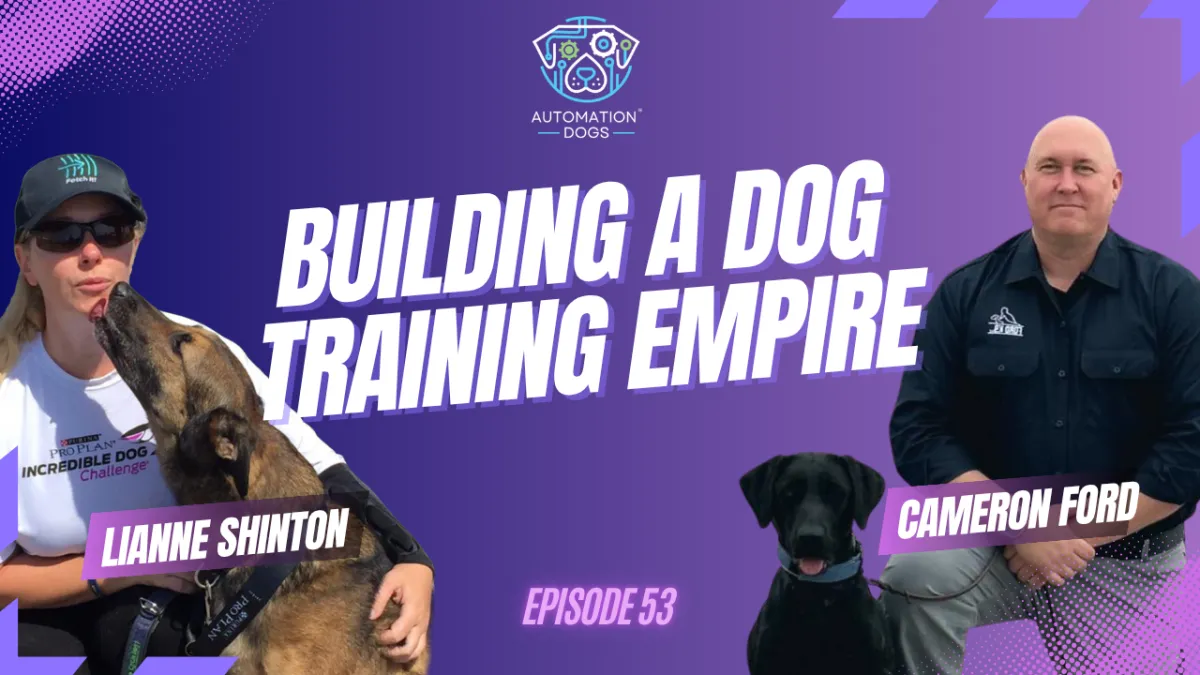
Building a Dog Training Empire
with
Cameron Ford
February 24, 2026
75 min
Automation Dogs Podcast
About this episode
In this episode of the Automation Dogs Podcast, Lianne Shinton sits down with seasoned expert Cameron Ford to uncover the foundational secrets to building a dog training empire. Drawing from his military background, Cameron shares invaluable insights on the importance of finding your niche, mastering client communication, and embracing accountability to reduce trainer burnout. Dogs Podcast, Lianne Shinton sits down with Cameron Davis from MCK9 Training to uncover the secrets to building a bulletproof relationship with your dog. From the crucial role of mentorship in growing a successful pet business to managing difficult dog behaviors, Cameron shares actionable advice you can start using today. Plus, discover why dog reactivity might actually be your fault. Tune in now to transform your dog training journey!
“If you chase every rabbit, you won’t catch any. If you chase one, you’ll catch it.”
— Cameron Ford
Let’s Build Your Growth Plan
Automation Dogs isn’t just software — it’s a sales growth system backed by strategy, coaching, and support.
On your free Strategy Call, we’ll:
Pinpoint where your leads are slipping through the cracks
Show you how to fix your follow-up and close more clients
Map out a simple, proven plan to grow your business
Every dog training business is different — this call ensures the strategy fits your business, not a generic template.
If it’s a fit, we’ll show you exactly how we’d implement this for you.
If not, you’ll still leave with clarity on what’s holding your sales back.
Full conversation
Transcript
Lianne Shinton (00:01)
Hey everybody and welcome. I'm Lianne Shinton from Automation Dogs. Welcome to my podcast. Today I have Cameron for joining me. Hi Cameron.
Cameron Ford (00:10)
Hi, how you doing?
Lianne Shinton (00:11)
I'm great. Thank you for asking. I have heard Cameron speak. I was at the IACP conference, the International Association of Canine Professionals in Minneapolis in 2023. I got to hear you speak and outstanding. Cameron has, of course, Ford Canine. And also I listened to his podcast. I love the name Canine's Talk in Sense. Love that name. Like it took me a minute.
Cameron Ford (00:25)
Thank you.
Lianne Shinton (00:38)
Cause I was like, when I, think when I said it out loud, I was like, canine's talking sense.
Cameron Ford (00:39)
You
Yep. Yeah. A little play on words there with, ⁓ you know, being in the detection dog community, you know, we'd like to use the word sense in a lot of different ways. It's sensible or it's, you know, make sense and all that kind of stuff. So why not make the podcast say we're talking about sense? So there you go.
Lianne Shinton (00:59)
It's brilliant. Brilliant. Now, a lot of the time when I hear you speak, I think most of the podcasts I've listened to, you talk about the dog stuff. And there was ⁓ one podcast you were on where you told your life story, which is amazing. And of course, thank you for your service. So I would love to dig in a bit today on your journey. And you've done such amazing things.
Cameron Ford (01:17)
Thank you. Thank you for the support.
Mm-hmm.
Lianne Shinton (01:27)
And I try to focus my podcast on the business side of being a dog trainer and being an entrepreneur. It's hard. And I see quite commonly where dog trainers are just like, they get itchy feet and they want to move into something else or they just can't take it. So I just think you've built something amazing. Now you've moved into Northern California and so brilliantly taken over Michael Ellis's old school.
Cameron Ford (01:36)
Mm-hmm.
Lianne Shinton (01:57)
Wow. ⁓
Cameron Ford (01:59)
Yeah,
it's, it's, it's, he and I had been friends for 20 plus years. And, you know, kind of how that part came about was just, invited me up to speak at one of his, one of his last classes he was doing. And we, we hadn't trained around each other for a long time. So when I was there, did the lecture and did the training with his students, you know, he got to see, and I got, you I already knew everybody knew who Michael was, but Michael, knowing who everybody else is, is a much harder job, right?
So, you know, but he, got to spend time together. He saw what I was doing and how well it kind of matched his philosophies and what he does. So then it just kind of over the next, I would say year or so we were up here a number of times and he was just like, you know, do you, how would you feel about taking this place over? He goes, you know, I'm, I want to start looking at retirement, you know, relaxing and not doing all, he did 10 years of the immersion course here. So.
And he knew that, as you mentioned earlier, before we got on, you know, I had been in Las Vegas and I was outgrowing what I was using in Las Vegas, which was my house. So I was, I was running out of space and Michael just said, Hey, you know, I know where you're at and this is where I'm at. I think this could be a good transition and you take this over and I can kind of still be here, but drift in and out as I want to. And that's exactly what we did. So in, in late 23.
I slowly started taking over and then last, in 2024, we had more responsibilities we hadn't fully taken over than last year in May we fully took over.
Lianne Shinton (03:35)
Wow, right place, right time, would you say?
Cameron Ford (03:38)
Yeah. Yeah. yeah.
And those that have seen his facility here, ⁓ it's amazing. It was a, it has like a cool history to it. was a church way back in the day. Then it became a school. Then it went back to a church and then back to a school, but the school for wayward kids, kids were in trouble. And then it kind of just became really bad disrepair and it became for sale. So him and a really good friend of his as a developer purchased the property, completely rehab the entire place.
And now it's a dog's dog trainer school. So we have a big, you know, interior training area. have a cafe. We have rooms for students that come and stay here. Um, I have a big podcast studio in one of the rooms in the building. So it was, it was Michael was right with our growth and you know what he had here. I mean, there's a dock diving pool here too. So there's a dock diving pool turf field out front. It's three acres. So yeah, there like, it was a no brainer to, to make that
choice to be like first being my trainer, Natalie, we're like, did he pick us? Like out of all the people he could pick, he picked us to do this with. So that was extremely humbling. Yeah. So yeah. And then, and now it's been, ⁓ you know, and coming up in may of this year will be one year of us fully running the school and Michael getting to use it as, as his playground in a sense, like he didn't have to be the, yeah, he's just a landlord now. He doesn't have to be the guy.
Lianne Shinton (04:44)
Wow.
Cameron Ford (05:03)
doing everything like he used to do. it's been a good, it feels good to give him that, what he's deserved to be able to do what he wants to do now versus always having to work as hard as he did. And he's one of the hardest working people I know just in how much time he gives to people and so forth. So that's really cool to be in that spot now and to do whatever I can to pay homage to what he's built.
Lianne Shinton (05:09)
Yes.
Yes, I hear this all the time about Michael and I of course, I'm like, my gosh, Michael Ellis, wow. And something you just said about like how he gives, I would be competing in monitoring against him and he's helping me on the side. Like this is how you can fix this jump thing. Here's a tip. And you know, just, just such a kind person.
Cameron Ford (05:33)
Yes.
Yes. Everybody, you, you those that have, the guy you see in the videos is the guy you get in person. You know, there isn't a different personality. He is that personality. There is, which is the best thing is Michael is authentic as it gets.
Lianne Shinton (05:55)
Yeah.
Yeah, I, do you know who Tony Robbins is?
Cameron Ford (06:07)
I don't know.
Lianne Shinton (06:08)
Tony Robbins, the, yeah.
Cameron Ford (06:10)
Tony Robbins, Tony Robbins. was thinking of a dog person. They said Tommy Robbins. Tony
Robbins. Yes, know who Tony Robbins is. Yes, yes, yes, yes.
Lianne Shinton (06:16)
Yeah, kind of when you were saying that about Michael, I accidentally bumped into Tony Robbins once. was walking into, I used to live in Vegas and I was walking into a Kenny Rogers concert. I love Kenny. And I heard behind me, I heard the voice, you know, that deep like, you know, and he and the trajectory of it, like he was so tall, he was so tall. And I knew he was behind me and like elbowed the person I was with and turned around like Tony Robbins behind us.
Cameron Ford (06:23)
Wow.
yeah, yes.
Lianne Shinton (06:45)
and just shaking hands and kind and just like what you said about Michael and there's not many people like that that are just awesome.
Cameron Ford (06:51)
Yeah.
so giving of who they are because, you know, cause I asked Michael, cause I get it, you know, as an instructor and as a trainer, you put a lot into what you're doing when you're teaching classes. So especially at the end of the day, you're mentally kind of cooked because the audience, however many students or people you have attending your event, all of them have you, but you have all of them.
And every single person usually has questions or they just want to engage with you and so forth. So I had to ask him like, how do you, cause his volume of people is way more than mine. And I feel tired on the volume of people that I have. So I was like, how do you do it? And he goes, I just accept the fact that I put myself in this position. So therefore I owe it to them who have followed or bought the videos or all the different things that reached out to him.
It's like, owe it to them when I show up at a location that I will give them everything I possibly have for as long as I can. And he like, he even goes to like dinners almost every night when they go, like he and I have traveled to Australia together, right? We did different things, but we were there overlapping the same time. And, you know, my events, can say like a sort of smaller, his were like 150 people big and he'd go out to dinner each night. And, know, like you said, he's in the dog world. He's a celebrity. So he's just, you know, constantly.
surrounded by people engages with them. And I think to myself, Holy cow. I don't know if I have the stamina that Michael Ellis has or the brain bandwidth to do that. But I took that lesson he gave that he said to me and I said, you know what, you're right. I want to make sure that, you know, those who bring me out, ⁓ that I give them, you know, at least one day in the event, you know, in the three days that I'm usually there and, you know, engaging with questions and so forth.
just because it's to remind yourself to be appreciative of how you got there.
Lianne Shinton (08:54)
I love that he had such a great answer as Michael always does. ⁓ But it's like a really good principle. And I think that's something I'm hoping I can get something from you today too, to share with dog trainers, ⁓ even the simplest things of just like showing up, being on time, be good to the dogs, be good to your staff, things like that, that I'd like to dive into. But before we do, maybe could you share your journey?
And as you do, if you don't mind sharing some of those like aha moments, maybe a setback that, you know, I'm kind of the mindset of like a setback. I learned from it. It's a setup. So things like that. And maybe we can get into like, if you were going to start over and do it all over again, based on what you know, like what would you have done a little bit differently?
Cameron Ford (09:43)
Yeah. Yeah, for sure.
Yeah. So like I was telling you, I started my career in the military is kind of the very beginning of it. As a little kid, my neighbor was a police canine trainer and he had it obviously an effect on me. So after I did my military time as a dog handler, got out, I had an opportunity to have to kind go back a little bit where I was stationed at when I was in the military was Germany.
So I got to see basically the birthplace of a lot of dog training and a lot of working dog aspects. And then while I was over in Germany, I traveled to all the countries I could that had like Mondria ring, Belgian ring, MBPK, KNPV. I did all the different places, learned a ton. And then I came back, got out of the military and started my first business in Florida. And that was called Universal Canine. And ironically, there was another Universal Canine that came on afterwards and they got in trouble. But I always had to clarify. I'm like, I'm Universal Canine Florida back in those days.
And that business was, I was using the, basically the connections I developed when I lived in Germany to bring dogs over the United States. I ended up being a vendor, a U S vendor for the big dog company that sells equipment called Schweikert. Schweikert does, you know, the Schutzen based equipment most times, Schutzen IPO, IPG, whatever the different acronym now is these days. So, ⁓ I started that business, I had 10 acres and it was heavily geared towards the law enforcement sector.
Lianne Shinton (11:01)
Yeah.
Cameron Ford (11:09)
by bringing the dogs in and doing police canine classes. And there was a lot to that. And at the time I was 27 years old starting this kind of business. And I'm teaching guys that are now my age, you know, how to work their dogs and do these things because of the experiences I had both from the military and I got to go through a, like I would call it, like a modified version of the German police dog handler school. A good friend of mine spoke English and helped me kind of come along with him and learn all that stuff. And I got an honorary DPO2 title in my dog.
So anyhow, when I came back, you know, I, my biggest thing was I didn't really know what to expect. I had never been there at 27 years old and this is going to be in the early 2000s. So this is pre social media. This was pre, this was just, I invested at that time, a lot of money in a website. And by doing that, that in those days got me the, had eight, had San Francisco PD come all the way across country to go buy dogs and go through school with.
Cameron Ford at that time, know, 28 years old, ⁓ to, do that. And that was because of the internet. So that was, you know, let's call it phase one of what the dog business is today. So the internet networking, you know, the biggest thing was timely response to emails, you know, because again, that there was no text messages. was phone calls or emails only and being very responsive in that. that still holds true to today. But the.
Lianne Shinton (12:10)
Wow.
Mm-hmm.
Cameron Ford (12:35)
The lesson that kind of there was to stay in communication. Again, I'm a young kid at that time trying to prove that I could do something. Then the biggest thing was how to balance the investment of training dogs and training people because, know, many of those that are in the dog business, we have our own dogs, we have dogs that we're training, but we also have to engage with people. So whether it be students or the owners of dogs, et cetera, you have to be really engaged with that. So, or balance it out, say.
because what happens is you'll get really focused on dogs. If you're a dog person and you'll spend a lot of time to that and you're, you'll suffer a little bit on your communication style and to engage with people. And we've all heard it. There's the people that are really good dog trainers, but not so good with people. And then there's also, you know, the opposite side where there's people that are really good with people that don't translate their skills as good in an audience setting. Like you give them their dog or you give them a dog to work with on their own at first. They're good. ⁓ but
Lianne Shinton (13:13)
Mm-hmm.
Cameron Ford (13:34)
the balance of it is how to really be a good communicator and explain what in many cases for the average person is a very complex concept when it comes to like how you reinforce and what you do to then how to ⁓ do it in a way that a layman can understand. So that was one of the beauty things, you know, not to pick up Michael again, but that's who I watched, you know.
I saw his videos because these are VHS tapes or DVDs back in those days. And he would, he would break down things that I thought I understood, but didn't know much better way. And then another one was like, like a dog Hilliard. So what I'm trying to say to a lot of people is go find that person that you, that, that resonates with you and how they communicate and then do your best to imitate that style. And that's what I did a lot of for, you know, I was like, well, I like how they explain things. So I do that.
So after I did that business, what ended up happening was the, ⁓ I had a very valuable land. So in like, I think it was 2006, ⁓ I got offered really good money for the property and they bought the property. We're to make it a big neighborhood. Then the housing market crashed. So I got lucky. Not what I got for the property. Cause that wouldn't have normally happened that way. But then I got the opportunity to, that's when I became a police officer. So sold the business.
Lianne Shinton (14:45)
⁓ yeah.
Cameron Ford (14:57)
⁓ went into police work, became a police officer. I was already kind of, I was already a state instructor as a canine handler or a canine instructor for the state. So in Florida, I didn't work a dog there, but I was a trainer for a lot of the agencies. I was a cop, but also a trainer. Then at the height of the Afghanistan, Iraq wars, I was made an offer to kind of come in and become a government contractor to train. ⁓ at that time was probably close to 200 dog teams going to Iraq and Afghanistan.
So I went to Texas and while in Texas, I did that for different companies. And then I got, um, I was also still, I was a reserve, uh, police officer in Texas and I had a dog then. So that time kind of came and went. And then that gave me the, they ended up having the opportunity to become the senior instructor, one that later on the senior instructor for the Navy SEAL program on the West coast. And that was a humbling moment because I was confident I had been in dogs at that time.
close to 20 years, want to say right around that. And when I got there and got to see what was required of the dog teams handler and dog to go execute missions was beyond what my scope of training skills were at that time. So I could do a lot of it, but it really pushed me to have to get outside my comfort zone. So that's another lesson I learned was yes, I'm confident I have skills. I could do training in certain ways, but
Lianne Shinton (16:08)
Wow.
Cameron Ford (16:21)
to be kind of humbled and have to go find some new skills. Really, it was uncomfortable at first, but I can tell you after I did it, it was the best thing I ever did because it led me down to the path, which is the science path that I get known for nowadays, which is canine cognition, a lot of the science in relation to detection. And because I had to prove to that world, they weren't going to just take strictly my word for it, but what else could I?
used to substantiate an idea of why we should do this or how we should change that. And that again was uncomfortable, but it forced some learning to happen. And through that uncomfortability, I came out better trainer, better communicator on the other side. And there's plenty of mistakes. Like there's times where I will absolutely say, and this is kind of a crossword for a lot of trainers, if you're really passionate about it, but our passion sometimes
will be very misunderstood. And in my case, don't know if I it was misunderstood, but being passionate meant I would call out errors. I would be, and I was bad about my own industry. I felt like an obligation. had to make sure law enforcement did it this way or looked at it from a different point of view. I had a lot of disgruntled feelings from the old guard that were in front of me that were like, just shut up, do it this way. Don't question anything. And I was much more of a questioner. but by, by instructing in a kind of very
accountable slash, I won't call it looking down, but just like say, see, that didn't work. See, you really need to be open-minded and do this. And through the years, what I've learned now, and this was also thanks to Bob Bailey, who I got to teach in front of one time. And I asked him his opinion, like, you know, what kind of advice would you give me? And his was forgiveness. And out of all the things to say to me, I was like, forgiveness. He's like, you know, your material, you know,
You know the science, know the dog behaviors, you know all that kind of stuff, but you can't, come in and to your world, to the law enforcement, real estate community, you come in like a first sergeant and that's not always the time to do that. You need to come in and be, how can I help you? And Michael said very like the exact same thing. Don't come at it with your agenda of like, see, I'm going show you this. I'm going show you this. I'm going show you this. I'm going show you why it works and why you need me. And what it really was was.
Lianne Shinton (18:32)
Hmm.
Cameron Ford (18:46)
How can I help you? Where are you at? What do you do? What do you work on? What resources do you have? How do you do it now? And then look at it and say, okay, I have some ideas, but let me ask you first, what are your ideas to do this? And you'll let them kind of lead you to, the more you do it that way, you'll hear from them what works for them and maybe why they might avoid something that was already in your mind that you might want to do so that you can kind of shelve that part of it.
So being flexible as the instructor with the approach of how can I help you was far better than being the instructor that you come in to prove how good you are at what you do. And there's nothing wrong with, but that will show itself through the help that you go to them based on what they're needing, not with your agenda. And that was, that was an adjustment for a while for me to kind of embrace that way of looking at it. But I can hands down say,
Lianne Shinton (19:26)
Hmm.
Cameron Ford (19:43)
It's the most effective and it's so well received when you look at it that way. So from, yeah, that was, like I said, that was a big lesson learned. so after the Navy SEAL part, you brought up Vegas. ⁓ So I ended up in Vegas working for some friends of mine. They had a company called Silver State K9. They were in like semi retirement mode. So they let me, they did me a huge favor, said, Hey, come on, we'll put you on a very low salary, but generate business for us and it'll grow.
Lianne Shinton (19:47)
Yeah, what a great evolution.
Cameron Ford (20:13)
Yeah, I definitely, I was in there now social media existed. ⁓ I was pumping stuff out. didn't know what I was doing because I wasn't on social media at all, very much at all during the seal team time, because that wasn't, that was frowned upon. You didn't want to go on social media and talk about stuff. So I had to kind of really learn social media and what I did was I just kind of copied what I saw people that I liked, like the stuff, the content that they would put out. I'd be like, okay, how can I do that kind of message for what I do?
And there was a, there was a crossroads there when I got out of the seal teams. Do I go the direction of the bite work, the protection, all the, what I would call the sexy dog stuff that people really gravitate towards. But when I was looking at it, there's a lot of people that do that. And then I looked at detection and I was like, you know, there's really nobody doing detection. And though it is a very niche market and it's not nearly as big as a ton of other dog, you know, training aspects out there.
but nobody was really that into it. There's a few, but not much. So I said, you know, I'm not getting any younger. So taking bites and hits and all this stuff that I used to do. Cause now I'm in my getting at that time I was in my mid forties. I was like, you know, I need to look at something different. Detection was kind of, kind of cool. And I was getting a lot of the science and I had some really good experience from tough operational expectations for a bomb dog to go through.
Lianne Shinton (21:21)
yeah.
Cameron Ford (21:39)
Like we expect a dog to go do this and then go do that and then go find the bombs. And that helped me understand like how pressure changes what we do, you know, how to communicate to a dog because you have to get your training really solid because when the operation actually happens, you're not there right there with the dogs. You have to show up. There's a lot of things that you have to pressure test and see if it works. So that's, I said, okay, got into detection, went to Las Vegas.
my friends businesses were heavily towards detection. So it was a good fit for both of us that grew and then COVID happened. And then like, you know, we're a non-essential business and we're pretty certain that once if they do lift restrictions, we're not really going to do this full time like we were. So you're free to go do what you want to go do. So literally May of 2020, right in the heart of COVID, I had 2000 bucks in my pocket.
I had to move and I had to start a business. So I just started off with that little bit of money, bought some folding tables and some chairs. I got a house I could rent that was, I was hoping was going to be affordable for me because it was $400 more than the last place I had. So I didn't know how I was going to do it, but I was going to figure it out. And I just did my first, I did a first like two person seminar, two people came out because it was COVID so they drove.
And that gave me a few, you know, a few grand more. And then I bought a few other little things to be able to teach. And then I got asked to go other places. And since I was, I wasn't married, had no kids. I was like, I can go travel. I'll go anywhere. So I started getting on the road a little bit, getting out there and teaching these different detection types of classes, whether it be for sport of nose work or professionals. And then the, then the gear started turning a little bit more. Then
being in Las Vegas, Resorts World was a new casino at the time. They were looking for dog vendors to provide dogs and training. I bid on it, I want it, and that gave me the big kick forward with financial ability to start going and doing things. And then it just kind of became, how much work can I do with the limited resources I have? So I had like 10 dogs in a house, getting dogs trained, hired a few people, first were volunteers. I'm like, who wants to work for nothing, come work for me. ⁓
to turn you into an employee at some point. just don't know when I won't have insurance and benefits and all the kind of things not for a while, but dog people love doing it. So I had a few great, you know, first time volunteers. And then it turned into, ⁓ within a year, less than a year, ⁓ the trainer who's still with me now, Natalie Morris, she came out and volunteered and this woman was, was putting in work, getting up at three o'clock in the morning, going to work her normal nine to five job. It's done at five.
goes home, gets her dogs, drives an hour to me and would train and work at my place for free till 10 o'clock at night and do that cycle for three months. And then until I finally said, you're working full time, go quit the other job. ⁓ So that growth, know, especially at that time, was just the keys to success was communication. Again, I've been being very accessible to everybody. The next part was just refining my social media skills. I didn't know anything. I just imitated.
techniques or videos that I thought that I liked messages that resonated with me, but then getting feedback from people to find the message that resonated with them. And then that's was, that was where the kind of the birth of the podcast started at that time too. ⁓ actually actually the birth of the podcast was technically before that it was while I was working at SilverState, but it didn't get really ramped up until I was, I was over on my own. And this, this microphone was one of my best messages or best tools for marketing at that time to get the word out.
And then ironically, I kind of joke around the day. I'm like, in this day and age to be kind of considered a, like a dog trainer, you have to have a certificate that says the word gold or silver on it. You have to have a podcast. You have to have a good tick tock account and IG account, and then you can hang your shingle up regardless of what work you've done. As long as you got those check marks, because that's kind of the industry's kind of created their own benchmarks that way. And, but what you really want to look at is how are you different? Like I looked at detection.
Lianne Shinton (25:42)
You
Cameron Ford (25:52)
because it wasn't being covered. And there's a lot within dog training that you can pick that you can say, I want to focus on this. I'll do other stuff too, but this is what differentiates me from the broad strokes of all the other trainers out there. And whether it's, you know, I mean, there's how many thousands of board and trained businesses out there, but certain ones will find ways to make it where they're different, whatever their thing is.
You have to find your differentiator. And once you've got the differentiator and the people can understand it's different and they're willing to pay you for that difference, that's what you capitalize on. And you start going out there and doing that. So that's kind of the journey that got me to where I am now. And it had, I had a start over, you know, I can say that I was cushy and comfortable with the government jobs that I had.
When I sold my other, my first business, universal K9, I sold that I was feeling good, but then I had permanent jobs to go to. had government work. And then when COVID hit the reality was this is the only money you got and you got to make it work. So it was, that was a good crucible to go through to kind of make it. Now, like you said, if I were to start over again, I'm good because as a trainer, I would also say one of the best things I did was I created passive income. And that was the webinars that was.
the online classes that I created that kind of support you when you may not be as busy with your in-person stuff. it, I mean, these days, you know, people have been, Patreon has been the big thing for a long time. Now the newest hottest thing out there is school, S K O O L. Every dog trainer is creating a school account and doing that. And that's a smart way of creating passive income. But I would say if you can do it, try to do it without some of those platforms.
only because you're also paying the platform. So, you know, if, if you're able to, I, what I did was I invested my money into my website and my website hosts everything. And I, I pay very little to anything else besides credit card fees kind of thing. So, but to be able to have that safety net of income coming in while you, this is one of the biggest things I was telling Michael, you know, when Michael and I kind of linked up, I was like, man, you got to get stuff on your own website. You got to create, you know, you have so much intellectual content out there.
just organize it, put it on a website and I gave it my web guy. And then now he's got the michaelhaleschool.com and he's really built a huge library of videos there and education. So those that are out there, do your physical, do your in-person stuff, but also make sure that you have your way to bring money in passively through either videos, content, et cetera, et cetera.
Lianne Shinton (28:36)
Awesome. I really, I mean, you didn't have a strategic plan. just, you know, got along this journey and found, found this amazing path, but you stayed focused. And I think that's kind of the failing of a lot of us entrepreneurs is where we have all these great ideas and we're like, let's try, Oh, this is a great idea. Let's go with this. But you stayed focused though. You had a bit of itchy feet and moved around a lot and kind of satisfied that.
Cameron Ford (28:43)
Yeah
Yep.
Lianne Shinton (29:06)
⁓
Cameron Ford (29:06)
Yep.
Lianne Shinton (29:07)
so yeah.
Cameron Ford (29:09)
And I'll say, there's a great saying that someone told me, it's all shared to everybody. If you, if you try to chase every rabbit, you won't catch any. If you chase one, you'll catch it. So like you said, find whatever you want to stay focused on, but stay focused on it. Get that one. And then once you have that one, then look for the other one. if you, and you're right, I see it a lot in a lot of things I see online is there's a lot of this, this, this, and this.
but the person isn't necessarily known for any specific one of those. And so they're chasing these different things because they're trying to find what works and I get that. But sometimes you've got to stay the course on the one, even though it doesn't feel like I can tell you right now in the beginning of doing, when I was just doing detection stuff only and I was out there doing it, it wasn't ringing in stuff at first. And I mean, not as not what I needed to survive off of, but I had to stay the course. within that, like my flex within that thing. So my lane was detection.
And my experience was police, military, so forth. But I branched off into the sport world, got to learn that a little bit. And then that opened some floodgates that I didn't expect to have. know, I didn't know. Yeah. The sport world was like, we have money right now. We'll pay you immediately. Come teach us. Or the police world and military words, like we have purchase orders. We have to wait 30 to 60 days, blah, blah, blah. So when I stayed in my lane, but expanded that.
Lianne Shinton (30:19)
Yeah, the sport world.
Cameron Ford (30:36)
to other little niches within that lane that created some openings. So you can have a little variety, but just don't jump from too far from one thing to something completely different, because then you run into the issue of not really being known for one or the other. You blend in again.
Lianne Shinton (30:53)
Yeah, you really picked the perfect ⁓ niche. Like you said, it's easier on your body. It's safer, less liability. It's a joy. It's amazing seeing some of these dogs that have some supernatural talents for scenting. Yeah, that's awesome. One of the bits of advice I was given when I was thinking a while back, like, maybe I'll do an online course or something.
Cameron Ford (31:03)
Yes.
Lianne Shinton (31:23)
⁓ It was said, look at Amazon and click on the book section on Amazon and look for a book on Amazon in that course that you're thinking of creating. And if nobody's doing it, it might not really be the best thing that will make you any money. And I thought that was good advice because if you look up like maybe a book on Mondial Ring, there might not be one, maybe a course on Mondial Ring.
Cameron Ford (31:44)
Yep, that's true.
Lianne Shinton (31:52)
might not get you get any money coming in.
Cameron Ford (31:58)
Yeah. It's the same I run into quite a bit with nose work. There's a lot of, number of pet businesses would love to add nose work to what they do. And I always tell them it's a great idea because it really actually helps your clients out that have obedience problems because they're now actively doing something with their dog, which satiates a lot of the issues that they deal with, like activity and so forth and over stimulation. And
but then they kind of get down on it because whatever area they might be in, it's not as popular, it's not as known or whatever it is. It's changing. I'm like every year the sport of nose work, whether it be ScentWork AKC or NACSW or even in other countries like Canada, they have SDDA. The sport world is growing in detection tremendously, but it still has gaps in the, you know, depends on where you're at in the States and certain areas just don't have.
a whole lot of people doing it. So that kind of discourages it. My thing is like, go out there, sell it, talk about it. You know, do do whatever you do. Go to these places, set up, ask like, what's going on? Oh, we're doing detection. Detection. What do you what do you mean? We look for a birch, anise or clove. This is the fun stuff. It's any breed. That's the beauty of it. Any breed. There's no papers. There's no it's it's there's a lot of people kind of get into it with their dogs. They're a little bit older because they realize they don't want to keep doing agility. It's not good in the dog's joints anymore, but they want to stay active. So
Lianne Shinton (33:07)
Yeah.
Cameron Ford (33:19)
They find their way to nose work and it's great. Then there's the dogs who really benefit from nose work because they've been in a shelter and they don't have great skills, but then they get to go use their nose and do something fun. So I just tell people that look at detection as a business. If you don't, because the biggest thing I get all the time is, I don't have military. I don't have law enforcement. So don't really think about getting a detection. And I'm like, if you're a good dog trainer, you can get in detection at least
at a entry level by learning the sport side of things. Maybe do it with your dog first. Get your feet under you, understand the rules of the program, why they do things, because it won't make sense on certain things. People are going go, I don't understand why they do it that way. There's a method to their madness and you're not always going to agree on everything. That's dog training in general, but just find the, get yourself into it, immerse yourself. Like you said, like whether it be find a book or whatever, but fight, get a way into it. So that way you learn more about it and you
cut your teeth at it. And then you start going, okay, now I'll help somebody else. And that's kind of my trainer, Natalie, her and her best friend kind of did it, played around with it for a while. Natalie really found a passion in it. And then, you know, stepped her foot in the gas pedal was like, I'm going to figure this out one way the other. I want to get good at this. And now she ended up, you know, I just ended up moving to Las Vegas and she, you know, had heard the podcast. She's like, I can't believe these guys in my area. So anyhow, when her through her immersion or immersion into everything, it
helped her understand. And then I took somebody like her who only did it for fun and as a sport. And now she, she trains cops and does everything else within this, this discipline. So if you're like in, depending on what business you're in, the detection is never going to go away. That's the bigger thing too. And all the things that are out there, you know, with all the controversies of, you know, the conversations of force, free balance, bite work, no bite work, you know, all these different things that go on.
Lianne Shinton (35:02)
Mm-hmm.
Cameron Ford (35:12)
Detection doesn't ever get into those arguments. Detection is always motivation based training. ⁓ It's you're playing with your dog. Most cases, as far as like your interactions, you know, the dog finds that you're all playing, you know, the searching is the dog's natural skill. The hardest thing for the humans is the handler learning their dogs, which is a critical skill anyway. So there's always pluses to it. So it's, but it's intimidating. I get it. I get it because people come into it like, I don't even know where to start. Like, what do I do? You just have to.
You know, I say F A F O you have to mess around and find out kind of thing in order to, to learn what works for you. Do you feel comfortable? Do you like it? Is it your jam? Is it not your jam? And if it isn't your thing, then move on. No big deal. But those that get into it. Don't get overly intimidated. Just immerse yourself in it and learn all you can. And there's, there's lots of resources in it. You know, we have, of course I have mine. There's, there's now over the past five years, there's become a very big, a much bigger surge of good instructors out there.
Lianne Shinton (35:45)
Hehehehe
Cameron Ford (36:11)
that are happy to teach people there's in the FENZI Academy, have, know, Stacey Barnett does classes on there. there's another great trainer, Robin Grubel. She does stuff in, ⁓ Iowa, you know, for both search and rescue, nose work and all kinds of stuff. You know, Bill Gaskin is another guy. came from the military, but he's now become one of the big names and, traveling around and doing nose work and all that kind of stuff. So you just kind of have to find your way and then learn from some of these other people, the resources that are out there and then make it your own.
Do like it as a dog rub? Put your spin on it.
Lianne Shinton (36:43)
Love it, love it. Now, we're talking about the what. I like to think too about the who. So for me, for example, I've been training obedience and behavior mod for like 34 years, and it took me a long time to realize I really do like working with the super fearful dogs, ⁓ the ones that...
Cameron Ford (37:05)
Mm-hmm.
Lianne Shinton (37:06)
are hiding at the back of the crate and it's actually quite easy for me to get them out and I'm very spatially aware and they're kind of my jam. And a lot of times they are with a family. I'm really good at working with the woman of the family. So I found kind of identifying my who really helped me in this journey as well.
Cameron Ford (37:12)
Mm-hmm.
Mm-hmm.
Yeah. And that's, it's, it's still subjective, right? It's who kind of resonates to you in how they communicate the way they do the things. And that's, that'll kind of be your guide, your guidepost. ⁓ you have to kind of follow that. And then from there, make the commitment into whatever direction you go. And there's a saying that comes from the SEAL team, ⁓
Lianne Shinton (37:40)
Mm-hmm.
Cameron Ford (38:01)
world, which is burn the ships. And what, what we mean by burn the ships is there's no way back. We got, we got to land. We're on the mission, burn the ships because we're not getting back. You got to fully commit and get through it. And when you're in this in your, when you have your struggles or you're unsure, once you kind of commit, burn the ships and go with it. And
Lianne Shinton (38:15)
Mm.
Cameron Ford (38:27)
Because if you still feel there's something over here, you'll end up slowing yourself down. You'll go back and get back in the ocean, go a different direction again, and you're at sea and you're not on land. So you're not doing what you need to go do. it's it's a, it is that you want to go do, immerse yourself in it. Find those that you gravitate towards that makes sense with you, but also be very willing to listen to the ones who may not.
maybe they even irritate you. Maybe the way they deliver their message isn't so great, ⁓ but there might be some things, two things you're gonna learn. You're gonna either confirm that you don't wanna do what they do, or you'll go, know, despite that, I do, that is a good point. And I'm gonna throw that in my toolbox. And I always tell dog trainers, even in the world I'm in,
There's when you're 20 years old, get out of, you you need to live in your first house or your first apartment or whatever it is. Your toolbox that you have at that time is something you bought at Lowe's. got a hammer, a screwdriver set, and a few little things in there. You can't really fix much, but you can do a few things. I, as you grow, your goal is to be that, that old person in the neighborhood who you knew they had that garage that is just filled with tools and they have all kinds of stuff.
And it's the one where people go to and they say, ⁓ I have this thing that I can't fix. I don't know what the tool it is. And they look at it and they go, ⁓ it's right. I have one of those things that come over here and they open the drawer, do whatever they dust it off and they go, here you go. This will work. And I love that analogy because as I've gotten older, it's, I don't have a toolbox anymore. It's now turned into the garage full of tools and there's plenty of things that haven't used in years. But when I come across the right dog and the right handler, I'm like, yeah.
I'll go use that or I'll share that with the person. like, you can try this, you know, it may work. may not, but right now you've tried these other things. Let's see where this is at. But the more diverse you have that toolbox and the way I got that diversity was because, like I said, when I was in Europe, I went to every place I could go to. That's how I met Ivan Belobanov. We met on a train, on a competition field in 1999. You know, I was out there. He was an up and coming. He was just, I think it was his second worlds that he was at.
You know, we became fast friends. got to learn from him. I learned from these other guys in Belgium. learned from people in France and then Germany, of course, and Holland. And there were a lot of things I'd be like, I don't want to do that, but you know, it worked for them or. Wow. How did they like, I would have never thought it like, I'll give you a perfect example. Like I had a military police dog that went out very well. And I was asking these German police guys who I had become friends with.
I was like, you know, having a hard time, this dog won't let go, blah, blah. Um, the guy goes, I'll give it a try. So he had like a bag and I didn't see it at first. He was just kind of staying in a corner and he had a, um, a bite sleeve on set the dog up to bite the sleeve. He says, He kind of nods his head to tell my dog, let go, give a dog to come in, let go. My dog doesn't. He says, you know, that's when I say the word nine or no for German. And then he had a bunch of water in his mouth, which I didn't know.
He spits water at the dog, which gets the dog's attention. And he drops the big bag of like, was full of like, metal, the tin cans, you know, like Coke cans and stuff like that drops on the ground. it makes boys a dog cop right off. My dog had never seen that before. Now as a military dog, I'm like, I don't know how much I liked how that my dog was willing to pop, but it was just that he didn't see that. But it showed me a very unique way that, you know, and I'll be honest, like that worked about two more times and it didn't work anymore, but it just showed me.
Lianne Shinton (41:44)
Yeah.
Mm-hmm.
Cameron Ford (42:12)
that there was a different way to approach it that I had never seen before. And though it only worked a couple of times, the dog was after that was like, that doesn't bother me anymore. is my, was one of my first things I remembered that I said, you know, I'll I'm open to, you know, listening or seeing some things and there will be definitely things that I will never do. And there'll be some things that I'll go, huh, I didn't think about that, but dang, that works pretty good. And with that open mind,
I was able to, and we're all dog trains. We all put a twist on things. Like we'll see so and so do it that we really liked. And we just kind of develop our own style. That's the, that's the, the analogy I make is like, everybody knows spaghetti. Everybody spaghetti is spaghetti as is defined, but you go to Jersey and ask somebody for spaghetti versus you go to California and every person's got their kind of recipe, their flair to it. That's dog trainers in a lot of way, you know,
Lianne Shinton (42:46)
Mmm.
Cameron Ford (43:11)
We're all dog trainers, spaghetti, but how we do it is different. And that's our recipe. And it's very okay to have your recipe. Steal whatever ingredients that you like from the other recipe that you learned you for. The first bowl of spaghetti you had from somebody else, go, ooh, that was a little too much salt on that one. I'll do mine, but I'm gonna change it to this. And then next time you're like, I never thought of adding that to spaghetti in the sauce and you'll add that. So that's kind of just a really human analogy of what...
this business kind of is.
Lianne Shinton (43:42)
It sounds like mentorship too. You mentioned Ivan and of course Michael and many people. And I see on Facebook on the dog trainer groups and folks will ask like, Hey, I want to become a dog trainer. Where should I start? And people will chime in and say, get a mentor. And I definitely agree with that. Surrounding yourself with people that are better than you is a really good path to go on.
Cameron Ford (44:05)
surround yourself with people that'll ask you questions and be inquisitive about it. Again, not so much being like, this is the way to do it. They'll share that with you, but they'll also ask you, how do you think you're gonna do this? you know, it's again, it's a leadership thing that I also learned from being in the SEAL team community, which was, we can highlight things that don't work, but good leaders.
Lianne Shinton (44:13)
Mm.
Cameron Ford (44:31)
We'll go to you because it's really easy to go, I, didn't work. That didn't work. And they're to go to me and go, well, shut up and do it that way. But the good ones are like, all what's the solution? What solutions do you have? Then I go, I don't know. That's what I'm here to ask you for. No, no. I offer this and you said that doesn't work. So if you say that doesn't work, what solutions do you have and give them the freedom to kind of work through solutions. And then that's what you said where mentorship comes in. You can say, okay, you're right. That could work. Here's potential fallout from that idea. Here's how it could work. Well,
And then you have to give them the freedom to do it. You know, it's like Mel Brooks, or I think I may have missed her name, but she's got the book, Let Them. And yeah, so sometimes you just got to let them, because if you spend your time trying to control them to do it your way or how you want to do it, you're probably not, it's not going to work as well. But if you let them and they, it doesn't work out, they're probably even more receptive now to this idea that you've had.
Lianne Shinton (45:05)
You
Yes.
Cameron Ford (45:31)
You kind of had to hold back on it because when you first brought it forward, they had resistance to it for any whatever reason it was. So instead of trying to flex and say, I'm the trainer or I'm the master, whatever it is, do it my way. You can say, all right, knock yourself out. Let's see how it goes. Maybe you'll prove me wrong. Maybe this, this dog combination and you prove something that I wouldn't have picked and it worked and I'll pat you on the back and say, Hey, I'm glad you did that versus the battle of.
which is that that's the tough part about mentorships, especially within the dog community is there's a lot of do it our way. I see that that's heavily in the cop world. I see it heavily in the search and rescue world. I see it in other dog training disciplines, ⁓ but we should probably embrace a little bit more of the let them because this, we all know this, the dog training world is really dictated by a lot of fear.
Lianne Shinton (46:06)
Mm-hmm.
Cameron Ford (46:26)
if you do that, you're to ruin the dog. if you don't do that, this is good. And it's all this fear mongering, but there's truth to it too. So there is not that they're wrong, but there, but sometimes you also have to be willing to go, me just see. And smartly doing it because there's a lot of ways to break a dog. What I'm talking about is like very simple things like, well, if you don't reward that right there, that dog will never do it again. Or if you reward too much, that that's all a dog will ever want.
Lianne Shinton (46:56)
Mm-hmm.
Cameron Ford (46:56)
What I'm
saying is that could be true, but what's also true is could be something else. And we have to be willing to try the other thing, whatever it is, or reduction of this or the increase of that to see does it work without being, cause sometimes the people are telling you that, if you do that, this will happen to your dog. I usually will ask him like, has it happened to you? Well, no, a friend of mine told me and they said that this is what happened to them. And then I'm like, okay, it's
could be true, but that's not this dog. That's not this person. This is different. And I'm taking that into consideration, but I also think it could. what's the worst thing, you know, and again, this is relative, but in most cases, what's the worst thing that's going to happen? My idea didn't work. know, the dogs are so amazingly resilient. I mean, we know this. None of us are really all that great. The end of the day, they just figure us out and they start learning what we want through the reinforcement schedules that we give them.
Lianne Shinton (47:39)
Right.
Cameron Ford (47:53)
And then they go, okay, this is how it works. So they're very forgiving and you have to be willing to put yourself out there, make the mistakes and say, does that work or not work? and experiment.
Lianne Shinton (48:06)
Yeah. And you mentioned earlier about how communication is so important and communicating with people. And a huge part of what we do is probably more communicating with people. And a lot of dog trainers get into this because they love dogs and the dogs are cool, but it's more important that we help the owners to train their dogs. Yeah. The communication and we get so excited and then we just like brain dump at the owner. they're like, I don't even know my name anymore. But.
Cameron Ford (48:25)
⁓ yeah.
So
true.
Lianne Shinton (48:36)
Yep, just calming down and moving through the learning process with them. And people learn in different ways. And that's probably stuff that you learn in the military, psychological tests and things like that to accelerate how you help communicate with people better than someone that hasn't had that training where it's just taken years of working with people and figuring it out, reading some books and hoping for the best.
Cameron Ford (48:59)
Mm-hmm.
Mm-hmm. And I still make mistakes. still, my passion will get the better of me sometimes. You know, I'll jump up to like prevent something from happening that let's say, or like sometimes I struggle with, the dog always comes first to me. So if the person's not getting it or their timing is bad, I'll either take over or I'll be like, and I have to catch myself and say, no, but like the dog can handle it in most cases or.
I just say, instead of me jumping in to take over or to, to, like you said, many cases over explain or do something is I have to, let's let, have to terminate the session and say, let's go put the dog up and let's, let's see what we call it hot wash. Let's hot wash. happened? Let's see what let's go over the good and the bad and how can we improve? And, and like you said, we as dog people, especially if we really like what we're doing, we will give you all these really cool.
fascinating words and descriptions and definitions. And none of those most pet people could even understand any of it. You have to break it down. I don't, I can't remember it was Edison or a survey. Like if you can explain it to a five-year-old and they understand it, then you've made it where it's, understood. You're right. So we have to do that. I, I, one of the biggest lessons I've had is I got so geeky into the science aspect of detection. I spent.
Lianne Shinton (50:14)
You
Cameron Ford (50:26)
literally from when I started the business in 2020 there, really putting out the science of this and the science of that, because it was exciting to me. And over the years, I started finally realizing that I was getting reinforced by the 5 to 10 % of the people that were like me. The other 90 to 85 % of the people in the room just wanted to be better with their dog. They didn't care about big words. They didn't care about...
Lianne Shinton (50:50)
care about the word.
Cameron Ford (50:53)
odor dynamics and how air is moving and what the odor is doing and what this chemical is. I didn't, I can't even read my dog. I don't know what my dog's on odor or not, you know? So I, over the past 18 months, I completely shifted gears and I couldn't, I don't care less about the science. I care less about teaching the science until I got you to do the basics. Until I can see, we can solve your one problem, which is can you do this with your dog and you can do it consistently then.
I know when to add a little bit more to your database. But if I come in and give you, this huge file dump on you, you, you're not going to remember hardly any of it. Like you said, they don't remember their name at the end of it. There's just like glassed over eyes and it was like, okay, I'll you next week. So you just have to, you have to find a way to get to the common ground, solve their problem. That was in the first thing, like in the pet world back in the day when I did pet stuff, I learned this pretty quick was I,
Lianne Shinton (51:26)
Mm-hmm.
Ha ha ha.
you
Cameron Ford (51:51)
ask them why they got the dog. Why did you get this dog? What's the reason behind it? And let's just, I'll roughly call it 80 % could be more. It's an emotional reason, you know, because of this and whatever. So then what are you doing? You got this dog for you. What are you doing for it? Like, how are you meeting its needs? Because you know, it needs to go out. It needs to go on. It needs to be engaged. It needs to do these things. I got three kids and I'm super busy and work and
I just wanted to stop chewing the sofa. I wanted to stop jumping on people. I wanted to stop losing its mind when it goes out the door. Okay, so what are you willing to do to solve that? You can bring it to me and I can fix these things. But you have to look at this one. I'm the Betty Ford Center. Your dog's an alcoholic right now. I have controlled environment. It won't drink here. There's no alcohol anywhere. But when I bring this dog back to you, you've got the beer on the counter. You've got the Jack Daniel's bottle open on the coffee table. Your dog's gonna be a drunk again in no time.
So I need to know from you, what are you willing to do to get better? And if their answers are, well, I guess I need to do this. And they start showing that then I give them a little bit more, but I, I tell them is there's, can pay me all this money and, and I don't care what dog trainer you go to. If they take the dog, they will, they can do stuff, but you're going to do what everybody does. You're going to dog home and you're going to not get what you want. And then you're going to to the next dog trainer and go.
and talk about the other one. Well, I went to so-and-so and they, paid five grand and it didn't fix the problem. And now I'm here with you. I'm getting frustrated. And, and my thing is I got to start with you. What, how do I make you accountable? Because I can do anything. You are the problem. So unless you go home and put away your Jack Daniel's bottles and you put the beer away and you know, all that stuff that, that this dog is doing, you have to make that first adjustment. If I can get you bought in now, we'll make some progress.
And I usually do it by not making them do typical being stuff. starts with simple stuff. Let's go for a walk. Let's go hang out. Let's go talk and then watch how they interact with the dog and do stuff. And then you can start saying, see how that happened there. You just work on that only. Let's do this. And you know, because like you said, if we go into it with complex things, okay, here's an e-collar, here's a place board. We're going to use negative punishment and they have no clue. And none of them will ever carry the gear, whatever the gear is with them. They just want their voice.
Lianne Shinton (54:07)
Hmm.
Cameron Ford (54:14)
and maybe a leash to solve all their problems. Okay. So if I'm really good at what my job is, which is to educate people to have you better with their dogs, how do I meet them at the limitations they have and the commitment they're willing to put into it? But that first step is I got to get them bought in that they're willing to commit because I got to tell them, if you're not willing to do this, you're going to, I'm going to train your dog. You're going to leave me and you're going to talk shit about me to the next guy you go to because this didn't solve your problem because the problem was you, not this. So as soon as we get you to agree,
You are the issue. The reason why you're here, the dog, the issues it has is you failed the dog. So if you can accept that and you're willing to take accountability for that, we can move forward. But if you're not, you're kind of not the customer I want. You're just going to go, I'll take your money, but that's not what I'm here for. I actually here for the dog. I'm here because you came to me because your dog has an issue. I don't want to see you give up on your dog and your dog turn into a little foster dog bouncing from either animal controls to foster homes or to.
your friend's house, because I don't want that to happen. So my best bet is to either we have accountability and you say you're willing to do this, or you take the accountability and you say, you're right. I'm not, maybe this isn't for me. That's tough on because that's not how it's emotional. They love the dog. They really love the dog, but they also have to have the cold reality of either two things happen. You accept the dog for the way it is and your sofa is going to have holes in it and do whatever, but you can't bitch about it anymore. Or.
Lianne Shinton (55:29)
Yeah.
Cameron Ford (55:40)
you actually take the steps and we solve the problem. Or the last one is you find this dog in better place than what you can give it.
Lianne Shinton (55:48)
That was just a great way of teaching and just the analogies are super funny. ⁓ I asked a group of dog trainers recently, like we mentioned, I mentioned who, like who is your who or who are you trying to help? I said, who is your ideal client? And they said, my ideal client is somebody who really wants to do the work and put in the work to train the dog. And I'm like, good luck with that. ⁓ But that's our job is my feeling we're the coach.
Cameron Ford (56:02)
Yeah.
Lianne Shinton (56:17)
and everything you just said, there was some moments there where I was like triggering for me. I'm like, yep, been there. But I also love to lean into that stuff because I know that I have the talent to help people to get through that and help them with their dog.
Cameron Ford (56:31)
Mm-hmm.
Yeah, you have to find that common ground. The first thing is, what is your problem with your dog? What are you struggling with? This, this, and this. Okay. What have you done so far to solve that? they'll give you different things. And like said, I do this by, we go to a very neutral place and we have the conversation, they bring the dog there and I'm just doing, back when I did this, I'm just observing their behaviors with their dogs. I'm watching the dogs doing, watching how they engage with it. And then I might...
find one thing I want them to do different. Like, hey, right now, just do this. And then I'll do that. Like sometimes it's just sitting there. I want you and your dog to sit here while I'm talking to you. That's all we got to do. The dogs will be wiggling around and you see them get frustrated. I said, okay, so now if you get frustrated and elevated, what do think the dog's going to start doing too? How can you just show me how you can solve this? They're like this. Well, I don't know. That's why you're here for. Okay. Here's one idea, right? All I want you to do is just do this, whatever that is, depending on what's happening. And then we'll see some things and it takes patience. It's going to fail a couple of times at first. Like just
Bear with this, you know, but you're giving them that skill without all those crazy things that makes it feel overly intimidating. And they get these little wins and you're saying, this is that's that lesson today. This is all you need to do. I want you to go a couple of places and this is the only thing you got to do. All the other problems we're to get to, but this doesn't happen. This isn't, this isn't going to happen in 14 days. You know, this is going to happen over a course of time, which is why I need you invested. I need to know that you will do this. And then whoever else in your family is going to start joining us too, because we can't have.
miscommunication happening or conflicting communication happening where this is allowed with this individual, but not allowed with this individual. So let's make sure that we're on the same page. And again, those who truly, truly care about their dogs and they want to learn a lot of them do, they feel overwhelmed because most dog trainers talk to them like they're talking to another dog trainer. And, and, or they take the dog, do all the things and hand it back. And now this dog has a complicated or a fairly
Lianne Shinton (58:23)
Mm-hmm.
Cameron Ford (58:32)
in depth skillset that the person has no clue what to do. Cause the trainer did it all. The trainer knew the behavior, saw the ear flick or the tail wag and knew right then to stop it at a spark before it came to fire. The owner doesn't see it until it's a raging inferno. So there is no stopping it when it's a spark. It's full on. So I gotta, let's just do some simple stuff. See that what happened right there? Oh yeah. Okay. Cool. And we set this up for success, but this, takes time and
you're going to pay, it's going to cost this in financial terms based on how we get objective or how we get to our objectives. And I don't do it. I never did it kind of based on time. did it based on objectives. Let's get to this first. That's what this costs. Okay. We get to that next. That's what that will cost. And they'll, they'll, they'll kind of understand it. They'll get bought into it better. The reality we all know is it's people's schedules and their time to do it. And that's again, the reality I want to show them.
Are you willing and able to do this? And if you are, we can get it done. But if you can't even do this simple, you can't even give me an hour, you're not going to give the dog this ever. And you're going to have this problem. So either accept that this problem is going to live with you forever. And as a dog ages, maybe it gets better. as, because they will find their way. I always tell them, did you go through some dog in the past? Yeah, whatever happened. Well, over time, it got better. Why? Well, because I see the, I'm like, Hey,
Lianne Shinton (59:41)
Yeah.
Cameron Ford (59:58)
So this, didn't happen overnight, right? No, it didn't. Okay. This is, this is going to take time. Now this will go way faster. As you invest in this, this problem will get solved way quicker. The only way that it got solved before is because it took so long and you accepted a few things and the dog became less motivated or just older and didn't care anymore. It kind of found its own life routine and you were good with it. So that's kind of how I do it. But it all starts with the accountability of the owner that they're willing to invest into the dog to.
get it what it needs to be happy and satiated, and then they're happy as the owner.
Lianne Shinton (1:00:34)
Love it, love it. That's such great advice. And hopefully folks will take that away. Cause that is a big pain point. And I see it quite often where dog trainer's like, I don't want to do this anymore. I don't want to be a dog trainer anymore. My clients are burning me out, but if we can be better coaches for our clients, that can make our life better.
Cameron Ford (1:00:48)
Yes.
Yes. No, you're I hear it all the time. I mean, it was the whole reason why Natalie came to work for me. She, she did, uh, aggression cases and problem cases. And I was so, her words are, was so burned out. I'm trying to go through that and just the frustrations and I get it. I hear it all the time and it's real. It's, true. If you just change how you look at it and how you change, how you want to deliver a message and find the common ground with the owner of the dog.
Lianne Shinton (1:01:09)
Yeah.
Cameron Ford (1:01:22)
you'll feel less frustrated. It'll still happen. It's not gonna go away. But what you're gonna do is, but you'll limit your frustration because the clients you're gonna work with are the ones that are willing to invest with it, with you. That's how you eliminate the frustration. But if you accept every dog that comes in the door because you see it as money, at that point, we're not focusing on the right thing. If I'm focusing on how many dogs I got coming in, I'm getting 2, know, $2,500 or $3,000, I need 10 dogs at 30 grand this month, you're doing it on money.
Lianne Shinton (1:01:34)
Yes.
Cameron Ford (1:01:51)
Let's just assembly line and get it out, as you can, cut corners. I got two weeks, blah, blah. That is always a recipe that will never be truly successful for the clients. It's business successful. You'll have money in your pocket, but how do you really feel as a dog trainer? Did you accomplish a goal? And I asked dog trainers this whole time. They're like, yeah, no, it sucks. I invested that time. I did some good stuff with that dog, but it then goes away and it goes to them. I'm like, okay, but we're not then...
You are looking at it as a business thing, which is fine. But if your heart is in it for the dogs, the money will come with it. But if you have it reversed and you're focusing on how much money you're bringing in, you're not going to be very fulfilled as a trainer, which is the frustration part that comes in. I want to go do this. That's why I hear it all the time because it comes to me for detection. I want to do something that means something to me. Like I want that relationship with my dog and we're doing something together. It was just so frustrating. I was in the dog pet, or the pet dog world and it was just.
You know, rigmarole the same thing I come in training, it wouldn't do it. Blah, blah. I'm like, yeah, but you, could have been different if you looked at it from a different lens. And if you change your lens, you'll see it very differently, but it's hard. You know, it's, it's very easy to follow the, kind of the model that exists because that's what you're competing against versus going back to being, setting yourself apart, staying in, finding that lane to be in and going after that. then that.
Lianne Shinton (1:02:56)
Hmm.
Yeah.
Cameron Ford (1:03:12)
It will come to you, but you have to stay the course and ride that bumpy road. There's some potholes on there occasionally and you have to go through it.
Lianne Shinton (1:03:19)
Yeah. And I totally know what you mean about like everybody's kind of doing those like quick fix board and trains, you know, I've done it myself and we, we give out like the wrong impression to owners. Like, yep, we'll have this all solved in two weeks, but you know, the followup lessons, they're quite critical. And I see some trainers are just like one followup lesson and you're good. Um, but yeah, that, that part is a huge component because it's like you'd mentioned like,
Cameron Ford (1:03:25)
Yeah.
Correct.
Lianne Shinton (1:03:46)
a dog that's like got to have his Jack Daniels and it's not like he can just go to Betty Ford or go to a couple AA meetings and he's fixed. Like this is ongoing maintenance for a lot of these owners play a role in it. It's like we all know as dog trainers that that piece is critical. So finding a way to satisfy that and help them in your packages can really like help with that burnout.
Cameron Ford (1:03:49)
Yes.
Correct.
Mm-hmm.
You know, one of the things I gave them, it is funny because it said AA, we kind of had a thing like the chips. Like if you got to a certain point, you would get this thing for you and your dog. And it showed that you had reached this level. and, and I took it from basically the Apple watch where you saw your rings connect. So you wanted to do it so you could get to end of the day and you saw that you closed the ring and did whatever. So I wanted to create something that was similar for the people. Cause when they, when they were bought in, they wanted to get to that point.
Lianne Shinton (1:04:21)
Yeah.
Cameron Ford (1:04:38)
So then they were, then they were like calling you like, I have free time today. Can I come over and just want you to watch this and work on this if I can. And, and that, because it came goal oriented and they could get to a benchmark because they, they, they wanted to reach that, that position or close that ring. They were invested in it and that would be success. But when it was like, we got this, we're to train it. Well, you know, I'll show you a few things. They're not invested. They expect you to make that dog perfect. And when it goes to them, they're like, why?
Lianne Shinton (1:04:48)
Mm-hmm.
Cameron Ford (1:05:08)
I paid you all this money and it still doesn't do it. And they're calling you up and they're bothering you because they're like, well, I got home and he peed in the house again and he did this, you know, what do I need to do? Because clearly this isn't working. If we just change the lens and come at it this way, get the accountability, get the buy-in, get the motivation. become the, they're going to spread the word. So like, again, it's a slower form, but man, you're going to have to say no to a lot of business because
It has success right now when it's the model is get it in as fast as we can or whatever the timeframe is because client, I get half the problem. Isn't because necessarily the businesses want two weeks. It's the clients typically don't want to be away from their dogs for two weeks. So it's, this is where I say, this is where I said, it's not a time thing. It's a benchmark thing. We're going to do this first. This is our first goal. Boom. Accomplish that goal. What's goal number two is this.
Lianne Shinton (1:05:50)
That's it. Yeah.
Cameron Ford (1:06:05)
But again, that's how we execute missions in, whether it be the SEAL team world or my little military world. We have to say first step is this get here. Let's get that done. Okay. What do we do here? Now, if this happens, how do we, how do we adjust? If this occurs, let's say aggression out of nowhere, we didn't see that before aggression occurs with dog. Okay. What's our, what's our work around how we're going to fix that problem, how we divert and then come back, you know, so you have to have your plan, you know, your first step, but what are your option A, B and C within that first step?
And then the next step, same thing, what are this? And then how do we make sure you also go back, hit the fundamental again, then go forward again, you know? So this just takes a little bit of planning, but people like it when you customize it for them. And in today's world where AI and more things are becoming automated and less authentic, they're going to, this line of work is always going to be around. No robot is going to come replace you as a dog trainer. A robot might be a dog walker, but it's not going to be, it's not going to be a dog trainer. So you, this career field is going to be a sought out
Lianne Shinton (1:06:55)
That's true.
Cameron Ford (1:07:04)
field when a lot of people's jobs go away. So this market is going to get flooded with a bunch of new blood from people that are going to be into their second career or they got started in their job, away and they're going to look for something that has longevity and animal human relations are going to have longevity. But the more authentic you are about what you do, you're going to get more attention. You're going to stand out from the crowd.
Lianne Shinton (1:07:13)
Hmm.
Lot to think about there, excellent points. So we are at the top of the hour and I have some lightning round questions that are more on the fun side. It sounds like you've obviously been to some amazing places in the world. What is your favorite place?
Cameron Ford (1:07:39)
Okay, perfect. Okay.
⁓ If I off of history, Europe was definitely amazing, especially the dog sets of things. In recent times, I've absolutely loved going to Australia and New Zealand and working with the people down there because Australia and New Zealand is slightly different because they can't like everything is there is bred there. Like they don't import dogs. Everything is and they have very unique ⁓ rules just like Europe. Like Europe has in many cases.
A lot of tools that used to be used like e-collars and so forth are not allowed in certain areas, if at all. So it's been fun to go to these places, one, because they're beautiful, but then two, learning from people that have had to make, to adapt to things that, whether it be legal things have changed or adapt to the constraints of their society. They can't import dogs. So they have to learn to breed a certain way and breed certain types of dogs. So super fascinating. Those two locations would be what I would say is like my favorite location. So I would say Europe, just based on the history.
in Australia just because of the uniqueness of what they have.
Lianne Shinton (1:08:51)
I have not been to Australia or New Zealand. My mom is on her way to New Zealand right now. But you just gave the same exact answer that Michael Ellis did as far as the, yeah. But his reason why was very different. So you might have to listen to the podcast where I asked him the same question. But yeah, he's very into nature, obviously, and the birds and the different animals and stuff. that's where it went.
Cameron Ford (1:09:02)
really?
Okay. Yeah. Yeah.
⁓ yes. is, his birds.
yeah. Yeah. He, he, couldn't wait to go to Australia. ⁓ you know, like I said, he and I had to go together together, different, slightly different times were spaced out in my couple of weeks and he couldn't wait to go see birds. He was all about getting to go see the birds of this location and that location and all the great stuff that, ⁓ yeah, you're right. His, his hobby and things as animals and birds, especially. And maybe once we get on Michael, there's a good side, send them bird stuff. Yeah, exactly.
Lianne Shinton (1:09:37)
Yeah, and nature.
All right, another fun question. Favorite type of music?
Cameron Ford (1:09:48)
It's most cases, environment, mood related. If I had to say one I would drift to most often would probably lean towards the countryside a little bit just because of growing up in Florida, living in Texas. And then after that was San Diego, then Vegas. So the Texas kind of had a pretty, in the, in the military aspect and a lot of the stuff I came from was in Texas. San Antonio is the hub of the military working dog program.
It was where the Air Force basic training was. So I have a fondness to memories related to that country life of being out there at that time. And so even when today, ⁓ certain times I don't listen to country music all the time, but you know, if I'm not into whatever's on that, I usually drift to that.
Lianne Shinton (1:10:35)
That's cool. I thought you might say rock and roll.
Cameron Ford (1:10:38)
Yeah, no, would be, it's definitely more country, ⁓
Lianne Shinton (1:10:43)
Okay,
very cool, very cool. ⁓ Well, we are past an hour and I don't want to keep you any longer. I so appreciate this great conversation and all your time today, Cameron.
Cameron Ford (1:10:55)
Yes, no, my pleasure. Thank you for having me on. I hope the listeners have some takeaways and you know, if they want to find me, I'm sure you can put it in the show notes. You know, it's, not hard. I've actually backed off social media a little bit now, ⁓ just because it's, it's become so toxic as an environment that messages and information you try to share just gets lost and, know, arguments or whatever. So we, created a membership group on Facebook.
So those that are members of, I'll still post, you know, general things to social media, but the nuts and bolts of training and detection related things where I go deep in the weeds and then we share a ton of videos is within that Facebook group that we have. And then, um, the, website itself, you know, the four canine has like, those are looking to get into this. We have all kinds of online classes, webinars and so forth. So that stuff's pretty easy to find.
Lianne Shinton (1:11:46)
in the Facebook group, is that like a paid group or a free group?
Cameron Ford (1:11:50)
Yeah. So if you're, if you're a member of Ford, of our Ford K9 website, you get automatic access to the Facebook group. Yeah. So, and like I said, my talking sense Facebook group, that's the podcast one I share. It's a lot of sharing of general information in that one. And then that's where I said, I'll randomly hop in there, post some kind of curious question and one that I don't, I'm not too worried about it getting derailed or different things. ⁓ and again, my whole goal is to keep the learning going and not get
Lianne Shinton (1:11:54)
Okay.
Okay.
Cameron Ford (1:12:20)
turn into he said, she said, this way is better than that way. A lot of stuff I stay is I keep it where I want it to be productive and engaging and not divisive. ⁓ that's part of, I said, by backing out a little bit more. I used to ask the hard questions and I'd see the whole conversation go a totally different direction than what I intended. I know a lot of people go through that these days. So it's now more a focused effort. I kind of focus on sharing some general information and then very specific within the private sector stuff, the private groups. Yeah.
Lianne Shinton (1:12:31)
Mm-hmm.
Excellent, excellent. So yeah, you you trying to keep the peace. I like that. Yeah, I missed the days. I'm Yeah, those like just things that go down the crazy conversations and I missed the days when people didn't talk about religion and politics and ask a woman their age and just replied. So yeah, I think we're on the same page about that stuff. Yeah. Awesome. Well, so it's Ford k nine and it's the letter K and the number nine doc.
Cameron Ford (1:12:56)
Yeah, yeah. It's just not productive. Yeah.
Yes.
Perfect.
Lianne Shinton (1:13:20)
And then the school is at Santa Rosa, right? Santa Rosa? Santa Rosa.
Cameron Ford (1:13:21)
Thanks.
Yep. It's in Santa
Rosa, California. have, we have classes, have, we have detection dog training school coming up in May. There's still some spots open for that. We have an advanced handler class. So those that are already handlers, we have one coming up also, I think it's in April. You hop on our website, we have all the events there. And then of course there's the parts where I've traveled to you and do seminars. And there's like, if you go to the, believe it's under contact us or frequently asked questions, and then you'll see like how to host us, but the easy answer to issues, email.
We'll take care of it. That email link is right on the website. Just info at fordk9.com. So super easy.
Lianne Shinton (1:13:57)
Perfect, perfect. Well, thank you again, Cameron, and thank you everybody for listening. Again, I'm Lianne Shinton with Automation Docs, and have a great day.
Adam G. Katz
33:48
Yeah, so this is really cool. Copywriting, not copyright in terms of like, you know, when you write a piece of music and then you copyright the music, but writing copy is the art of writing persuasive text that persuasive words that get people to take action. And so the whole concept behind copywriting and advertising in general is that you can A -B test different words, right, to figure out what gives you the best response. So if I write one ad, as we call that, the A, and I use the word, the phrase, invest in your dog's happiness. And then I take the exact same ad with the exact same image and everything's the same, but I just changed the headline and I changed it to we can train any dog. So a recent test that I did, you know, you can run those two ads with Facebook or with Google, whatever you're using, and you can find which one gets the most clicks, which one gets the most sales just by changing. the words in one line of text, you can get three times the amount of sales or more from one versus the other. And so to me, it's still like magic. It's like, wow, I can figure this, I can figure out what words work better than other words and just by changing the words, I can make more money or I can reach more people or I can help more dog owners. It's crazy, it's like magic, right? So especially with Google Ads over the years, we were able to test and figure out and the sales letter that we used for dogproblems .com to sell the membership site, we did extensive testing with that. And so we figured out, you know, what are the money keywords? What are the keywords that get people to click and to take action? And so, and Facebook's an amazing platform for that because you can get so detailed. So it's minuscule detail. about what works and what doesn't work. So it's really pretty cool. The more you can study in master language, the better the communicator you're going to be and the better communicator you can be means that you can... You have more success with your clients, you can have more success with your love life, you can have more success with your business, with your family, with your kids. It affects everything. Like the words that you use, you know, changing, sometimes just one word can have a dramatic effect on the results that you get. And so for me, I'm very passionate about that.
Lianne Shinton
36:29
You're very passionate about this topic and I think it's something that most of us don't even think about. And nowadays I just use chat GPT and I think it's actually making me dumber. But I guess one question I had as we were starting to think about like text that's going to attract people to your business is, you know, knowing in the news, like they say, don't watch the news because the news.
Adam G. Katz
36:40
Hehehe.
Lianne Shinton
36:55
makes everybody negative. It's kind of falsified. And there's been studies that show that there's like a 63 percent higher click through rate and this and that if you're publishing negative news, if you're making people worried and stressed about tornadoes and terrorism and all that kind of stuff, people are going to watch. They're going to tune in. So I wonder. and you would probably be a good one to answer this, is there some way we could use that when we're trying to attract people without being too crass? But if we talked about like, hey, dog's getting hit by cars, you get training and you can avoid some of those things, dogs having foreign body surgery, is there something we could do kind of in the negative that would attract more people or would that maybe? get all the Karens upset and like unfollowing because we're talking about scary stuff.
Adam G. Katz
37:57
The answer is it depends. It depends on the context. So if I'm writing long copy, which is like, for example, if I push somebody to a landing page or maybe I give them a brochure, I want them to take something home and read about me or. If I'm being interviewed, like if I send out a press release, then yeah, I mean, conflict works great to get eyeballs. That's why you see so many of these Twitter threads just blow up because it's all about conflict, right? And the news, the news media loves conflict. So anytime that you can create conflict, that's a good thing for... in a certain context, right? So it depends. If I'm sending out a press release, maybe I'll invent, or not necessarily invent, but amplify or magnify a conflict that already exists. So for example, I've always been a balanced trainer, so I use tools to train dogs. I use prong collars, I use remote collars, I use choke chains, et cetera, et cetera. I use a crate. And the enemy to that are the purely positive trainers, and these are trainers who don't use any of those tools. They take a different approach, and I think that, I legitimately think it's... 90 % kind of a bullshit approach. There's maybe 10 % that is good. If you... put it in the right context, you know, puppy training stuff or certain types of temperaments, but in general, I think there's a lot of politics in dog training. And so what I'll do is I'll amplify that in the context of, you know, coming out as a white knight in my pressure releases to position myself as the person that's bringing you the real information, the actual dog training approach that's, you know, used by police dog trainers and search and rescue dog trainers and handicapped. dog trainers and stuff and isn't trying to sell you something to take advantage of you and rob you of your money, right? So there's, you're setting up a conflict there and the media loves that. The media loves if you come out and you've got an issue and you're angry about it and you're challenging about that. But I will say that in the context of your, for example, the copy, which is again the text on your website, I think there's a better approach and the better approach is simply, looking at how do you push their emotional hot buttons and talk to them in the language that they understand basically what we call enter the conversation in their mind, right? So... If you ask most of your dog training clients, before they're your dog training clients, they're just a prospect and they come to you and you say, what is it that you're looking for? And they usually have like one issue, like, he jumps up on me or he doesn't come when I call. So, okay, that's easy to fix. In general though, in addition to that, what else would really help you? And everyone pretty much says the same thing. They say, well, I just kind of want my dog to listen to me. I just want to get my dog to listen to me. Okay, so that's actually a headline that I've used. I listened to what people were saying and I used that as one of my headlines and it worked great. It's almost easy to a certain extent because what you're doing is you're listening to the language that they're using and you're entering the conversation in their head and I just want to get my dog to listen to me. And so you slap that headline on the top of your website. Here's how to get your attention. Nashville dog owners, here's how to get your dog to listen to you anywhere you go, right? And boom, it connects, they understand, you've just pushed their emotional hot button. And then the next process, of course, is using different tactics, like features and benefits, not just listing features, but also listing benefits. So the feature is you get to teach your dog to come on command. The benefit is that you never embarrass at the dog park again. You know, the feature is you get to teach the dog to lie down and stay down. The benefit is that you can take your dog with you to Starbucks and have him lie down. And when you go in to get a napkin or another bagel or something, you can come out, he's still going to be there, right? So, so features and benefits make your website more persuasive, make your advertising more persuasive. Testimonials written the right way, not the wrong way. The wrong way is, hey, Lianne's an amazing dog trainer, dot, dot, dot, Susan. L, right? And it's a picture of a dog that looks like you bought the picture from istockphoto .com. It's not credible. It doesn't persuade anybody, even if it's true, right? So what we do, we do a done for you dog training business website where we take care of all this stuff so you, the dog trainer, doesn't have to figure it out on your own. I've already A -B tested all this stuff and so we basically plugged your name and your photo and your services into my template that I've created and A -B tested and it works like gangbusters. So when you write testimonials, you want to have a picture of the owner and the dog so they can see that it's a real person and the client's first name and last name and the city and the state which... lends to credibility. It says, Hey, this is somebody that's actually in my, maybe in my neighborhood, definitely in my community. It's a real person. It's not just something that this dog trainer made up. This is completely not credible. Right? So you do testimonials the right way, not the wrong way. You incorporate social proof, you know, as seen on. XYZ magazine as seen in the something, the Beach Reporter, the XYZ Bulletin, voted number one dog trainer in Boise, Idaho for five years in a row. You put that on your website and that's social proof. It says to people, hey, it's not just. Adam saying, I'm the best dog trainer, you should come work with me. It's somebody else saying it. And so, for example, if you're walking down, you know, down a road and you end up walking behind two women and you kind of overhear the conversation and they happen to be talking about the best auto mechanic in Nashville. And they're like, this guy's incredible. And not only that, he's super cheap and he's super nice and I never have to wait. And they've got coffee in the lobby. They're just great, right? And I overhear them saying that, because they're not trying to sell me anything. Like they're not compromised. I'm like, hell yeah. If I need a mechanic, I'm going to go check out the guy that they were talking about, Jim Bob, right? But. If Jim Bob walks up to me on the street and says, hey, I'm a mechanic and I'm the best mechanic and blah, blah, blah, blah, blah. I professional dog trainer knows all of this stuff. Like if I pull on the leash at a certain time, the dog's gonna react this way instead of that way. Well, when it comes to marketing and advertising and copywriting, there are all these shortcuts and hacks you can use to get better results from your website and your advertisement and all of that. So the whole goal is that instead of having to spend a bunch of time and energy and money and you get 100 people who end up on your website and then one out of 100 calls you, what if you could just change what you have on the website, like the words and how you phrase things and go from like one in a hundred to like one in ten or maybe one in five. Where you've just 100 extra revenue without having to even spend any more money. So this copywriting stuff, strongly recommend that you look into and learn it because it's an applicable skill that will help all aspects of your life, but specifically your dog training business.
Lianne Shinton
46:17
Yeah, I've definitely experienced using content that my clients could relate to. I've done it wrong, where I say the word recall or reactivity and things like that, where my clients are like, what's a recall? And I'm like, yeah, of course they don't know what that is. You know, it's the come command. But how simple is that? But lesson learned.
Adam G. Katz
46:40
Absolutely. Yeah, yeah, you never want to use industry jargon. to non -industry people. It's like an in -group, out -group thing that industry jargon was kind of designed to help people in the group differentiate themselves from people outside the group. But when it comes to marketing and advertising, and that's fine when you're talking to other dog trainers, but when it comes to marketing and advertising, you want to speak the language of the client, of the average dog owner. And let's be honest, even when you're talking to other professional dog trainers, half the time, they don't know what those words mean anything, or they have different, different definitions than you do. So it's like, you know, you clear communication is so important and specifically words that push their emotional hot buttons so that, you know, you can get them to pick up the phone or text you or whatever means of contact that you're using. You can get them to take action. And so I've got a couple of books that I typically recommend to people who are just getting into it. Now, I'll give you a fair warning. Copywriting like anything else is a skill and it could take years to do. it really, really well. But at least if you know what good copy is, either you could, you know, make some improvements yourself or if you do hire a professional copywriter, at least you'll be able to see kind of what is good copy and what's not good copy. So one of the books I recommend is called Copywriting Secrets by a guy named Jim Edwards. You can get the book on Amazon .com. It's a really good book for people that don't know anything about copywriting. It'll really cover a lot of the basics. And the other one is called Cashvertising by a guy named Drew Eric Whitman. cash and advertising, cash for tizing. Also a really, really good book and that one's super easy to read. You could read it probably in a couple hours and knock that one out and at least get a basic understanding of what this copywriting stuff is. The number one mistake that new copywriters, specifically dog trainers make that I see when they try to improve the copy, the words on their website and their advertisement is that they write stuff that sounds like a spam email, right? It's like got a hundred exclamation points and it's this is the greatest thing you ever you know and it's too hypey so you have to learn how to to moderate to push their emotional hot buns without sounding like the guy that's coming out and screaming and yelling about how great your thing is because that doesn't actually sell anybody.
Lianne Shinton
49:13
It's fascinating. I'm more of an audiobook person, so I'm gonna have to look and see if I can just listen to those books, because I probably haven't read a book in like 70 years. So, yeah.
Adam G. Katz
49:22
Yeah, no, do it, do it. Especially the one by, I'm pretty sure the one by Jim Edwards is available as an audiobook. It's psychology. So I mean, if you like dog psychology, you probably like human psychology. And the more you learn about how the mind works and how you can influence people, the better marketer you're gonna be, the better business person you're gonna be. I'll give you another quick example. The law of reciprocity. There's another book called Influence by a guy named Robert Ciodini who was a researcher in the, I want to say late 80s and he found that there are seven core principles that you can use to influence people. One of them is the law of reciprocity and we're hardwired to kind of feel certain ways. Like for example, if I give you something, you're going to feel obligated to do something for me in return. or give me something in return. Like it's very hard to receive a gift and not want to actually. return the favor and give somebody else a gift or if somebody does a favor for you, it's hard to not then, you know, feel like you're kind of obligated to do a favor in return, unless you're a sociopath. But for most people, there's this law of reciprocity. And what these researchers found out was that not only is there a law of reciprocity, but you can do something small for somebody and then they can feel compelled to do something big. back for you. So the example that they gave in the book, they looked at this cult that used to be in all the airports in America. and the Colton members would go out in front of the airport and they would pick wild flowers. And they'd walk up to people in the airport and they'd gift them a flower and then they'd follow it up and say, and by the way, if you wouldn't mind donating to our church, we would really appreciate it. And they found that just doing that, giving them a little free gift, increased their donations by something like 400%. I mean, it was something really, really extraordinary how much more donations they got just by doing that. one little thing. So how do you use that as a dog trainer? One of the ways that I used it was people would come to our free consultation and it'd be hot outside and they'd walk into my little area and the first thing I'd do is I would offer them a free bottle of water. You know, it's hot outside, would you like a bottle of water? thank you so much. They go, they sit down, they enjoy the bottle of water. Well, what happens is I've just gifted them something. Now you've got that law for a supprocity working in your favor. Doesn't mean you're going to sign every client, but when it's like the difference between yes or no, just a little bit this way or a little bit that way, I want every little thing I can use to be working in my favor. So there's a lot of benefit to sitting human psychology in addition to dog psychology. I know everyone's a, you know, every pro dog trainer in their heart is a hobbyist and they want to spend all of their free time studying dog behavior. My advice is if you want to have a successful dog training business, it also requires studying human psychology as well because as you know, 90 % of this business is training the owner, not training the dog.
Lianne Shinton
52:42
Yes, absolutely it is. And yeah, it's like a bait word for me as a dog trainer. Like when you mentioned like, well, if you like dog psychology, you might like human psychology, you might like this book. I'm like, I'm totally getting that book now. Like, you know, I'm just, it's just fascinating to me. It's interesting to me. I always want to learn about stuff like that. So, and I think that we could probably start a cult too, just as a side business, because you keep mentioning this and I'm like, I feel like maybe this is like an aha moment.
Adam G. Katz
52:55
Yeah. This could be your next business, Lee.
Lianne Shinton
53:13
Well, I could keep it organized with our CRM and everything, like make sure we capture all those leads, put them in nurture and give them a flower. So.
Adam G. Katz
53:19
I'm a free flower I got from the back of my house. The other thing that I like is that I'm a very value oriented individual. I don't want to spend a dollar and get $1 of value. I want to spend a dollar and get $3 worth of value back. And in all my, every aspect of my life I'm like that, right? Like I only buy previously owned vehicles, cars, because I feel like, you know, let somebody else take the depreciation hit, you know, and then I could still get 90 % of the car's life and I'm getting it at a 30 % discount or a 50 % discount or whatever. So I like the value play. And that's what all this stuff kind of is, is it's saying like, okay, if I'm gonna invest whatever it is, a thousand bucks a month in my business, 2 ,000, 3 ,000 bucks a month. off, like how can I increase the value of the dollars that I'm spending to get back more value for my money? And that's what studying human psychology, specifically marketing and advertising does for you. It allows you to get more value for your money. And I love that.
Lianne Shinton
54:27
Yeah, you're definitely a numbers guy. See, I'm not a numbers guy, but it's nice to have you as part of our team, you know, supporting our dog training through the free Facebook group, through using, you know, Google ads, Facebook ads, your website development. It's great because you can look at things from a different perspective than I, because I'm like not a numbers guy, but everything I hear from you is you're definitely a numbers guy. No? OK.
Adam G. Katz
54:52
I'm not a numbers guy though, I'm a psychology guy. I mean, the numbers, they're important, right? I mean, you need to know some basic numbers, otherwise, you know, the money's gonna go out and you're gonna be left broke. But I'm very much more of a, I guess, psychology guy than I am a, like there's guys out there. You're probably more of a numbers person than you are, or an organization person.
Lianne Shinton
54:58
Yeah.
Adam G. Katz
55:16
then you're letting on. I mean, in order to run the type of software and business that you do, I would imagine you're very, very organized with columns and follow -up series and all that kind of stuff. And that is super important as well. And that's not really my strong point. So I think that what you're offering, because it automates so much of this stuff for the average dog training business owner, is a real gift because if you had to do that kind of stuff, and I don't have the temperament to do that kind of stuff, like I can write a follow -up series, but in terms of setting up the technical part of how to put that into play, I wanna work with someone like you who could do that for me, and specifically a system that we can put in place that will automate that process, and that's a huge part of this whole thing too, because if all you're doing is just trying to bring in a new lead, but you're not, not working the lead consistently, you're leaving 90 % of your money on the table. Meaning, if I get a lead and I call that lead back once and they don't answer the phone and I hang up and then I go on to the next lead and I never follow up with that first lead, I'm leaving a ton of money on the table. And so with your program, with your system and your software, you're able to automate so much of that follow -up sequence so that... I'm not having to kind of like keep everything super organized myself and do a lot of, the follow -up can be automated through text and through email and stuff. And so it's, what you're offering is a huge part of the marketing puzzle that dog trainers can use to... to make more money and to help more dog owners and to really reach their goal and to make running a business much easier. I mean if I had this when I was, you know, when I had my in -person dog training businesses, it would have made my life so much easier and it would have made all the marketing stuff that I'm talking about so much more effective too because you've got, you know, a back end and you're organized and all of it. So I think it's, I think what you're doing is great. I think it's a necessary component to every dog trainer's business.
Lianne Shinton
57:31
Yeah, in the past, you know, I ran Google ads with you and they were fantastic. I was getting so many leads, but I wasn't answering my phone. And so eventually I ended up building out a CRM that could help with that. So yeah, lead follow up, cause you can't just pay for leads and they come in and then you're like not converting them because it could be, you need sales training too, but it could also be that those leads are basically just going in the garbage. So that's definitely important.
Adam G. Katz
57:50
Yeah.
Lianne Shinton
58:00
I wanted to ask more about the Dog Trainer Toolbox and like where people can get started. You know, maybe they already have a website or maybe they don't. Maybe they're interested in Facebook ads. Maybe talk a little bit about that.
Adam G. Katz
58:12
Sure. So if you go to dogtrainertoolbox .com, you'll notice that there's a number of different services as well as information products. So for example, if you're just getting into the business and you don't know how to sell yourself on the phone or you don't know how to run an in -person consultation, or maybe you do, but you just want to be better at it, we've got information products you can purchase and then download and go through those. And a lot of those have actual real -life recordings of clients calling dog trainers. can hear other dog trainers like what they're doing right and what they're doing wrong. So it's pretty cool stuff to kind of get you on the right path because if... Again, if you pay for leads but then the leads come in and you answer the phone, hello, or you don't know how to talk to clients, you're not going to make sales. So we've got the info products. We've also got a number of services, some of which I offer myself and others that I refer you to because they're people that I've worked with or my friends or clients have worked with them and said, hey, we've got a really good result. So for example, I'm not currently running Google Ads, but if you go to dogtrainertoolbox .com, you can click on the link. box that says Google Ads and I'll send you, you put your email in and I'll send you, I'll connect you to the guy that I do recommend who is running Google Ads and does a really good job. As far as where to get started, really I think the foundation for everything is your website because if you're running Google Ads, if you're running Facebook Ads, if you're doing... veterinary clinic networking, if you're doing cold walk -ups or if you're doing on the street side training and people are rolling down their window and you're giving them your business card, eventually they always end up on your website. So the better your website converts, the more money you're going to make, the more consultations you're going to book. It just makes everything else that you're doing work better. I get people who are like, well, can't I just like copy your demo site and I'll change it a little bit? I mean, in theory you could, but every single time that I've looked at the people who do that. They're really, they don't understand like the why behind why it works and they miss that when they try and copy it. And then also typically like the spacing's all wrong and just doesn't end up looking like a professional business website. So we've got that, we've got that offer, the Done For Your Dog Training Business website so that you get up and running from day one and everything on the website's already been A, B tested to get you the best response possible. And it's almost like having an unfair advantage. over a lot of the other dog training businesses in your market because if they spend a dollar to bring traffic and you spend a dollar to bring traffic to your website, your website is gonna be converting so much better than theirs is. So that's for starters. Google Ads is great. Google Ads, you're getting really high quality traffic. You're getting people who are actively looking for what it is that you have to sell, who are clicking on a link and coming to your website, and then hopefully your website persuades them. So Google Ads is great. The downside to Google Ads at this point in time is that literally every dog trainer is using it, and it's super expensive. So even back when I was running the Google Ads, you're paying an average of $2 to $6 per click, and I know in a lot of markets, It's now it's even more expensive than that. So you know you think about it like somebody clicks and that's like that could be dinner for you and your wife at Taco Bell, you know, that's which isn't cheap anymore either but right so, you know some markets like Las Vegas you could easily spend 12 to 14 bucks per click for the money keywords and those are the ones that you want right? Those are the ones that really move your needle. You don't want to advertise, you know for a keyword that's like a Filipina dog trainer who wears red tennis shoes and trains. at the Main Street Park because you're gonna get like, you know, one click a year and yeah, you're gonna get it for a nickel but it's probably not gonna convert. You wanna go after those money keywords, the ones that really, really move the needle. Like... dog trainer near me, dog obedience training near me, dog training, dog trainer, those types of keywords. And there's a lot of them, right, that you want to focus on. And so because they work so well, and it's basically an auction, you're bidding against all the other people who are bidding on those keywords too. And so it could become very, very expensive just to run the ads. And if you don't know what you're doing, you're going up against people who are professional ad managers who do know what they're doing. And so, for example, if you've been on the keyword dog training, right, Google has a high likelihood of showing your ad when somebody types in dog training book or dog training leash or whatever, right? And you're not selling a dog training book, you're selling dog training, you know. services, right? And so the professional ad manager, he knows how to run a negative keyword list and make it so that if somebody types in dog training book, your ad doesn't show and you're not wasting the four to six dollars per click on that, you know, having that ad show for that. So there's a real benefit in working with a professional. Same thing with Facebook ads. So what I like about Facebook ads is that click for click, you can buy clicks, you can buy leads for about 30 to 70 % less than you can with Google Ads. So for example, Google Ads in a certain market you might be spending six, eight dollars per click. In the same market, you might be spending anywhere from 40 to 70 cents per click. So it's significantly less expensive. That being said, people go to Facebook to look at kitty videos and to screw around with their friends and argue about politics. They're not going to actively look for what you have to sell. They're not going to Facebook for that and that's why you need to use the right... the right words in your advertisement to actually hook something. So it's kind of like a school of fish swimming by and you need to use your ad to hook those and pull those in. But you can pull those in for much cheaper than you can with Google. So on average with Google we're seeing a cost per lead of anywhere from $40 to $60. Again, depends on the market, depends on the... the keywords that you're targeting, but in general $40 to $60 per lead. With Facebook we're seeing an average of about $10 per lead. So it's significantly more affordable. And so there's a lot of opportunity there. Now that has to, what also has, you have to weigh is that the quality of the leads with Google is typically better. which, you know, again, but you're paying for that. So there's a little bit of a difference there per lead, but the leads are so much cheaper that you end up coming out ahead. And we have several clients now who've completely stopped running their Google ad campaigns. and are only running Facebook campaigns because it's working so well for them. Now, do I recommend that? No, I think that if you have the staff, if you can handle the volume of leads, do both. You know, as long as you're getting a good return on investment, you know, if you're spending a dollar and you're getting $3 back, or if you're spending a dollar and you're getting $10 back, keep doing that. Don't stop doing that, right? But what I am saying is that it's a really good idea to not have all your eggs in the Google basket and to at least test and diversify getting leads from different sources. And Facebook is one of those that I found right now is working really well. You know, next year it might be TikTok, it might be something else that comes up. It might be Twitter, who knows what. But for right now we're getting really good results with Facebook ads. So if you're interested in that, go to dogtrainertoolbox .com, click on the box that says Facebook ads, and you can test it for really pretty cheap. And the other thing is the way that I do it, which is different from a lot of other people, because I've been a dog trainer myself, I don't do any long -term contracts because I know that all marketing all advertising is always a test and so you can run it for a month very inexpensively compared to Google Ads And see if it works, right? And if it works it gets a good return on investment It typically continues to work month over month If it doesn't work you shut it off and then deploy the money elsewhere in testing something else So what you're doing is a business owners as a doctoring business owner. You're constantly collecting different things that that feed you leads right so that you're not dependent upon any one lead source because any one lead source can dry up you know typically over a period of months but can dry up at any time or maybe your ad account gets banned because Google just arbitrarily decides that you did something wrong even though you didn't that happens so it's really really a good idea to to not have all your eggs in one basket and diversify your lead inflow.
Lianne Shinton
1:07:23
Yeah, and as you say that, that you don't have the contract, you know, you can go month to month. I think for dog trainers out there, if you're doing well right now, everything's going good, you're very happy with the income you're making, it might be a good time to explore doing some Facebook ads so that if there is that ebb and flow that tends to happen in the dog trainer world, you can contact Adam and say, turn my Facebook ads on, I need them right now. or I wanna grow, I wanna have more staff, you know, I really wanna turn my receptionist wants to be a trainer, like I wanna double my training clients. So you'd be able to just turn those ads on and off kind of, I assume.
Adam G. Katz
1:08:04
Yeah, to some extent, I mean, you're always, what's gonna happen is you're gonna... If you work with someone like me, you don't have the month -in -month contract, but if you have a campaign that works, you probably want to continue to have it running even if you dial down the ad spend because you're paying to hold the territory. So, for example, I only take one client per market. I was thinking about not doing that for Facebook ads because in theory you can run several different clients in the same market and it shouldn't matter so much, but... I've A, B tested one specific set of ads that work really, really well. And so to bring on additional dog training clients, sorry, that came out funny, additional dog training clients in the same market. it becomes a little bit of a problem because it's like now I need two sets of ads that work equally well otherwise one is getting more of an advantage than the other client. So really what I've decided to do is just take on one client per market and so once you hire me for markets like a city typically or a territory like a part of a city if it's a mega city like a Dallas or Los Angeles maybe you get the part of the city that you can reliably service. reliably cover. and then somebody else can take the other part of the city. So for example, if you're in the South Bay and somebody else is in the North Bay, then that doesn't matter. But for medium to smaller size cities, typically you're gonna have one dog trainer per market. And so because of that, you're paying not only for the ads, but also the management fee goes towards locking up your territory. So once you have me or whoever you're working with that's good, you wanna hold onto them so that your competition doesn't end up using that person. And then, And when you're ready to turn it back on, you're like, hey, sorry, this guy's been paying me and I can't just turn him off because he's been paying me and go back to working with you. So if you find somebody, my advice is at least continue to run the campaign enough to cover the costs of keeping that person because there's a lot of people advertising now to the dog trading industry. And I see people coming in every week because what happens is these marketing gurus, they use dog training as a good example. They're like, here's an industry that's great for becoming an agency. And you see these guys that they go to a weekend seminar and then suddenly they're a dog training marketing professional, right? And they're offering their services for Google Ads and for SEO and for all this stuff. And they're learning on your dime. They really don't know what the hell they're doing, right? And so you get a lot of these people come in and typically those guys want to lock you into a long -term contract because there should be is it just takes some time for it to work and it really doesn't. I mean within 30 days you should pretty much know I mean sometimes there'll be a campaign that's kind of like it's kind of iffy it's kind of on the borderline let's maybe run it for an additional month and see how it does see if we can kind of get it together and dial it in to get it to work even better but for the most part like if it's just dead and you're not getting If you work with me, you're gonna get leads. The question is how many leads do you get and how much profit do you make from those leads? But generally speaking, you're gonna know by the end of the first 30 days, does it make sense to continue this or should I turn it off and deploy the money somewhere else? So if it works well, in my opinion, you should... keep that stuff in place and continue to use that ad manager even if it just means turning it down and you're paying to just kind of cover the cost of the campaign in order to hold that territory. Otherwise your competition is going to be using them.
Lianne Shinton
1:11:53
Yeah, that's pretty exciting that you can get results in 30 days. That's fantastic.
Adam G. Katz
1:12:00
Yeah, if it works, you start getting leads within the first couple of days. And sometimes there's some tweaking, but usually by the end of the first 30 days, you kind of know like, okay, does this work or does this not work? By the way, also, I've been finding success with two types of Facebook ad campaigns. One of them is called lead campaigns, where...
Lianne Shinton
1:12:06
Wow.
Adam G. Katz
1:12:22
Basically the person clicks on the ad and then there's a form that pops up and they enter their information or in some cases Facebook pre -populates their information which is kind of tricky but it pre -populates their information and then we have them enter, excuse me, we have them enter a couple of... personal details like what's your dog's name, that type of thing, just to make sure that they're awake and they're a real person, not a bot. And then they fill that out and then they press send and then Facebook basically sends you the lead, right? And so they never actually hit your website. So that's the first way that we run these campaigns. And then the second way that we run the campaigns is just a strict traffic campaign where they click on the ad on Facebook. and then it takes them to your website and then your website closes them. And I found that both work and both don't work. So typically what we'll do is we'll start out depending on the qualities of the different market and the individual dog trainer, whether or not they have a dog training website that converts traffic really well, like our Done For You dog training business website does, or not. So if they do have a good website, typically I'll start off by sending the traffic to their homepage. But other clients, maybe I try it with the lead ads first and if that doesn't work then we switch it over to the traffic campaign. So they both work and they both don't work depending on the market and the individual dog trainer.
Lianne Shinton
1:13:49
That's fantastic information. So we are almost getting to the hour here and there's one thing I wanted to ask you because you're funny and I remember you telling me this story once and I wanted to see if you could share like a funny story from your experience as a dog trainer, but I do have one that comes to mind. So I'm hoping it's that one that you're going to share, but if you've got another one, I'm totally excited to hear it.
Adam G. Katz
1:14:01
Funny looking. Huh? Okay, well give me a hand. I'm not sure which one you're...
Lianne Shinton
1:14:21
There was a Chihuahua in a park with a cup and a Dasani water.
Adam G. Katz
1:14:27
Yeah, yeah, yeah, I got it. So a very frou -frou woman shows up at the park. I was running one -on -one private dog training lessons from a local park in Los Angeles. And she shows up and she's got this little chihuahua or some little dog, I can't remember. And she shows up and she was like this classic stereotype of this. uppity white woman, I hate saying that but let's be honest, uppity white woman who's uptight and stuff and she's got her little goosey bag and she's got the dog's, I don't know, the dog had a little outfit on or some bullshit and she's got her Evian water bottle and she's got the little cup, you know, just in case the dog gets thirsty, you know, for our, during our one hour session, you know, if the dog gets thirsty or something she's got this and she's got the bag over her shoulder and the leash and and the husband in tow and the husband is completely disinterested. He's playing with his, I don't remember if he was playing with his phone or playing with something, right? Completely not paying attention, just yes dear, yes, no dear, yes dear, following us around. And so we're in the middle of the park and of course the dog defecates, right? And she like, and then she keeps walking and I'm like. You know, you need to clean that up. This is like my office. We don't want somebody stepping in it. And she gets so flustered and she's so nervous. I don't know why, because I don't think like I'm a super intimidating guy or something, but she gets so flustered and so nervous. She goes, and she says, well, I didn't bring a bag. And so like, I'm like, well, like. maybe use the cup like the water that you've got the Evian bottle water, the Evian water and the cup, dump the water out of the cup. And in my mind, I'm thinking dump the water out of the cup and use the cup as a shovel, right? To pick out the poop and then throw the cup away. So she says, yeah, good idea. So she dumps the water out of the cup and sets the water bottle down and reaches down with her bare hands and picks up the poop and proceeds to put it into the cup. And I react, right? Now, the husband's not paying attention at this point, right? Or maybe that's just normal for them. And I'm like, my God, that's, what are you doing? What are you doing? And she gets super defensive and she goes, what, what? I'm like, use the cup as a shovel, you idiot. Don't use your bare hands. That's disgusting. And so the husband who now doesn't want to seem like he's, Also an idiot says, honey, what are you doing, what are you doing? So then she redirects and gets defensive towards him and she says, what, what, what do you think is gonna happen once we have kids? You don't think there's gonna be like poop on the floor and you're gonna have to pick it up with your bare hands? And I was like, my God, I need to start a mail order company so I can get away from working with these kind of people. Gonna start something up with this new internet thing. Gonna make myself six million dollars. Never have to deal with dog owners again because these people, as you know, don't tell me you don't know, these people are fucking crazy because you're dealing with the general public just like you would in any retail business. You have some amazing, wonderful people, but you also have people that are just fucking nuts. And that's just the way that is. So that was one. I mean, really, I had so many colorful characters. I had a woman who, I didn't realize it at the time, but she was like one of the top porn stars. come and be like my client and apparently she had a crush on me and she took me out to dinner and I just thought it was like, hey, take a dog trainer out to dinner kind of thing. And then I come to find out she's like this porn star and stuff. She didn't look like it. Like, you know, she dressed down, you know, wore like the glasses and stuff and you know, and so I, you know, I was this innocent kid. So I had a guy that was like the captain of the Kings, the hockey team. and his like Jerry Maguire like agent and just all kinds of interesting people. I had one guy that had been like a professional pool player and gambler and he had some kind of condition and he had like large chunks of skin falling off his arms. And I had another couple, they came to me like on a Friday, paid for the program, young couple, good looking couple. being a little bit rough around the edges, but nothing abnormal. And they go home, they finish the lesson on Friday, they go home on Saturday night, or they go home after the lesson, and then on Saturday night, they get into an argument, he pulls out a gun, shoots her in the head, puts the gun in his mouth, swallows the bullet, kills himself. And then the weirdest thing is that the following Tuesday, The brother who was a truck driver, like a long haul truck driver who lived with them, calls me on the phone and wants to know if he can get the money back for the unused dog training lessons. And it wasn't that much, it was like 600 bucks maybe. And I was like, how far down the list does the dog trainer have to, your brother and his wife just killed themselves in your house. And how far down the list does the dog trainer have to be of money? And I just told him like, You know, you can use the credit and bring the dog in, but no, we don't offer refunds. And he was like, okay, well, I'm pretty good with dogs anyways, so I think I'll just train it myself. Thank you. And I was in such shock, I thought this must be some scam just to get their money back or something. But no, I called the Toronto Police Department, confirmed the whole story. It was as reported and just, just weird, weird stuff. So I had my limit around year seven. For me, that was like as much as I could take of dealing with the general public. Because I'm an extroverted introvert and I really don't like people so much unless, not like you obviously, but like the general public, I don't like being around the general public. Pretty happy just being in my little cave here and doing what I do best. So to those of you who love working with people, I salute you. My hat's off to you. You're doing the Lord's work.
Lianne Shinton
1:20:53
Yeah. I think you have a bit more of a wild ride than some of the rest of us. I gotta say though that the Sony poop cup story, I've kinda like told a few people that as if it's my own because it's so funny. Like how you recoiled in disgust when she like scooped it up and put it in the cup. That's what we do.
Adam G. Katz
1:21:16
Yeah, and then the husband like, keyed off me, right? Like the husband probably would have just ignored it and was like, yeah, she's doing crazy shit like this all the time. But like when he realized that I was like recoiling in horror, he wanted to be kind of like on my side of the issue, not on hers, which big mistake to those of you who are married, big mistake, always side with your wife. But.
Lianne Shinton
1:21:23
shit. I can't. Yeah. Yeah. Hahaha! Yeah, that one's fantastic. Yeah. Awesome.
Adam G. Katz
1:21:41
Yeah, so, anyways, hopefully this has been helpful and like I said, anybody who's interested in growing their dog training business, check out dogtrainingtoolbox .com and definitely follow up with Lianne if you haven't already because I think her programs, her software, her offer is really a winner in helping you really manage and grow your dog training business as well.
Lianne Shinton
1:22:04
And what's that free group again? The Doc Trainer in Marketing.
Adam G. Katz
1:22:07
If you go to Facebook, it's the Dog Trainer Marketing Group. You'll see a picture of me with the Dutch Shepherd. And all you gotta do is click join. It'll ask you a couple of questions to make sure you're not a bot. And it's free and it's a super resource because we've got some members that are doing well over a million dollars. Some of them are doing two million dollars a year. And it's just awesome to be able to, especially if you're new, to get in there and get answers from.
Lianne Shinton
1:22:21
It is.
Adam G. Katz
1:22:33
not only myself but other people who are currently doing it with their dog training business. So super resource and the best part it's free. Also if you haven't yet check out Katz on Marketing, K -A -T -Z, Katz on Marketing on YouTube, that's my YouTube channel. I've got over 300 videos at this point on the art and science of starting and growing a dog training business. And again you can watch it in your living room, it's completely free. And it's, if I do say so myself, it's a wealth of information.
Lianne Shinton
1:22:39
Yeah, just the other. Yeah, absolutely. And just the other day, like you're very interactive on that Facebook group. And I love like, I think it was Mike Joseph posted something about like how to deal with the objection of like, I got to talk to my husband and you, I think you made a video like to help. And that's the thing. You're not just like using chat GPT to respond to us and try to help us. You're getting out there and helping us with real words and you know, real responses and video responses as well. So that's really appreciated. Yeah.
Adam G. Katz
1:23:28
I'm the best, yeah.
Lianne Shinton
1:23:30
Well, thanks everybody for watching. I'm again, Lianne Shinton, the host and owner of Pet Biz Experts CRM. And thank you, Adam, so much from the Dog Trainer Toolbox. Awesome.
Adam G. Katz
1:23:39
My pleasure. Thanks, guys.
Ready to Grow Your Dog Training Business?
Stop piecing it together alone. Let our software & coaching give you
the tools and support to build a thriving business.

Explore
Automation Dogs
Let's Talk
© Copyright 2026. Automation Dogs - Flagler Beach, Florida, USA. All rights reserved.