
How to Prevent Puppy Bad
Habits Early
Cameron Davis
March 3, 2026
55 min
Automation Dogs Podcast
About this episode
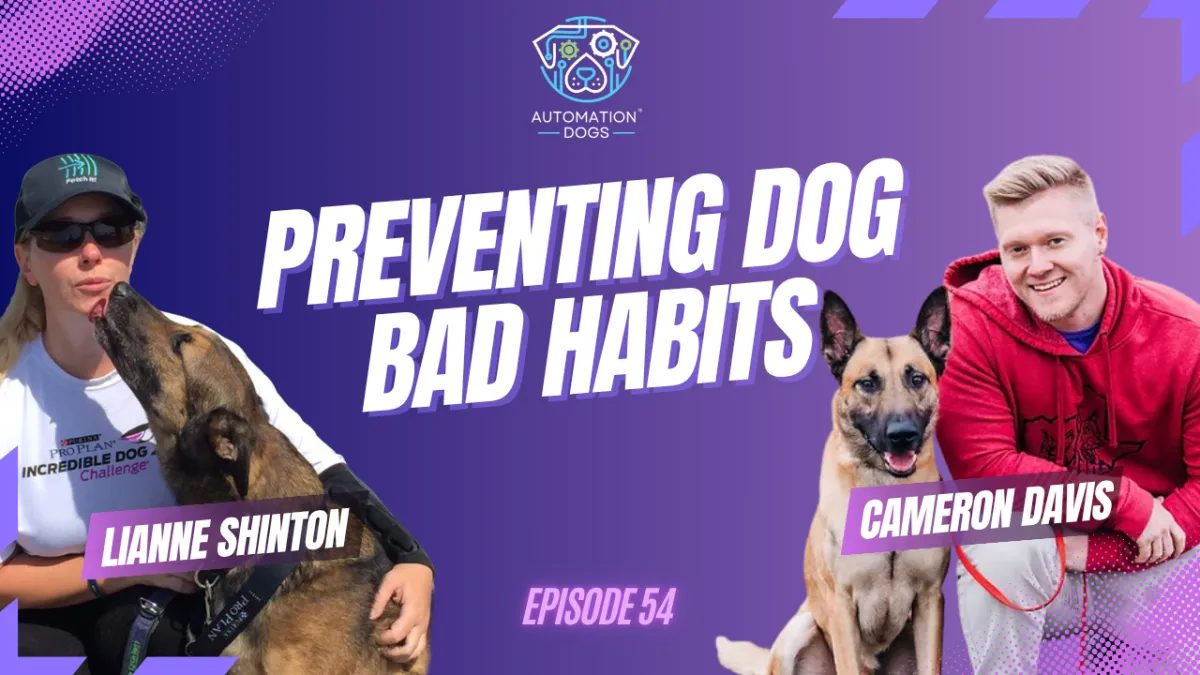
In this episode of the Automation Dogs Podcast, Lianne Shinton sits down with Cameron Davis from MCK9 Training to uncover the secrets to building a bulletproof relationship with your dog. From the crucial role of mentorship in growing a successful pet business to managing difficult dog behaviors, Cameron shares actionable advice you can start using today. Plus, discover why dog reactivity might actually be your fault. Tune in now to transform your dog training journey!
"These are the things that we handle like reactivity issues with dogs or aggression."
— Cameron Davis
Let’s Build Your Growth Plan
Automation Dogs isn’t just software — it’s a sales growth system backed by strategy, coaching, and support.
On your free Strategy Call, we’ll:
Pinpoint where your leads are slipping through the cracks
Show you how to fix your follow-up and close more clients
Map out a simple, proven plan to grow your business
Every dog training business is different — this call ensures the strategy fits your business, not a generic template.
If it’s a fit, we’ll show you exactly how we’d implement this for you.
If not, you’ll still leave with clarity on what’s holding your sales back.
Full conversation
Transcript
Lianne Shinton (00:01)
Hey everybody and welcome. So I'm Lianne Shinton from Automation Dogs. Welcome to my podcast where I commonly speak with dog trainers to find out about what they have going on in their area and how they're helping people. And then I also help dog trainers helping them to capture, nurture, and close more clients that they can help. So today I am interviewing from MCK9 Training in Texas, Cameron Davis. Welcome Cameron.
Cameron (00:29)
Hello, hello, how are you?
Lianne Shinton (00:32)
I'm good, good. How's the weather over there today in Texas?
Cameron (00:34)
It is a
cold cloudy day.
Lianne Shinton (00:39)
Okay, well I'm in Kansas and it's not too bad, but yeah, it's winter.
Cameron (00:41)
It's 50, I mean, it's Texas cold.
It's 50 degrees. So we will, I think that's cold, but it's cold to us.
Hahaha
Lianne Shinton (00:51)
Yeah, I
totally get it. So ⁓ I know that ⁓ I've known you for a while and today I wanted to kind of dig in and talk about like how you got started in dog training and what MCK9 is all about. So would you mind just sharing a little bit about you and introduce yourself?
Cameron (01:09)
Yeah. ⁓
so like my dad said, I'm Cameron. I've been training dogs. It's all started back in high school. I will be old. ⁓ a lot of my clients, a lot older than me. they get mad when I say this, I'll be 30 in April this year, ⁓ which will actually, which will mark, ⁓ 10 years of business. Actually, I started right after got back from Michael's school. but I
Lianne Shinton (01:28)
Yeah, you're a baby.
Cameron (01:37)
My parents asked me in high school when I was a freshman, what would keep my grades up? And I said a dog. They were like, what? Why do you want a dog? And I was like, I want a dog. And so they got me a Doberman off Craigslist. I know, I know, but that's where I got one. And from then it's just been dogs ever since. I did an apprenticeship with my mentor Clay.
at high school going into my senior year and then after that I tried college for a little bit. And so community college was going to be with counting of all things. And I was like, no, this isn't for me. And luckily I had a very good support system. And my parents were like, whatever you want to do, you want to do the dog thing, do the dog thing. And so I left and did an apprenticeship with Jonathan Katz. And then after that apprenticeship, I went to the Michaelville School for Dog Trainers in California. And then in 2016,
That was in January 2016. I got back from April, May, April, May 2016. I started MCKNIT training, which where I'm located is Montgomery, Texas. But it's also Montgomery County. A lot of MC stands for Montgomery County. And in fact, it does not. It actually stands for MC, which is my middle name. I...
in high school or just in the school system. It was Cameron MC Davis. I do have a long name and that's just what I love.
Lianne Shinton (03:14)
So your middle name is...
Cameron (03:15)
It's Mac Carl,
M-A-C-K Carl. And so, yeah, I'm named after both my grandfathers.
Lianne Shinton (03:19)
Okay, cool, that's a cool middle name.
Cool, I like the dog trainer shirt that lets people know you're a dog trainer so that they can come up and talk to you.
Cameron (03:29)
Oh yeah, it's always on.
I always have it on. There's times where I'm like, okay, I'm going out with family, okay, I'm not. I may have the business hat on, but I'll try not to put the shirts on now, because people will try to stop and talk to me about stuff. I'm like, okay, I'm putting dad hat, or husband hat on, not business owner hat on, so I have to catch myself. And.
What's crazy is that one of the grandfathers I named after is my mom's dad. ⁓ He bred and trained Dobermans after the Korean War. So I kind of got all of that from him and just wanted to be around dogs. Very, very old school with the stuff that they would talk about, he would tell me. ⁓ But it was very cool to hear his stories of, you know, during the war, was Captain Hag of Doberman. That's why he came back and started reading them and stuff like that.
Lianne Shinton (04:28)
So that's where I love Doberman's, that's like an awesome smart dog.
Cameron (04:29)
I don't have one out of out of my six. I
do not have one ⁓ I am actually debating and You know as dog trainers we tell people you gotta do what's right by the dog and Get the the best dog for your lifestyle and I just the lifestyle and then right now of course me of course I can love a Malin wall or Dutch Shepherd you know Doberman but
I have a, to be a one year old son, a four year old, then tomorrow an 11 year old and having a puppy mowing lawn and touchy, just with how I have clients and stuff. like, you know what? I think it's time to hang that breed up for a little bit and I will get one later. And so now, believe it or not, I'm looking at copper spaniels and boykins and
Completely changing looking at breeds. I never ever thought I would ever get into Just something more Just you go into the for clients to approach me Having something like that versus walking the street with the Doberman or a mountain wall But something I can stop fun with that's my big thing. They gotta be able to do stuff. I can't any
Lianne Shinton (05:44)
Mm-hmm.
Yeah.
Cameron (05:57)
cannot be a dagun terrier.
Lianne Shinton (06:03)
think it's ⁓ something good for people to hear too, that you're really thinking about the right breed for a family and to be around a lot of people. And that's something that I think a lot of folks, they just maybe look at a picture and they're like, well, I want a Tibetan Mastiff. I live in an apartment. ⁓ And there's so much research that we can do now.
and talk to someone like Cameron to make sure that we're finding the right breed, hopefully for the checks, all the boxes for whether we're single or we have a family or we want a dog to be athletic with us and go jogging with us. Like there's going to be a better choice and probably a not so good choice.
Cameron (06:50)
I mean it, believe in life.
thinking of dogs, trying to convince people like, hey, because it is a day and age right now, you're gonna spend money on a good puppy. And that's a good thing, not a bad thing. Because you know what you're going to get. have people that care about their puppies and their dogs that they're gonna tell you, you're gonna get this from this, from this, from these two, you're gonna see this, from those two you'll see this, versus.
Lianne Shinton (07:10)
Mm-hmm.
Cameron (07:25)
Billy Bob Joe taking, oh, I got a female dog and a male dog. Let's just see what happens. Right? I, as a dog trainer, see that all the time. And so it's, one of the things that it's hard because you really don't know what you're going to get. Even yes, cause you know, you have a male and a female dog. doesn't mean they should always be bred. And then obviously we have the whole rescue stuff that we have to deal with too.
Lianne Shinton (07:53)
Yeah, and from a health standpoint too, you know, it sucks when you get a family dog and then you don't know the genetics. And yeah, my perfect angel is from a wonderful Malinois breeder, but a working Malinois breeder. And you know, that's the right fit for me. Stephanie O'Brien from Lusen. Yeah. Yeah.
Cameron (08:05)
From which breeder?
yeah, yeah, I know Stephanie. I know Alvar, I know her better, but we're friends on Facebook,
almost all the dog training can be friends on Facebook. So yeah, I actually like her dogs a lot. Like if I was to get one of them, funny, if I go back to mouse, which I know I'll it one day, ⁓ I would get one from ⁓ Jonathan Katz, one of his lines, or when I was so weird.
Lianne Shinton (08:22)
Yes, yes.
Cameron (08:36)
when I went out to Michael's school, because I was only used to like those type of dogs. Jonathan had some pretty intense melon walls and I was just used to them just kind of just always being on, not having an off switch. And I liked how Michael's dogs were like, they were, they had the drive to do everything else, but they were also just like pretty naturally chill. Not as like a puppy, but even as some of the younger ones you would pull out, they were not as antsy and stuff like that.
They are very tall dogs though. ⁓ I'm a big fan of medium to large, not large to massive preets. So like to me it could, going back to Dobermans, I hate the large breed Dobermans you see nowadays. I think a Doberman should be between, as a male no more than 80 pounds. It's just an athletic breed if we're going off the origin.
Lianne Shinton (09:11)
Yeah.
Cameron (09:36)
standards.
Lianne Shinton (09:36)
Mm-hmm.
Yeah, it's interesting as a dog trainer, we become very picky about what we're looking for in a dog.
Cameron (09:43)
yeah, very picky. We, but, then it's like, you know,
I tell you all the time was like, you we don't have jobs for dogs anymore. Like 50, 60 years ago, you didn't take your dog to dog training. There, there was a few people that went to like obedience classes, YMCA, and they did specific things because they wanted to do something cool with their dog. That was very far and a few between. ⁓ like dogs just act right because we knew what a dog was back then. We've forgotten.
what a dog is and what they are capable of. And now we want to treat them as if they're babies. Um, some say like Tyler Mudo says that if we don't humanize dogs enough, other trainers say, we humanize dogs too much, but I'm on, I'm kind of in between. Um, I agree with Tyler on that one. I do other trainers on that.
I just tell my clients, I'm like, look, if you want to call yourself a firm mom, for dad, for parent, whatever. Parent is what you should be. Not the, mean, I have three kids trying, can't be a friend and a parent at time.
There's something with dog, there's something with dog.
Lianne Shinton (11:05)
Well said.
Yeah, well said, well said. Now, just to shift a little bit to something that you mentioned earlier, you sound like you've surrounded yourself with the best of the best, and you really appreciate having a strong mentor to help you grow as a job trainer and evolve to be the best you can be. Can you share a little bit about how important that is to you, having a mentor that is incredible, like a Michael Ellis?
Cameron (11:29)
you ⁓
So
it was funny that first video I ever saw of Michael was in 2009. Yeah, 2009, 2010. One of the old Learburg videos. It was just something I always knew I wanted to learn from him. And so I was like, okay, whatever I can and one day I'll get out there to go learn from him. I never got into Ivan until later years and Bart and all the other guys.
The biggest thing I tell dog trainers up and coming that if I was to redo this all over again, I would have started at 20. I would not have started my business at 20 years old. There's so many things you're going to walk into that you have no clue you're going to walk into. People are going to BS about a lot of stuff that's going on with their dogs and you don't know how to filter through that as a 20 year old. I put myself in
Lianne Shinton (12:31)
Yeah.
Cameron (12:34)
pretty uncomfortable situations because I took a owner's word as well. And so having a mentor that like, hey, you should try this and that doesn't look too good. You need to do this instead. ⁓ even now I'm always having different mentors, people that I've admired and watched over the years. Like, Hey, can I work with you? Can you do coaching calls? Like right now I'm working with a guy named Katie Matthews who I've been following for the past four or five years. So it's more of.
I'm always wanting to learn and become a better teacher. Something that I've, something I've been, I think all dog trainers relate to this, we're really good with the dogs. Like, perfect. But that's not the reason the dogs are good with us. If we just have the dogs and the dogs are able to flip a switch and we can make them be better, that's fine. But we're not home, we don't go home with the dogs. We end a session, we go home for the day. We...
Lianne Shinton (13:12)
Mm.
Cameron (13:34)
Send the dog home after a quarter of a train. The biggest issue we struggle with is teaching the clients and making sure the clients follow through. And so that's something that I've tried better. How do I educate? How do I push my clients to become better dog owners? Because sometimes it's, the answers are right in front of them. They just can't see it. And so having a mentor there to help guide and to, hey, you should teach this way by
Clay, my other mentor, he was kind of a struggle with me because I met him when I was like 15, so I've known him for very long time, 15 years, and he never would answer questions. So if you gave him a question, he'd give you like three answers. It was always like an open-ended answer, so you would have to filter through the answers. And I'm very quiet when I'm learning. It takes me a few hours to process the information.
and I'm very hands-on. So I couldn't just watch a video and learn. I have to be like in it. I have to mess up. You have to tell me I messed up and go from there. I have to watch how people mess up and I'm going to keep trying until I get it right. I can't, but I also do the same thing with my book. I'm reading a book. I'll go try it, but if I can't see it, I'm still in my brain. I think it's right. And so like I said, having a mentor there to guide you through that is what I think most.
Lianne Shinton (14:39)
you
Cameron (15:02)
Up and coming dog trainers.
Lianne Shinton (15:08)
Yeah. I mean, that was quite interesting. Everything you just said, because you strongly, like we all should as dog trainers, we have to be a coach for the humans because the dog has to listen to them. They have to be able to do the things that we tell them to do. And you also kind of turn that lens around and pointed at yourself and talked a little bit about how you learn. ⁓ because yeah, everybody learns differently and it's important for us dog trainers to be able to be that.
coach for them, to motivate them and help them learn.
Cameron (15:38)
Yeah.
Lianne Shinton (15:43)
Now for MCK9, so people to find you, they would just go to mck9dogtraining.com. Is that right?
Cameron (15:49)
Yeah, mckinntrading.com.
⁓ I'm on Facebook, ⁓ on Instagram, on TikTok. ⁓ I try to do all the social medias that we can. ⁓ Now I do a lot through Facebook ads, so that can give me a lot of ⁓ business at the moment. That's pretty much how most people find me, or the vets around here that I'm cool with.
Lianne Shinton (16:19)
And then what does that first starting point look like if I have a, you know, puppy and I want to get dog training with you or talk to you? What is that first kind of journey? Part of the journey look like.
Cameron (16:30)
So with
my puppy program, typically do how old the puppy is. If it's under 16 weeks, I'll come to your home and meet the puppy because obviously they have shots. ⁓ And so I'll come meet with you, get a feel of what your goals are. And if you're ready to go, I put you into my puppy guidance program where I'm going to help you for the whole first year of the puppy's life. And so the biggest thing that I see with ⁓
clients when they have a young dog is there's wrong yet. Right? We don't, it's blank canvas. They may be having some house breaking issues. They may be having like the puppies getting into things, but you know, a lot of people will baby proof, but they won't puppy proof their house. And so, and they're just like, they're forgetting things. They're all the bad habits are actually starting right then as the puppy so daggily cute. You want to pick it up all the time.
friends want to come over and play with the puppy. Your kids are all over the puppy. Puppies running and jumping on the couch. It's starting to, as every day gets bigger, starting to climb on your leg. It's barking. Oh, it cried the whole night the first time. And then you're like, Oh, I couldn't bear it. So you brought it in bed with you. And then six months goes by and the dog started to become a problem. And so my goal for puppy program is to help prevent all that. And like, Hey, if you stick out a little longer,
you're gonna start ⁓ creating boundaries and rules and structure in the house that's gonna help so your dog understands what's expected of them. And I'm probably sure every dog trainer says this is we give dogs too much freedom too soon in the house. And so people think of off leash, think outside, but 99 % of the problems that you have are in your house. And we have to fix that first before we can go outside. And so there's that.
And then we'll do a few sessions. I don't agree with vets and most of the dog trainers don't agree with vets when it comes to socialization. Now, just be smart about taking your puppy out to places. Just don't throw them. Don't go to, you know, PetSmart where they have the band filled in there and you walk through a puppy, have an accident, don't do that. But you can take your puppy to Tractor Supply, Home Depot. You can take your puppy to a friend's house that has
Lianne Shinton (18:29)
Good point.
Cameron (18:57)
vaccinated dogs, get your puppy out, seeing the world. There's plenty of ways to put your puppy in a basket with a blanket and walk around getting your dog out because they're obviously are going through a fear period. And by the time you're back, it's like, ⁓ now you can go up. And so I want to help avoid all that. And then as your puppy matures, now because they're really doing obedience because the first few weeks, first two months is really just
Lianne Shinton (19:16)
Mm.
Cameron (19:27)
managing the puppy around the house and creating some structure, creating some minor rules. You can't sit there and expect your puppy to do a 50 minute down stay. This is what I'm laughing, this is people expect of their puppies when they first got them. Because a lot of people, what they'll do is when they get a puppy, if they haven't had one for a long time, or if a dog had just passed away and they got one a few months later, they always go back to the dog before that puppy.
Lianne Shinton (19:32)
Yes.
Cameron (19:56)
or the dog they have when they were kids. Oh, it wasn't like this with this dog. It wasn't like that with that dog. And you always got to think the picture. I love when I've had, now being a father, I can tell people like, look, I got three kids. I got two daughters and a son. They are complete opposites on each other. My oldest is my most sensitive. My middle child is a nutcase and she does not care about feelings. And my son is one, so he's about to be one, so he's still figuring stuff out.
Lianne Shinton (20:01)
Yeah.
Mm-hmm.
Cameron (20:25)
But that dude has no pain tolerance. Like he literally felt smacked at the tile for it, just kept on going. And so just different things that were just what would we expect from a child. It's the same thing kind of with a dog in the same way as it's a different dog. They all have their own wants, needs, and desires.
Lianne Shinton (20:53)
I met, this is making me think, I literally met someone the other day and she saw the logo on my shirt with the dog and she's like, are you a dog trainer? And I'm like, I provide services for dog trainers, like a software. And I'm like, what kind of dog do you have? And she's like, how did you know? And I'm like, I can tell when someone wants to ask questions about, tell me about their dog. And it was ⁓ like a Chihuahua mix. And she's, I think three months old.
Cameron (21:11)
Now.
Lianne Shinton (21:22)
and she said that she's having housebreaking problems with the puppy. And I asked a few questions and learned that like right now while she's at work, the puppy is home alone with full access to the entire house. And I'm like, wow, scary.
Cameron (21:39)
My sister just
got my niece as a puppy and of course it's a doodle. I have no issues with doodles. They pay our bills. That's what I say when people ask, do you have issues? No, they pay my bills. I've met some pretty cool ones over the years, so I have no qualms with them. But my sister was the same as I'm trying to tell her how to start.
preventing separation anxiety, start creating the house up to a better structure of the puppy. She's doing good. I mentioned having a leash on, she goes, what do mean? I was like, have a leash on a puppy. But why? I was like, because if the puppy does something and grabs something, the puppy's going to learn that it can get away from you. We don't want that. She's like, oh, I never thought of it. I was like, I know, that's why I'm your brother.
You're lucky your brother's a dog trainer. Like I know. So it's just funny when people, they just expect the dog to get it really quickly. Don't get me wrong, some dogs are good. I have another puppy in. She's a Malmo puppy, a five month old Malmo puppy and oh my gosh. She's, her separation anxiety is like through the roof.
Lianne Shinton (22:41)
Hehehehehe ⁓
Cameron (23:09)
They couldn't handle her being in a crate and we're like, ⁓ we do. So they just caved. Now they got lucky in the fact that like, Hey, we let her out. She's not having accidents. Okay, cool. But she's still freaking out being alone. So we have to stop that. Like she has to learn it's okay to be by herself. ⁓ and don't get me wrong with dogs are gonna freak out. They're like a young dog is going to third temper tantrums and be upset about being in the crate. You just have to persevere.
Lianne Shinton (23:15)
Mm.
Cameron (23:38)
and the dog realized, okay, this is just life. And we as humans love to put emotion that's not there.
Lianne Shinton (23:40)
Yeah.
Cameron (23:48)
We love to, oh, we feel like you feel back, the dog doesn't feel bad, the dog just, this is just life, like, okay, I'm in my dream, I'm in my dream. And for a very young dog, they're gonna sleep, even older dogs, they're gonna reserve their energy and sleep 10 to 15 hours a day.
And so having them be in a crate now, granted, if you get a young dog and you have to go to work, yeah, you're to have to pay the extra money to have a pet sitter come in and let the dog offer an hour while you're in between. Or if you ever come home for lunch, like that's, that's doable. But just it's what you do when you get your puppy out of the crate for that time. That's what matters more than a puppy sitting in the crate for eight hours while you're at work. Now, yeah, the puppy's eight.
Lianne Shinton (24:08)
Yep.
Cameron (24:34)
nine, 10 weeks old, yes, when you're working on house breaking and crate training, you're gonna have to someone come in and let the dog out. That's just part of the process of having a puppy.
Lianne Shinton (24:48)
Yeah, and having a plan even before you get the puppy. With this individual too, she shared with me that, and this reminded me of what you just said, like sometimes our expectations, we just expected to just go this way. And she had said that she put down those peepee pads and just left her home alone with the peepee pads and expected the puppy to just housebreak herself.
Cameron (24:57)
Okay.
Yeah.
Put put down the peepee pads Go on it House but but the
pee pads don't address peeing in the house. They actually teach the dogs to pee in the house. Now don't get me wrong You live in the you know a high-rise in the city. Okay, cool. We can teach your dog to go in the bathtub. That's fine. But Yeah, no
Lianne Shinton (25:22)
They encourage it.
Cameron (25:38)
I'm not a fan of pee pads. never be a fan of pee pads unless living in, you're in that type of environment, apartment style. That is totally fine. I actually try to convince clients to do like the turf pads on the deck versus peeing in the bathtub. That's my second one. Cause then we can just bleach and clean it out and do all that. But yeah, when I was crazy, when I lived in Chicago and I did my apprenticeship there, you would get dogs out from like,
Lianne Shinton (25:40)
Yeah.
Agree, yeah.
Cameron (26:07)
the countryside. We had no grass. There was a little bit of grass where we would do protection work on club days. And that's all the grass that we had. But the relative time was fixed in a parking lot. So we would just leave dogs until they froze. They would just go because they were not used to going on concrete. That would take a very long time to teach. ⁓ And so that's just part of it. And you have to take things with older dogs. you move and do stuff like that, now granted, they can kind of...
contextualize things, but sometimes you do have to reteach some things. Especially if you get an older dog that's never been in the house.
Lianne Shinton (26:46)
Yeah. Now, ⁓ could you share a transformation story of someone that you've helped the family with a dog, for example, where it was a tougher one and you saw an amazing transformation?
Cameron (27:02)
Yeah.
And so there are a few recently. One was a client breakthrough. The dog was a tough dog. ⁓ She just got confident. The dog obviously wasn't gonna, wasn't this huge. It was actually an aggressive case. ⁓ I typically, how I manage stuff, we have 12 acres out here.
My kids help me a lot so I'm very particular if I take an aggression case on because I just don't like to have those types of dogs. But typically I take them on and with this case he was looking for a while, probably about eight weeks and he was fear aggressive. First day I met him he's trying to bite me but he's also peeing at the same time.
He's like, I don't really want to be here, man, but I don't know how to get you away from me. And so I gained his trust. I got him a lot more comfortable with me. Training him was the easiest part. Now I was teaching his owner, you have to be able to tell him no and control him under that situation and have a better relationship with him. feel like he needs to blow up at people, blow up at other dogs. And so.
That was a really cool thing to see her get confident and not get nervous when she held that leash. These are the things that we handle like reactivity issues with dogs or aggression. A lot of it comes by the handler, like the handler's teaching the dog accidentally to do these things, right? So when a dog is approaching and you're walking your dog, the first time your dog goes up on a dog, okay, that's, it threw you off. It's cool.
Lianne Shinton (28:32)
you
Cameron (28:55)
keep going, dog doesn't do it, then it does it again. And by case, case three, to create a pattern. So by the third time you're like, okay, now you're on guard looking for a dog coming by and you start to tighten up a leash every time you see a dog. But what that's doing is queuing the dog like, oh, okay, I'll take care of this. And they start reacting. And so there's that. The
Lianne Shinton (29:13)
you
Cameron (29:23)
The cool thing about my job is my clients come and they see me a lot. So their progress is always going. tell people like there's three parts of like obedience training when it comes to dogs. We teach, we prove, we maintain. We have to teach it or we will expect the dog. We have to prove it, mean with the dog, do it no matter what's going on. And then we have to maintain it. And that's kind of what I want all my clients to do because it's you're always striving to have a better relationship with your dog.
Lianne Shinton (29:56)
Yeah. And when you're saying you maintain it, it's making me think too, like you mentioned, you do take some more difficult dogs on and I'm thinking, Hey, this might not be fixable, but we're going to manage it. No one will ever realize this dog ever had any issues, but it's kind of like, I guess a drug addict as an example is like, you have to maintain a certain lifestyle, a certain, you know, maintain that training so they don't fall back into those old, you mentioned pattern.
Cameron (30:23)
Yeah, like
yesterday I went out to an eval and the dog had bit their son. He's an older, an older kid and I say older, he's against once. And the dog had rescue. was, he had went in for a hug or he was being rough with his dad, being goofy and the dog went out. And it's a pit bull mix.
Believe and she definitely has been in her and so They you know were super nervous I mean like they were shaking before I walked inside the house because they were just gonna attack and of course I put my suit on I'm gonna see That always just I mean they have a suck me on her shouldn't bite me I didn't see what they saw and so there they obviously calm back down, but I said look
Like, we're all gonna take her on or we're gonna do the training. But when it comes to y'all, just like I said before, a training a dog like that for us is very easy. We know how to manage our anxiety, our anxiousness, just the nerves when it comes to handling a type of dog. Because if we can control ourselves, it's gonna help the dog. Okay, I don't need to be nervous in this situation. I don't need to be freaking out. But the dog may not know what you're thinking, but can't tell how you're
Lianne Shinton (31:25)
stuff.
Cameron (31:54)
It can feel that you're anxious. It can feel that you're upset like going back to housebreaking Old-school way of rubbing a dog's nose in it when they peed the dog has no clue what you're doing. The dog thinks you're a jerk Right, but that was the old-school way the dog knows you're mad about something you come in your dog had destroyed something and you're upset I know something's wrong and if he will all the dog knows they did wrong. don't know the dog just knows you're upset
Lianne Shinton (31:58)
Yep.
Yeah.
Cameron (32:22)
So there's gonna stay away from you. Your dog can tell that you're uneasy if you have an anxious, a fearful, aggressive reactive, which we all know reactive gets blown up proportion these days, but we're just gonna use it for lameness terms for most people to understand that. The dog is going off of you. So if you are starting to act in a certain way, the dog's thinking this setting, this picture, this
Lianne Shinton (32:24)
Hmm.
Cameron (32:51)
Person is what's upsetting you I should be worried too. I should be on guard too and so that's a big thing in star trains like hey just Learn how to control yourself. Learn how to control your emotions around this Another cool one. This is a puppy one This guy really loves working with stuff. He loves. He'll cop the class. He's an eight month old blue healer, which I love. I love getting with a healer.
And this guy takes the training to a whole other level. We did our puppy program, I did the board training, got her all put under the foundations working. And he's like, come to class, I taught her this thing, I taught her this thing. And then I go back and it was just funny. He's doing really well, but it's just like little things he needs to on. Hey, you're talking too much to her. He's like, what do you mean? She's kind of like blowing you off in a few things. So you need to like bring it back a little bit.
Lianne Shinton (33:46)
Hmm.
Cameron (33:51)
just give her a cue. She doesn't reinforce it. he goes, okay, let me explain something. And so, like he was trying to teach her like a focused cue, which he was saying hi to. But we were in middle of group class and he was saying it so much that she just was like, being an eight month old cue, was focused on the setting, not him. And I was like, she met this time, I wouldn't do it. And he's like, all right. And so, it's just cool. I'll be like, cause I do let some of the dogs once we're done.
Lianne Shinton (34:10)
Yeah.
Cameron (34:20)
and they have to ask beforehand and once everybody's out I'll let some of the dogs that are cool with it, they'll want to run and just, I fenced off all six acres and so they'll run and just kind of run for a few minutes and so he was, were talking about it and there was just something to, we always love when the dog trainer, or as a dog trainer getting somebody in that's kind of like really into training and they love working with their dog, that's always the best part.
Lianne Shinton (34:53)
Yeah. There was something you said earlier too, ⁓ more with the dog that had bitten ⁓ in the family that had bitten the child or, you know, young man. And I think I just wanted to add to that that stuff happens and it's super scary and it sucks. The best thing you can do is get somebody in your corner that can help you. Just like if I have public speaking fear.
Cameron (35:04)
Thank
Mm-hmm.
Lianne Shinton (35:23)
I'm going to get coached on that. go to Toastmasters, but I will take action and surround myself with someone or some people that can help me through that. And I think that is critical. If you have a bite, you know, history with your dog, it's biting you. You need to get with Cameron because you need someone in your corner that can help you through that.
Cameron (35:40)
Yeah, I mean.
Yeah, and
I've turned dogs away because I'm just like, a dog training is expensive and people don't. It's expensive and the investment of it as I'm going to require a lot of time from you. is yes, there's a cost to it. Your dog is a big investment. And so but if you take the time, a little puppy, you take the time you hear most are from this.
most dogs are gonna live to 15 years. You take whatever the cost of dog training is and divide it up to how long your dog's gonna live. It comes out to pennies on the dog. But when you're dealing with an aggression case or a very strong reaction case, having someone there to guide you in the right direction.
Lianne Shinton (38:08)
Welcome back.
Cameron (38:09)
and go, are you gonna have?
Lianne Shinton (38:13)
Do remember where you were at where you were kind of at about the dark training be expensive.
Cameron (38:16)
I was going on a tangent.
the, I mean we should actually really say it's an investment, the having someone in your corner to help you with your dog when you're going, that helps. And not even that, what I've also seen is like when people struggle with dogs and with their dog and they come to one of my like group classes, pack walks, you legacy support.
After they're dealt the program and they see the other dogs are going through the same thing it helps them I'm not the only person going through this with my dog. It's not just me right, but a lot of issues we still deal with on a daily basis is because a Lot of it is the owners fault in a way Don't get me wrong. Of course, if you've got a dog from a shelter and they have these issues
Lianne Shinton (38:53)
Yeah.
Good point. Yeah.
Cameron (39:15)
By the time the dog gets to us, a simple correction could have stopped a lot of those issues from getting really worse. And that's something the dog does need as we, know, as most people aren't aware of how dog trends have this inner battle between them never saying no or not using punishment and using punishment. But I will always be able to tell a dog no and letting the dog know.
in their language, hey, this is not the right thing for you. It's how we learn, it's how dogs learn, it's how I teach my children. ⁓ And so that's something that is a good thing to have for people when they are trying to find a dog trainer.
Lianne Shinton (40:06)
Yeah, agreed. And it's making me think too of something you brought up at the beginning when you mentioned the word socialization. And, you know, like sometimes you got to tell the kids, no, I was thinking you could share on if someone comes up to you and they want to pet your Corso and you're training them, you know, you don't want just people coming up and hugging your dog. Give an example of how you would tell a person in public,
No, stop. Sorry, he's in training. And maybe speak on that a little bit as tips.
Cameron (40:40)
Yeah, I always
tell people when I'm out with dogs, puppy, I keep the cutest puppy in the world, depending on where you're going with the dog, I will tell them, we're in training now. So I might get mad about this, but I typically would just say, hey, let's go to be a service dog. And everyone's like, oh, okay, let's keep on walking. That's my go-to line. Everyone does that. I know other trainers that are like, oh, I'm on the phone. I go hide their headphones in.
just kind of like gear off, right? Just to avoid the situation. But you know.
Lianne Shinton (41:09)
Yeah.
Cameron (41:14)
People think that just because the dog is in public, it has to come up to them and say hi. That's just not the case, right? Like it's my dog, it's not your dog. It's my property, it's not your property. I don't go up and say hi to your husband and touch your husband or touch your wife or come up and touch your kids. It's gonna be very weird. It's gonna be very weird, right? But for some reason, it's accessible to do with the dogs. And now don't get me wrong, there are...
Lianne Shinton (41:30)
Kids, yep.
Cameron (41:40)
not the brightest people out there when they just think their dog should be able to go everywhere and they can't even control their dogs. And so that's another issue I have to take.
Lianne Shinton (41:50)
Yeah, yeah, yeah. And I thought that could be a good takeaway too for folks listening. Like if you're out walking your dog, it's your dog and everybody has to pet it. And I think those are some good tips like, sorry, I'm on the phone or he's training to be a service dog. You can't touch him.
Cameron (41:58)
Mm-hmm.
Yep. mean, and then it's, it's,
yep. mean, most people are gonna ask questions, he's just trying to be sort of like, let me just keep going. Or say, hey, we're just trying to avoid these things. ⁓ I.
typically don't make eye contact with people. Like I'm just like just going and I walk pretty fast like by that time and don't get me wrong. If I know the dog's safe, the dog's cool. I may allow it for the correct person. If the dog's behaving, I may allow it. If I have a fear of progress, kind of overcoming sometimes, I may allow it. So it just depends on the dog when I'm working on it. But obviously if it's an aggression or reactivity case, I'm not gonna let anything happen in that situation. And so it's just
Lianne Shinton (42:19)
You
Yeah.
Cameron (42:45)
knowing your dog and knowing what you want out of the dog, having the goals you're going to want. But every time a stranger come up to your dog, you're also letting your dog know that you're not the most important thing in the environment. So, that's not a good thing. We should work on that.
Lianne Shinton (43:07)
Yeah. And I think, like you said, having the expectation. So I'm not avoiding letting my dog interact. I'm not trying to avoid any of that. I'm actually come right by me, walk right by me. My dog will completely ignore you. That's my expectation. That's what I'm going for. Yes.
Cameron (43:20)
Because that's what we want because a of people think that
dogs should have to say hi to everybody. Not every dog, either Labrador or Gordron Trier wants to say hi to everybody. They just, they don't care. They're not gonna be the most outgoing dog. And the expectation you have for your dog is like, how do you expect your dog to act when someone comes in the door?
Do you want your dog to be barking, spinning, scratching, jumping up, going crazy when someone knocks on that door or when grandma comes in? Or do want your dog just to be calmly laying at the floor without you having to cue it? What do you want? Like, what do you want? Right? And so, uh, it was always funny. I use my parents example, uh, cause they kept from the
the older Dobermans I had trained until he passed away. And my dad thought it was the funniest thing in the world to let him go chase squirrels. He thought it was fine. They had an invisible fence so he would run to the border and get them off the property. He thought it was fine. But my God, he hated when it was like 7 a.m. or 6 a.m. or 10 p.m. and he would just start spinning, a Bacardi. He would start spinning and spinning and spinning and start barking. And...
Lianne Shinton (44:24)
You ⁓
Cameron (44:43)
They would say they would get on to it. would would. Yeah, let him just stop it. He just. Ignore them. All I had to do was open my door and he would run to his bed and lay down. Is it he just run his he was he he was he was was let off big like he was upset or like a sigh stop. That was it right and. Then it was at feeding time he would go and wait by now at 5 AM.
and just like poke him with his nose to get up. kid that wants to get to feed me. Now if my parents were gone and my door was open, he'd open the door and come in my room. He would try to, and as they know he would just go live like that. He would not mess with me. It's a relationship thing too with our dogs. The dog understands, say who do I have to respect here? Who's gonna be a pushover? Your dog definitely knows that about you.
Lianne Shinton (45:34)
Hmm.
Yes, yes, that's funny. ⁓ Yeah, my dog knows that I can be a bit of a pushover in some scenarios, but I absolutely love when I walk her every day on the sidewalk, we pass people and you know, she just walks by proud carries her toy and their compliments and I'm just like, I love her. She's so perfect. It's just seems so simple. But you know, it's it's such a great expectation to have your dog just ignore every
Cameron (45:47)
Hahaha.
Yeah.
Lianne Shinton (46:09)
She can be super friendly, like, you she'll jump and scratch if I let her so yeah. But I love that feeling having just a great dog that I can take anywhere around any distraction and she just completely, it is such a good feeling. Yeah. Awesome. Is there anything else you'd like to share today?
Cameron (46:10)
Mm-hmm. Mm-hmm.
⁓ huh.
Yeah.
Do you have any other questions for me?
Lianne Shinton (46:34)
⁓ Well, we did talk a little bit about reactivity and I know that is kind of a common thing. ⁓ Maybe if you wouldn't mind sharing a little bit because I think that's kind of a common thing that people like you mentioned, it literally happens once and you're like, I didn't expect that. two, three more times. Boom, you've got a freaking problem. So maybe just a little tidbit on a share on reactivity might be helpful for folks.
Cameron (47:04)
So I love it too, you can come down to what we back up and.
When someone's having issues with that, they may go, I'm only having issues with the dog outside all-in-issue. Okay. Yeah, he's pulling, he's barking at squirrels, and the rest of it doesn't be for people, it's gonna dogs, it be just at the end fire, maybe barking at cars, whatever. So then I ask, okay, how's he in the house? They're like, he's fine in house. He's fine in the house. What's going on there?
Well, like, you sometimes he'll go and jump on the counter sometimes we go and catch we're not supposed to Sometimes he starts out the door when you know, it's left open for too long Okay, so we still some issues so We want to go back and fix The things that the dog is having issues with in a controlled environment
before I can bring them out.
and put them into an uncontrolled environment. I can't control the moment I walk off my driveway. I cannot control what's gonna happen when a squirrel runs by, I can't control the timing of that. I can somewhat, sometimes control a dog, depending if we be at a park, we come to my place, I have another client come, or if I bring a dog, I can somewhat control the variables.
but I still need to help the dog get past this. And so if I can create a better structure for the client in the house and start teaching some fundamentals, getting the dog to engage with them a little bit more, and get out to just simple cues, nothing crazy.
and then get the dog to pass and then depending on the severity of the aggression is going to tell me how are we going to adjust this or the aggression with the reactivity how are we going to change this because i've taken dogs and the owner like he will react no matter what he sees a dog and i'll get the dog i'll be pulling on the leash that's also a very big important thing and then we'll pass it out no problem
and I haven't even had to give them a correction or anything or stop this behavior. What happens is most people want to correct the dog when the dog gets to red. Like when the dog's already in that state of mind, the goal is to correct beforehand.
Lianne Shinton (49:40)
Yeah.
Cameron (49:46)
That hard stare the dog goes like this, his dog and their eyes go wide, they start to dip their head back down. Their hair starts to stand up a little bit. Their ear goes to where the dog is, so the person or thing they want to react to. Catching that and catching that thought, like, huh, that's not what we're doing right now. You're like, now I to do that? Oh, okay, cool. Let's keep going.
It can be super simple as that and keep going. Sometimes you have to redirect them to prevent it from happening. ⁓ I am at some stages of where I'm not with the client. I hey, you may have to just be cautious because you're not ready to do that yet with the dog. So if we're going to be here and go for a walk with your dog and to walk, or you want to go walk with your dog.
Lianne Shinton (50:10)
Yeah.
Cameron (50:33)
When you come to a bend that you cannot see around, you need to go wide. So you're not coming up on a dog.
you need to go somewhere where it's just open and you can walk the dog versus walking in the neighborhood right now. Like just not kind of putting a bandaid on so we can fully address it. I have to see what's going on with the dogs. That's also the issue part of taking on, doing the border train for example. If I have a 120 pound dog, but the client's 90 pounds,
I have to be sure that they can get the same, the dog to know when they need to, the dog understands it clearer than, I said, as I just did it, right? And so having different tools and techniques and protocols are gonna help with my, the, like when I'm training a lot, I'll use a regular collar or a slip leash. I love slip leashes now.
I'm more used to those than I do use e-collars, right? ⁓ But being able to teach a client to give a dog a tap, okay, get them to focus back, helps so much. ⁓ And even so, not using the prom color, I got that tactile response, okay, no, you don't need to do that, helps so much. Having a...
Lianne Shinton (51:58)
Yeah, especially a hundred...
Cameron (52:01)
Yeah, you're having a large dog, mean even
Lianne Shinton (52:02)
a hundred... yeah.
Cameron (52:03)
you have a 67 pound dog, it's still, when they're going full force and the client is still an older person or the dog still needs to know, okay, that is not acceptable. No matter who has the leash.
it can sometimes be a little tricky on the program.
Lianne Shinton (52:19)
Yeah, I like what you said.
I like what you said too about like really analyzing the other things that might be going on that maybe the client, the dog owner doesn't even realize these things could be fixed. Like, you know, he's been getting in the trash or I let him in the backyard and he won't come in and he's getting zoomies and I can't get him back. And like, you can fix that too. That'd be great. Plus it's also helping because it's connected to the behavior.
Cameron (52:34)
huh.
Mm-hmm.
Lianne Shinton (52:48)
the reactivity that you're seeing.
Cameron (52:48)
Well yeah, well
a dog is trying to answer two questions all day. Those two questions are trying to answer for themselves all day. Do know what they are, Liam?
Lianne Shinton (53:01)
I'm gonna say no so that you'll.
Cameron (53:01)
You probably never thought of it like this.
So they are trying to get what they want and how do they avoid discomfort? That is all they're trying to answer all day. Those two things. It's super simple. When I was taught that I was like, okay, that makes sense. So like.
Lianne Shinton (53:12)
Yeah, yeah, yeah, awesome, yeah.
Say
that again so the people in the back here at Flirty, have to listen to this too, because she already knows this and that.
Cameron (53:22)
So.
So like all they're trying to answer is how do I get well, how do I get what I want? Now that is training you, training us, dogs are really good at training people, their owners to get what they want. And how do I avoid discomfort? So your dog jumping on you to get affection is getting something they want.
your dog coming over to you and like nuzzling you is basically what your dog whining at you in the crate. They don't want to be in the crate. That's what we just come through. So like they're trying these things to get what they don't want and what they do want. And so when you let them go to the door and scratch it, you just said, Hey, this is okay. So let me go outside.
when your dog jumps on you, when it wants affection, you just say, it's okay. This is allowed. So when we go outside, there's like, hey, there's no rules in the house. There's no rules inside.
So there's no roots outside, there's no roots inside. So the dog is trying to, why can't I do this? Why can't I do that?
Lianne Shinton (54:34)
Makes total sense.
Well said, I'm sure people are thinking right now. know I am. Flirty's kind of spoiled. All right, so just some fun questions, kind of lightning round. If you were a breed of dog, what breed do think you would be?
Cameron (54:57)
hardcore Doberman or that. I don't know. I do love those Germans, but I haven't I don't know when I'm ever going to get one again. But my wife, but I was just like, yeah, a Doberman would be cool. Roddy, any of those type of breeds.
Lianne Shinton (55:00)
You love those Dobermans, huh?
Yeah, right. I always like like a female Dober female rot. That would be a dream. But the doves and cancer sucks. So like
Cameron (55:29)
Mm-hmm.
Yeah, I
actually got a client one from a really respected breeder who I would probably get one from down the line. just, that was my biggest thing with them is I was watching the breed for such a long time and I was following some of the dogs that I really liked their careers. They were just like dying at four, dying at five. I was like, what the heck.
So was like, okay, I just like they're trying to do like great things. They were not making me the tent and I love a big great thing and it's funny ⁓ as we got some property we're debating on if we're gonna get like a farm dog and by God
Lianne Shinton (56:01)
Yeah.
Cameron (56:12)
I will never own, I will say I never train for a client a livestock guardian dog ever again. I just had a great Pyrenees come through, which is probably a good story. The client, she was terrified of this dog. I'm terrified of him. He a four year old great Pyrenees. And the dog just needed to be told no.
But all he wanted to do was just sleep outside with the goats and she had property, she gave him a job, it was totally fine. But I'm like, he's not a lion. He's going to bark at the Amazon people when come. He's going to bark at people he doesn't see on regular basis. He needs to knock it off when you tell him to. There's a definite respect thing. Because I mean, I had it done for six weeks. He did go after her for like...
Lianne Shinton (56:45)
Yeah.
Mm-hmm.
Cameron (57:08)
grooming because he would be painful because she had problems with grooming. And so it got really mad at one time. And so he did like bite her because he was in pain. I took the, because after a few weeks of being here with me, it took him a long time to like, it took him like a week and a half to like, okay, cool, cool. He would do this subtle like low. ⁓
see you. That's it. Just very low. It was not like a lab that goes, it's just very like, hey, I'm cool. And so you come up and I would just sit there and I would just brush him. Brush him. Grab poke, pull. Not a growl. He would just lay down and just look at me. I had the same thing with the giant schnauzer a year ago. They like couldn't touch him. He would get maly and I would hold his face and just pull on his beard. I'm like, I'm going to be rough as if.
Lianne Shinton (57:39)
Yeah.
Cameron (58:02)
something going wrong, what are you going to do? And so just going back and showing clients like, no, you can't do that. Sorry, my whole tangent, but yeah, no, definitely Doberman. I think, yeah, it's definitely a dog. A Doberman or a Ra, either would be cool to be if I was, don't believe in reincarnation, but if I was ever to be reincarnated, that would be it.
Lianne Shinton (58:26)
All right, favorite type of music.
Cameron (58:33)
I listen to country, listen to Christian music a lot. Yeah, don't really listen to like, financial state bands or like rock and roll. who you talking about? They're like, what?
Lianne Shinton (58:35)
Okay, I thought you'd say that.
Cameron (58:47)
Sorry, I was raised in the Baptist Church, so I don't really like listen. But my brother had like a mic. My brother was like really into rap, so he had like Mike Jones all over his wall, and all that stuff. like I remember those, type of music. But yeah, I'm in the country, the Christian stuff I listen to now. Yeah, about 45. We're about an hour from you today. About north west.
Lianne Shinton (58:48)
you
I figured you'd say country. Because you're near Houston, Texas.
okay.
Okay, Montgomery.
Cameron (59:17)
Yeah.
Yeah. Yeah.
Lianne Shinton (59:20)
And the last lightning
round question, favorite food.
Cameron (59:26)
Text Max.
Lianne Shinton (59:28)
Okay.
Cameron (59:30)
Like you can't we went to we went to New York for the holiday Christmas and We got back and I'm like, where are we gonna go? like, I need food. Okay, what do you mean? was like I need need I gringos and poppies which is too big Text my exchange she's like we come for a week and I was like, I know we know we go three times a week like what you expected me like we we were gone for a whole like
It feels like ages not being there. ⁓ Yeah, I know. Tex max. I love cooking a good steak. ⁓ I'm really into like two dishes that I make ⁓ in a steak and that's chili. And I'm actually really good at making chicken. My wife gets nervous when she's ⁓ Meaning she kind of over does cook her chicken a little bit. I don't get scared. I don't get scared. So it's like really like she's like
I was like, just don't get scared. Like I just flip it and know when it's done, I know the temperature and take it off. It's not that long. I just don't want to get sick. Like we're not gonna get sick. It's fine.
Lianne Shinton (1:00:38)
Yeah, I've dealt with enough raw dog food chicken that I've been lucky enough not to catch that with salmonella by now. yeah, you you definitely fit into that kind of Texan kind of box. So I you answered exactly the things I thought you would. That's fun. Awesome, Cameron. Well, ⁓ thank you so much for joining me today and hopefully someone listening.
Cameron (1:00:45)
Yeah, yeah, yeah.
Mm-hmm. Yeah. Yeah.
Lianne Shinton (1:01:07)
locally will reach out if they're having any issues with their dog or they're thinking of getting a puppy or have a puppy. But thank you so much for joining me.
Cameron (1:01:15)
Yeah, no problem. I loved it.
Lianne Shinton (1:01:18)
Awesome. And thank you everyone for listening. Again, Cameron Davis from MCK9 Training and website mck9training.com, right? Got it.
Cameron (1:01:30)
And it's MCK9
Training Facebook, Instagram, TikTok.
Lianne Shinton (1:01:37)
Perfect. All right, well thank you. Again, I'm Leigh Ann Shinton from Automation Talks and I appreciate everybody listening. If you wanna hear more conversations like this, please hit subscribe.
Adam G. Katz
33:48
Yeah, so this is really cool. Copywriting, not copyright in terms of like, you know, when you write a piece of music and then you copyright the music, but writing copy is the art of writing persuasive text that persuasive words that get people to take action. And so the whole concept behind copywriting and advertising in general is that you can A -B test different words, right, to figure out what gives you the best response. So if I write one ad, as we call that, the A, and I use the word, the phrase, invest in your dog's happiness. And then I take the exact same ad with the exact same image and everything's the same, but I just changed the headline and I changed it to we can train any dog. So a recent test that I did, you know, you can run those two ads with Facebook or with Google, whatever you're using, and you can find which one gets the most clicks, which one gets the most sales just by changing. the words in one line of text, you can get three times the amount of sales or more from one versus the other. And so to me, it's still like magic. It's like, wow, I can figure this, I can figure out what words work better than other words and just by changing the words, I can make more money or I can reach more people or I can help more dog owners. It's crazy, it's like magic, right? So especially with Google Ads over the years, we were able to test and figure out and the sales letter that we used for dogproblems .com to sell the membership site, we did extensive testing with that. And so we figured out, you know, what are the money keywords? What are the keywords that get people to click and to take action? And so, and Facebook's an amazing platform for that because you can get so detailed. So it's minuscule detail. about what works and what doesn't work. So it's really pretty cool. The more you can study in master language, the better the communicator you're going to be and the better communicator you can be means that you can... You have more success with your clients, you can have more success with your love life, you can have more success with your business, with your family, with your kids. It affects everything. Like the words that you use, you know, changing, sometimes just one word can have a dramatic effect on the results that you get. And so for me, I'm very passionate about that.
Lianne Shinton
36:29
You're very passionate about this topic and I think it's something that most of us don't even think about. And nowadays I just use chat GPT and I think it's actually making me dumber. But I guess one question I had as we were starting to think about like text that's going to attract people to your business is, you know, knowing in the news, like they say, don't watch the news because the news.
Adam G. Katz
36:40
Hehehe.
Lianne Shinton
36:55
makes everybody negative. It's kind of falsified. And there's been studies that show that there's like a 63 percent higher click through rate and this and that if you're publishing negative news, if you're making people worried and stressed about tornadoes and terrorism and all that kind of stuff, people are going to watch. They're going to tune in. So I wonder. and you would probably be a good one to answer this, is there some way we could use that when we're trying to attract people without being too crass? But if we talked about like, hey, dog's getting hit by cars, you get training and you can avoid some of those things, dogs having foreign body surgery, is there something we could do kind of in the negative that would attract more people or would that maybe? get all the Karens upset and like unfollowing because we're talking about scary stuff.
Adam G. Katz
37:57
The answer is it depends. It depends on the context. So if I'm writing long copy, which is like, for example, if I push somebody to a landing page or maybe I give them a brochure, I want them to take something home and read about me or. If I'm being interviewed, like if I send out a press release, then yeah, I mean, conflict works great to get eyeballs. That's why you see so many of these Twitter threads just blow up because it's all about conflict, right? And the news, the news media loves conflict. So anytime that you can create conflict, that's a good thing for... in a certain context, right? So it depends. If I'm sending out a press release, maybe I'll invent, or not necessarily invent, but amplify or magnify a conflict that already exists. So for example, I've always been a balanced trainer, so I use tools to train dogs. I use prong collars, I use remote collars, I use choke chains, et cetera, et cetera. I use a crate. And the enemy to that are the purely positive trainers, and these are trainers who don't use any of those tools. They take a different approach, and I think that, I legitimately think it's... 90 % kind of a bullshit approach. There's maybe 10 % that is good. If you... put it in the right context, you know, puppy training stuff or certain types of temperaments, but in general, I think there's a lot of politics in dog training. And so what I'll do is I'll amplify that in the context of, you know, coming out as a white knight in my pressure releases to position myself as the person that's bringing you the real information, the actual dog training approach that's, you know, used by police dog trainers and search and rescue dog trainers and handicapped. dog trainers and stuff and isn't trying to sell you something to take advantage of you and rob you of your money, right? So there's, you're setting up a conflict there and the media loves that. The media loves if you come out and you've got an issue and you're angry about it and you're challenging about that. But I will say that in the context of your, for example, the copy, which is again the text on your website, I think there's a better approach and the better approach is simply, looking at how do you push their emotional hot buttons and talk to them in the language that they understand basically what we call enter the conversation in their mind, right? So... If you ask most of your dog training clients, before they're your dog training clients, they're just a prospect and they come to you and you say, what is it that you're looking for? And they usually have like one issue, like, he jumps up on me or he doesn't come when I call. So, okay, that's easy to fix. In general though, in addition to that, what else would really help you? And everyone pretty much says the same thing. They say, well, I just kind of want my dog to listen to me. I just want to get my dog to listen to me. Okay, so that's actually a headline that I've used. I listened to what people were saying and I used that as one of my headlines and it worked great. It's almost easy to a certain extent because what you're doing is you're listening to the language that they're using and you're entering the conversation in their head and I just want to get my dog to listen to me. And so you slap that headline on the top of your website. Here's how to get your attention. Nashville dog owners, here's how to get your dog to listen to you anywhere you go, right? And boom, it connects, they understand, you've just pushed their emotional hot button. And then the next process, of course, is using different tactics, like features and benefits, not just listing features, but also listing benefits. So the feature is you get to teach your dog to come on command. The benefit is that you never embarrass at the dog park again. You know, the feature is you get to teach the dog to lie down and stay down. The benefit is that you can take your dog with you to Starbucks and have him lie down. And when you go in to get a napkin or another bagel or something, you can come out, he's still going to be there, right? So, so features and benefits make your website more persuasive, make your advertising more persuasive. Testimonials written the right way, not the wrong way. The wrong way is, hey, Lianne's an amazing dog trainer, dot, dot, dot, Susan. L, right? And it's a picture of a dog that looks like you bought the picture from istockphoto .com. It's not credible. It doesn't persuade anybody, even if it's true, right? So what we do, we do a done for you dog training business website where we take care of all this stuff so you, the dog trainer, doesn't have to figure it out on your own. I've already A -B tested all this stuff and so we basically plugged your name and your photo and your services into my template that I've created and A -B tested and it works like gangbusters. So when you write testimonials, you want to have a picture of the owner and the dog so they can see that it's a real person and the client's first name and last name and the city and the state which... lends to credibility. It says, Hey, this is somebody that's actually in my, maybe in my neighborhood, definitely in my community. It's a real person. It's not just something that this dog trainer made up. This is completely not credible. Right? So you do testimonials the right way, not the wrong way. You incorporate social proof, you know, as seen on. XYZ magazine as seen in the something, the Beach Reporter, the XYZ Bulletin, voted number one dog trainer in Boise, Idaho for five years in a row. You put that on your website and that's social proof. It says to people, hey, it's not just. Adam saying, I'm the best dog trainer, you should come work with me. It's somebody else saying it. And so, for example, if you're walking down, you know, down a road and you end up walking behind two women and you kind of overhear the conversation and they happen to be talking about the best auto mechanic in Nashville. And they're like, this guy's incredible. And not only that, he's super cheap and he's super nice and I never have to wait. And they've got coffee in the lobby. They're just great, right? And I overhear them saying that, because they're not trying to sell me anything. Like they're not compromised. I'm like, hell yeah. If I need a mechanic, I'm going to go check out the guy that they were talking about, Jim Bob, right? But. If Jim Bob walks up to me on the street and says, hey, I'm a mechanic and I'm the best mechanic and blah, blah, blah, blah, blah. I professional dog trainer knows all of this stuff. Like if I pull on the leash at a certain time, the dog's gonna react this way instead of that way. Well, when it comes to marketing and advertising and copywriting, there are all these shortcuts and hacks you can use to get better results from your website and your advertisement and all of that. So the whole goal is that instead of having to spend a bunch of time and energy and money and you get 100 people who end up on your website and then one out of 100 calls you, what if you could just change what you have on the website, like the words and how you phrase things and go from like one in a hundred to like one in ten or maybe one in five. Where you've just 100 extra revenue without having to even spend any more money. So this copywriting stuff, strongly recommend that you look into and learn it because it's an applicable skill that will help all aspects of your life, but specifically your dog training business.
Lianne Shinton
46:17
Yeah, I've definitely experienced using content that my clients could relate to. I've done it wrong, where I say the word recall or reactivity and things like that, where my clients are like, what's a recall? And I'm like, yeah, of course they don't know what that is. You know, it's the come command. But how simple is that? But lesson learned.
Adam G. Katz
46:40
Absolutely. Yeah, yeah, you never want to use industry jargon. to non -industry people. It's like an in -group, out -group thing that industry jargon was kind of designed to help people in the group differentiate themselves from people outside the group. But when it comes to marketing and advertising, and that's fine when you're talking to other dog trainers, but when it comes to marketing and advertising, you want to speak the language of the client, of the average dog owner. And let's be honest, even when you're talking to other professional dog trainers, half the time, they don't know what those words mean anything, or they have different, different definitions than you do. So it's like, you know, you clear communication is so important and specifically words that push their emotional hot buttons so that, you know, you can get them to pick up the phone or text you or whatever means of contact that you're using. You can get them to take action. And so I've got a couple of books that I typically recommend to people who are just getting into it. Now, I'll give you a fair warning. Copywriting like anything else is a skill and it could take years to do. it really, really well. But at least if you know what good copy is, either you could, you know, make some improvements yourself or if you do hire a professional copywriter, at least you'll be able to see kind of what is good copy and what's not good copy. So one of the books I recommend is called Copywriting Secrets by a guy named Jim Edwards. You can get the book on Amazon .com. It's a really good book for people that don't know anything about copywriting. It'll really cover a lot of the basics. And the other one is called Cashvertising by a guy named Drew Eric Whitman. cash and advertising, cash for tizing. Also a really, really good book and that one's super easy to read. You could read it probably in a couple hours and knock that one out and at least get a basic understanding of what this copywriting stuff is. The number one mistake that new copywriters, specifically dog trainers make that I see when they try to improve the copy, the words on their website and their advertisement is that they write stuff that sounds like a spam email, right? It's like got a hundred exclamation points and it's this is the greatest thing you ever you know and it's too hypey so you have to learn how to to moderate to push their emotional hot buns without sounding like the guy that's coming out and screaming and yelling about how great your thing is because that doesn't actually sell anybody.
Lianne Shinton
49:13
It's fascinating. I'm more of an audiobook person, so I'm gonna have to look and see if I can just listen to those books, because I probably haven't read a book in like 70 years. So, yeah.
Adam G. Katz
49:22
Yeah, no, do it, do it. Especially the one by, I'm pretty sure the one by Jim Edwards is available as an audiobook. It's psychology. So I mean, if you like dog psychology, you probably like human psychology. And the more you learn about how the mind works and how you can influence people, the better marketer you're gonna be, the better business person you're gonna be. I'll give you another quick example. The law of reciprocity. There's another book called Influence by a guy named Robert Ciodini who was a researcher in the, I want to say late 80s and he found that there are seven core principles that you can use to influence people. One of them is the law of reciprocity and we're hardwired to kind of feel certain ways. Like for example, if I give you something, you're going to feel obligated to do something for me in return. or give me something in return. Like it's very hard to receive a gift and not want to actually. return the favor and give somebody else a gift or if somebody does a favor for you, it's hard to not then, you know, feel like you're kind of obligated to do a favor in return, unless you're a sociopath. But for most people, there's this law of reciprocity. And what these researchers found out was that not only is there a law of reciprocity, but you can do something small for somebody and then they can feel compelled to do something big. back for you. So the example that they gave in the book, they looked at this cult that used to be in all the airports in America. and the Colton members would go out in front of the airport and they would pick wild flowers. And they'd walk up to people in the airport and they'd gift them a flower and then they'd follow it up and say, and by the way, if you wouldn't mind donating to our church, we would really appreciate it. And they found that just doing that, giving them a little free gift, increased their donations by something like 400%. I mean, it was something really, really extraordinary how much more donations they got just by doing that. one little thing. So how do you use that as a dog trainer? One of the ways that I used it was people would come to our free consultation and it'd be hot outside and they'd walk into my little area and the first thing I'd do is I would offer them a free bottle of water. You know, it's hot outside, would you like a bottle of water? thank you so much. They go, they sit down, they enjoy the bottle of water. Well, what happens is I've just gifted them something. Now you've got that law for a supprocity working in your favor. Doesn't mean you're going to sign every client, but when it's like the difference between yes or no, just a little bit this way or a little bit that way, I want every little thing I can use to be working in my favor. So there's a lot of benefit to sitting human psychology in addition to dog psychology. I know everyone's a, you know, every pro dog trainer in their heart is a hobbyist and they want to spend all of their free time studying dog behavior. My advice is if you want to have a successful dog training business, it also requires studying human psychology as well because as you know, 90 % of this business is training the owner, not training the dog.
Lianne Shinton
52:42
Yes, absolutely it is. And yeah, it's like a bait word for me as a dog trainer. Like when you mentioned like, well, if you like dog psychology, you might like human psychology, you might like this book. I'm like, I'm totally getting that book now. Like, you know, I'm just, it's just fascinating to me. It's interesting to me. I always want to learn about stuff like that. So, and I think that we could probably start a cult too, just as a side business, because you keep mentioning this and I'm like, I feel like maybe this is like an aha moment.
Adam G. Katz
52:55
Yeah. This could be your next business, Lee.
Lianne Shinton
53:13
Well, I could keep it organized with our CRM and everything, like make sure we capture all those leads, put them in nurture and give them a flower. So.
Adam G. Katz
53:19
I'm a free flower I got from the back of my house. The other thing that I like is that I'm a very value oriented individual. I don't want to spend a dollar and get $1 of value. I want to spend a dollar and get $3 worth of value back. And in all my, every aspect of my life I'm like that, right? Like I only buy previously owned vehicles, cars, because I feel like, you know, let somebody else take the depreciation hit, you know, and then I could still get 90 % of the car's life and I'm getting it at a 30 % discount or a 50 % discount or whatever. So I like the value play. And that's what all this stuff kind of is, is it's saying like, okay, if I'm gonna invest whatever it is, a thousand bucks a month in my business, 2 ,000, 3 ,000 bucks a month. off, like how can I increase the value of the dollars that I'm spending to get back more value for my money? And that's what studying human psychology, specifically marketing and advertising does for you. It allows you to get more value for your money. And I love that.
Lianne Shinton
54:27
Yeah, you're definitely a numbers guy. See, I'm not a numbers guy, but it's nice to have you as part of our team, you know, supporting our dog training through the free Facebook group, through using, you know, Google ads, Facebook ads, your website development. It's great because you can look at things from a different perspective than I, because I'm like not a numbers guy, but everything I hear from you is you're definitely a numbers guy. No? OK.
Adam G. Katz
54:52
I'm not a numbers guy though, I'm a psychology guy. I mean, the numbers, they're important, right? I mean, you need to know some basic numbers, otherwise, you know, the money's gonna go out and you're gonna be left broke. But I'm very much more of a, I guess, psychology guy than I am a, like there's guys out there. You're probably more of a numbers person than you are, or an organization person.
Lianne Shinton
54:58
Yeah.
Adam G. Katz
55:16
then you're letting on. I mean, in order to run the type of software and business that you do, I would imagine you're very, very organized with columns and follow -up series and all that kind of stuff. And that is super important as well. And that's not really my strong point. So I think that what you're offering, because it automates so much of this stuff for the average dog training business owner, is a real gift because if you had to do that kind of stuff, and I don't have the temperament to do that kind of stuff, like I can write a follow -up series, but in terms of setting up the technical part of how to put that into play, I wanna work with someone like you who could do that for me, and specifically a system that we can put in place that will automate that process, and that's a huge part of this whole thing too, because if all you're doing is just trying to bring in a new lead, but you're not, not working the lead consistently, you're leaving 90 % of your money on the table. Meaning, if I get a lead and I call that lead back once and they don't answer the phone and I hang up and then I go on to the next lead and I never follow up with that first lead, I'm leaving a ton of money on the table. And so with your program, with your system and your software, you're able to automate so much of that follow -up sequence so that... I'm not having to kind of like keep everything super organized myself and do a lot of, the follow -up can be automated through text and through email and stuff. And so it's, what you're offering is a huge part of the marketing puzzle that dog trainers can use to... to make more money and to help more dog owners and to really reach their goal and to make running a business much easier. I mean if I had this when I was, you know, when I had my in -person dog training businesses, it would have made my life so much easier and it would have made all the marketing stuff that I'm talking about so much more effective too because you've got, you know, a back end and you're organized and all of it. So I think it's, I think what you're doing is great. I think it's a necessary component to every dog trainer's business.
Lianne Shinton
57:31
Yeah, in the past, you know, I ran Google ads with you and they were fantastic. I was getting so many leads, but I wasn't answering my phone. And so eventually I ended up building out a CRM that could help with that. So yeah, lead follow up, cause you can't just pay for leads and they come in and then you're like not converting them because it could be, you need sales training too, but it could also be that those leads are basically just going in the garbage. So that's definitely important.
Adam G. Katz
57:50
Yeah.
Lianne Shinton
58:00
I wanted to ask more about the Dog Trainer Toolbox and like where people can get started. You know, maybe they already have a website or maybe they don't. Maybe they're interested in Facebook ads. Maybe talk a little bit about that.
Adam G. Katz
58:12
Sure. So if you go to dogtrainertoolbox .com, you'll notice that there's a number of different services as well as information products. So for example, if you're just getting into the business and you don't know how to sell yourself on the phone or you don't know how to run an in -person consultation, or maybe you do, but you just want to be better at it, we've got information products you can purchase and then download and go through those. And a lot of those have actual real -life recordings of clients calling dog trainers. can hear other dog trainers like what they're doing right and what they're doing wrong. So it's pretty cool stuff to kind of get you on the right path because if... Again, if you pay for leads but then the leads come in and you answer the phone, hello, or you don't know how to talk to clients, you're not going to make sales. So we've got the info products. We've also got a number of services, some of which I offer myself and others that I refer you to because they're people that I've worked with or my friends or clients have worked with them and said, hey, we've got a really good result. So for example, I'm not currently running Google Ads, but if you go to dogtrainertoolbox .com, you can click on the link. box that says Google Ads and I'll send you, you put your email in and I'll send you, I'll connect you to the guy that I do recommend who is running Google Ads and does a really good job. As far as where to get started, really I think the foundation for everything is your website because if you're running Google Ads, if you're running Facebook Ads, if you're doing... veterinary clinic networking, if you're doing cold walk -ups or if you're doing on the street side training and people are rolling down their window and you're giving them your business card, eventually they always end up on your website. So the better your website converts, the more money you're going to make, the more consultations you're going to book. It just makes everything else that you're doing work better. I get people who are like, well, can't I just like copy your demo site and I'll change it a little bit? I mean, in theory you could, but every single time that I've looked at the people who do that. They're really, they don't understand like the why behind why it works and they miss that when they try and copy it. And then also typically like the spacing's all wrong and just doesn't end up looking like a professional business website. So we've got that, we've got that offer, the Done For Your Dog Training Business website so that you get up and running from day one and everything on the website's already been A, B tested to get you the best response possible. And it's almost like having an unfair advantage. over a lot of the other dog training businesses in your market because if they spend a dollar to bring traffic and you spend a dollar to bring traffic to your website, your website is gonna be converting so much better than theirs is. So that's for starters. Google Ads is great. Google Ads, you're getting really high quality traffic. You're getting people who are actively looking for what it is that you have to sell, who are clicking on a link and coming to your website, and then hopefully your website persuades them. So Google Ads is great. The downside to Google Ads at this point in time is that literally every dog trainer is using it, and it's super expensive. So even back when I was running the Google Ads, you're paying an average of $2 to $6 per click, and I know in a lot of markets, It's now it's even more expensive than that. So you know you think about it like somebody clicks and that's like that could be dinner for you and your wife at Taco Bell, you know, that's which isn't cheap anymore either but right so, you know some markets like Las Vegas you could easily spend 12 to 14 bucks per click for the money keywords and those are the ones that you want right? Those are the ones that really move your needle. You don't want to advertise, you know for a keyword that's like a Filipina dog trainer who wears red tennis shoes and trains. at the Main Street Park because you're gonna get like, you know, one click a year and yeah, you're gonna get it for a nickel but it's probably not gonna convert. You wanna go after those money keywords, the ones that really, really move the needle. Like... dog trainer near me, dog obedience training near me, dog training, dog trainer, those types of keywords. And there's a lot of them, right, that you want to focus on. And so because they work so well, and it's basically an auction, you're bidding against all the other people who are bidding on those keywords too. And so it could become very, very expensive just to run the ads. And if you don't know what you're doing, you're going up against people who are professional ad managers who do know what they're doing. And so, for example, if you've been on the keyword dog training, right, Google has a high likelihood of showing your ad when somebody types in dog training book or dog training leash or whatever, right? And you're not selling a dog training book, you're selling dog training, you know. services, right? And so the professional ad manager, he knows how to run a negative keyword list and make it so that if somebody types in dog training book, your ad doesn't show and you're not wasting the four to six dollars per click on that, you know, having that ad show for that. So there's a real benefit in working with a professional. Same thing with Facebook ads. So what I like about Facebook ads is that click for click, you can buy clicks, you can buy leads for about 30 to 70 % less than you can with Google Ads. So for example, Google Ads in a certain market you might be spending six, eight dollars per click. In the same market, you might be spending anywhere from 40 to 70 cents per click. So it's significantly less expensive. That being said, people go to Facebook to look at kitty videos and to screw around with their friends and argue about politics. They're not going to actively look for what you have to sell. They're not going to Facebook for that and that's why you need to use the right... the right words in your advertisement to actually hook something. So it's kind of like a school of fish swimming by and you need to use your ad to hook those and pull those in. But you can pull those in for much cheaper than you can with Google. So on average with Google we're seeing a cost per lead of anywhere from $40 to $60. Again, depends on the market, depends on the... the keywords that you're targeting, but in general $40 to $60 per lead. With Facebook we're seeing an average of about $10 per lead. So it's significantly more affordable. And so there's a lot of opportunity there. Now that has to, what also has, you have to weigh is that the quality of the leads with Google is typically better. which, you know, again, but you're paying for that. So there's a little bit of a difference there per lead, but the leads are so much cheaper that you end up coming out ahead. And we have several clients now who've completely stopped running their Google ad campaigns. and are only running Facebook campaigns because it's working so well for them. Now, do I recommend that? No, I think that if you have the staff, if you can handle the volume of leads, do both. You know, as long as you're getting a good return on investment, you know, if you're spending a dollar and you're getting $3 back, or if you're spending a dollar and you're getting $10 back, keep doing that. Don't stop doing that, right? But what I am saying is that it's a really good idea to not have all your eggs in the Google basket and to at least test and diversify getting leads from different sources. And Facebook is one of those that I found right now is working really well. You know, next year it might be TikTok, it might be something else that comes up. It might be Twitter, who knows what. But for right now we're getting really good results with Facebook ads. So if you're interested in that, go to dogtrainertoolbox .com, click on the box that says Facebook ads, and you can test it for really pretty cheap. And the other thing is the way that I do it, which is different from a lot of other people, because I've been a dog trainer myself, I don't do any long -term contracts because I know that all marketing all advertising is always a test and so you can run it for a month very inexpensively compared to Google Ads And see if it works, right? And if it works it gets a good return on investment It typically continues to work month over month If it doesn't work you shut it off and then deploy the money elsewhere in testing something else So what you're doing is a business owners as a doctoring business owner. You're constantly collecting different things that that feed you leads right so that you're not dependent upon any one lead source because any one lead source can dry up you know typically over a period of months but can dry up at any time or maybe your ad account gets banned because Google just arbitrarily decides that you did something wrong even though you didn't that happens so it's really really a good idea to to not have all your eggs in one basket and diversify your lead inflow.
Lianne Shinton
1:07:23
Yeah, and as you say that, that you don't have the contract, you know, you can go month to month. I think for dog trainers out there, if you're doing well right now, everything's going good, you're very happy with the income you're making, it might be a good time to explore doing some Facebook ads so that if there is that ebb and flow that tends to happen in the dog trainer world, you can contact Adam and say, turn my Facebook ads on, I need them right now. or I wanna grow, I wanna have more staff, you know, I really wanna turn my receptionist wants to be a trainer, like I wanna double my training clients. So you'd be able to just turn those ads on and off kind of, I assume.
Adam G. Katz
1:08:04
Yeah, to some extent, I mean, you're always, what's gonna happen is you're gonna... If you work with someone like me, you don't have the month -in -month contract, but if you have a campaign that works, you probably want to continue to have it running even if you dial down the ad spend because you're paying to hold the territory. So, for example, I only take one client per market. I was thinking about not doing that for Facebook ads because in theory you can run several different clients in the same market and it shouldn't matter so much, but... I've A, B tested one specific set of ads that work really, really well. And so to bring on additional dog training clients, sorry, that came out funny, additional dog training clients in the same market. it becomes a little bit of a problem because it's like now I need two sets of ads that work equally well otherwise one is getting more of an advantage than the other client. So really what I've decided to do is just take on one client per market and so once you hire me for markets like a city typically or a territory like a part of a city if it's a mega city like a Dallas or Los Angeles maybe you get the part of the city that you can reliably service. reliably cover. and then somebody else can take the other part of the city. So for example, if you're in the South Bay and somebody else is in the North Bay, then that doesn't matter. But for medium to smaller size cities, typically you're gonna have one dog trainer per market. And so because of that, you're paying not only for the ads, but also the management fee goes towards locking up your territory. So once you have me or whoever you're working with that's good, you wanna hold onto them so that your competition doesn't end up using that person. And then, And when you're ready to turn it back on, you're like, hey, sorry, this guy's been paying me and I can't just turn him off because he's been paying me and go back to working with you. So if you find somebody, my advice is at least continue to run the campaign enough to cover the costs of keeping that person because there's a lot of people advertising now to the dog trading industry. And I see people coming in every week because what happens is these marketing gurus, they use dog training as a good example. They're like, here's an industry that's great for becoming an agency. And you see these guys that they go to a weekend seminar and then suddenly they're a dog training marketing professional, right? And they're offering their services for Google Ads and for SEO and for all this stuff. And they're learning on your dime. They really don't know what the hell they're doing, right? And so you get a lot of these people come in and typically those guys want to lock you into a long -term contract because there should be is it just takes some time for it to work and it really doesn't. I mean within 30 days you should pretty much know I mean sometimes there'll be a campaign that's kind of like it's kind of iffy it's kind of on the borderline let's maybe run it for an additional month and see how it does see if we can kind of get it together and dial it in to get it to work even better but for the most part like if it's just dead and you're not getting If you work with me, you're gonna get leads. The question is how many leads do you get and how much profit do you make from those leads? But generally speaking, you're gonna know by the end of the first 30 days, does it make sense to continue this or should I turn it off and deploy the money somewhere else? So if it works well, in my opinion, you should... keep that stuff in place and continue to use that ad manager even if it just means turning it down and you're paying to just kind of cover the cost of the campaign in order to hold that territory. Otherwise your competition is going to be using them.
Lianne Shinton
1:11:53
Yeah, that's pretty exciting that you can get results in 30 days. That's fantastic.
Adam G. Katz
1:12:00
Yeah, if it works, you start getting leads within the first couple of days. And sometimes there's some tweaking, but usually by the end of the first 30 days, you kind of know like, okay, does this work or does this not work? By the way, also, I've been finding success with two types of Facebook ad campaigns. One of them is called lead campaigns, where...
Lianne Shinton
1:12:06
Wow.
Adam G. Katz
1:12:22
Basically the person clicks on the ad and then there's a form that pops up and they enter their information or in some cases Facebook pre -populates their information which is kind of tricky but it pre -populates their information and then we have them enter, excuse me, we have them enter a couple of... personal details like what's your dog's name, that type of thing, just to make sure that they're awake and they're a real person, not a bot. And then they fill that out and then they press send and then Facebook basically sends you the lead, right? And so they never actually hit your website. So that's the first way that we run these campaigns. And then the second way that we run the campaigns is just a strict traffic campaign where they click on the ad on Facebook. and then it takes them to your website and then your website closes them. And I found that both work and both don't work. So typically what we'll do is we'll start out depending on the qualities of the different market and the individual dog trainer, whether or not they have a dog training website that converts traffic really well, like our Done For You dog training business website does, or not. So if they do have a good website, typically I'll start off by sending the traffic to their homepage. But other clients, maybe I try it with the lead ads first and if that doesn't work then we switch it over to the traffic campaign. So they both work and they both don't work depending on the market and the individual dog trainer.
Lianne Shinton
1:13:49
That's fantastic information. So we are almost getting to the hour here and there's one thing I wanted to ask you because you're funny and I remember you telling me this story once and I wanted to see if you could share like a funny story from your experience as a dog trainer, but I do have one that comes to mind. So I'm hoping it's that one that you're going to share, but if you've got another one, I'm totally excited to hear it.
Adam G. Katz
1:14:01
Funny looking. Huh? Okay, well give me a hand. I'm not sure which one you're...
Lianne Shinton
1:14:21
There was a Chihuahua in a park with a cup and a Dasani water.
Adam G. Katz
1:14:27
Yeah, yeah, yeah, I got it. So a very frou -frou woman shows up at the park. I was running one -on -one private dog training lessons from a local park in Los Angeles. And she shows up and she's got this little chihuahua or some little dog, I can't remember. And she shows up and she was like this classic stereotype of this. uppity white woman, I hate saying that but let's be honest, uppity white woman who's uptight and stuff and she's got her little goosey bag and she's got the dog's, I don't know, the dog had a little outfit on or some bullshit and she's got her Evian water bottle and she's got the little cup, you know, just in case the dog gets thirsty, you know, for our, during our one hour session, you know, if the dog gets thirsty or something she's got this and she's got the bag over her shoulder and the leash and and the husband in tow and the husband is completely disinterested. He's playing with his, I don't remember if he was playing with his phone or playing with something, right? Completely not paying attention, just yes dear, yes, no dear, yes dear, following us around. And so we're in the middle of the park and of course the dog defecates, right? And she like, and then she keeps walking and I'm like. You know, you need to clean that up. This is like my office. We don't want somebody stepping in it. And she gets so flustered and she's so nervous. I don't know why, because I don't think like I'm a super intimidating guy or something, but she gets so flustered and so nervous. She goes, and she says, well, I didn't bring a bag. And so like, I'm like, well, like. maybe use the cup like the water that you've got the Evian bottle water, the Evian water and the cup, dump the water out of the cup. And in my mind, I'm thinking dump the water out of the cup and use the cup as a shovel, right? To pick out the poop and then throw the cup away. So she says, yeah, good idea. So she dumps the water out of the cup and sets the water bottle down and reaches down with her bare hands and picks up the poop and proceeds to put it into the cup. And I react, right? Now, the husband's not paying attention at this point, right? Or maybe that's just normal for them. And I'm like, my God, that's, what are you doing? What are you doing? And she gets super defensive and she goes, what, what? I'm like, use the cup as a shovel, you idiot. Don't use your bare hands. That's disgusting. And so the husband who now doesn't want to seem like he's, Also an idiot says, honey, what are you doing, what are you doing? So then she redirects and gets defensive towards him and she says, what, what, what do you think is gonna happen once we have kids? You don't think there's gonna be like poop on the floor and you're gonna have to pick it up with your bare hands? And I was like, my God, I need to start a mail order company so I can get away from working with these kind of people. Gonna start something up with this new internet thing. Gonna make myself six million dollars. Never have to deal with dog owners again because these people, as you know, don't tell me you don't know, these people are fucking crazy because you're dealing with the general public just like you would in any retail business. You have some amazing, wonderful people, but you also have people that are just fucking nuts. And that's just the way that is. So that was one. I mean, really, I had so many colorful characters. I had a woman who, I didn't realize it at the time, but she was like one of the top porn stars. come and be like my client and apparently she had a crush on me and she took me out to dinner and I just thought it was like, hey, take a dog trainer out to dinner kind of thing. And then I come to find out she's like this porn star and stuff. She didn't look like it. Like, you know, she dressed down, you know, wore like the glasses and stuff and you know, and so I, you know, I was this innocent kid. So I had a guy that was like the captain of the Kings, the hockey team. and his like Jerry Maguire like agent and just all kinds of interesting people. I had one guy that had been like a professional pool player and gambler and he had some kind of condition and he had like large chunks of skin falling off his arms. And I had another couple, they came to me like on a Friday, paid for the program, young couple, good looking couple. being a little bit rough around the edges, but nothing abnormal. And they go home, they finish the lesson on Friday, they go home on Saturday night, or they go home after the lesson, and then on Saturday night, they get into an argument, he pulls out a gun, shoots her in the head, puts the gun in his mouth, swallows the bullet, kills himself. And then the weirdest thing is that the following Tuesday, The brother who was a truck driver, like a long haul truck driver who lived with them, calls me on the phone and wants to know if he can get the money back for the unused dog training lessons. And it wasn't that much, it was like 600 bucks maybe. And I was like, how far down the list does the dog trainer have to, your brother and his wife just killed themselves in your house. And how far down the list does the dog trainer have to be of money? And I just told him like, You know, you can use the credit and bring the dog in, but no, we don't offer refunds. And he was like, okay, well, I'm pretty good with dogs anyways, so I think I'll just train it myself. Thank you. And I was in such shock, I thought this must be some scam just to get their money back or something. But no, I called the Toronto Police Department, confirmed the whole story. It was as reported and just, just weird, weird stuff. So I had my limit around year seven. For me, that was like as much as I could take of dealing with the general public. Because I'm an extroverted introvert and I really don't like people so much unless, not like you obviously, but like the general public, I don't like being around the general public. Pretty happy just being in my little cave here and doing what I do best. So to those of you who love working with people, I salute you. My hat's off to you. You're doing the Lord's work.
Lianne Shinton
1:20:53
Yeah. I think you have a bit more of a wild ride than some of the rest of us. I gotta say though that the Sony poop cup story, I've kinda like told a few people that as if it's my own because it's so funny. Like how you recoiled in disgust when she like scooped it up and put it in the cup. That's what we do.
Adam G. Katz
1:21:16
Yeah, and then the husband like, keyed off me, right? Like the husband probably would have just ignored it and was like, yeah, she's doing crazy shit like this all the time. But like when he realized that I was like recoiling in horror, he wanted to be kind of like on my side of the issue, not on hers, which big mistake to those of you who are married, big mistake, always side with your wife. But.
Lianne Shinton
1:21:23
shit. I can't. Yeah. Yeah. Hahaha! Yeah, that one's fantastic. Yeah. Awesome.
Adam G. Katz
1:21:41
Yeah, so, anyways, hopefully this has been helpful and like I said, anybody who's interested in growing their dog training business, check out dogtrainingtoolbox .com and definitely follow up with Lianne if you haven't already because I think her programs, her software, her offer is really a winner in helping you really manage and grow your dog training business as well.
Lianne Shinton
1:22:04
And what's that free group again? The Doc Trainer in Marketing.
Adam G. Katz
1:22:07
If you go to Facebook, it's the Dog Trainer Marketing Group. You'll see a picture of me with the Dutch Shepherd. And all you gotta do is click join. It'll ask you a couple of questions to make sure you're not a bot. And it's free and it's a super resource because we've got some members that are doing well over a million dollars. Some of them are doing two million dollars a year. And it's just awesome to be able to, especially if you're new, to get in there and get answers from.
Lianne Shinton
1:22:21
It is.
Adam G. Katz
1:22:33
not only myself but other people who are currently doing it with their dog training business. So super resource and the best part it's free. Also if you haven't yet check out Katz on Marketing, K -A -T -Z, Katz on Marketing on YouTube, that's my YouTube channel. I've got over 300 videos at this point on the art and science of starting and growing a dog training business. And again you can watch it in your living room, it's completely free. And it's, if I do say so myself, it's a wealth of information.
Lianne Shinton
1:22:39
Yeah, just the other. Yeah, absolutely. And just the other day, like you're very interactive on that Facebook group. And I love like, I think it was Mike Joseph posted something about like how to deal with the objection of like, I got to talk to my husband and you, I think you made a video like to help. And that's the thing. You're not just like using chat GPT to respond to us and try to help us. You're getting out there and helping us with real words and you know, real responses and video responses as well. So that's really appreciated. Yeah.
Adam G. Katz
1:23:28
I'm the best, yeah.
Lianne Shinton
1:23:30
Well, thanks everybody for watching. I'm again, Lianne Shinton, the host and owner of Pet Biz Experts CRM. And thank you, Adam, so much from the Dog Trainer Toolbox. Awesome.
Adam G. Katz
1:23:39
My pleasure. Thanks, guys.
Ready to Grow Your Dog Training Business?
Stop piecing it together alone. Let our software & coaching give you
the tools and support to build a thriving business.

Explore
Automation Dogs
Let's Talk
© Copyright 2026. Automation Dogs - Flagler Beach, Florida, USA. All rights reserved.