
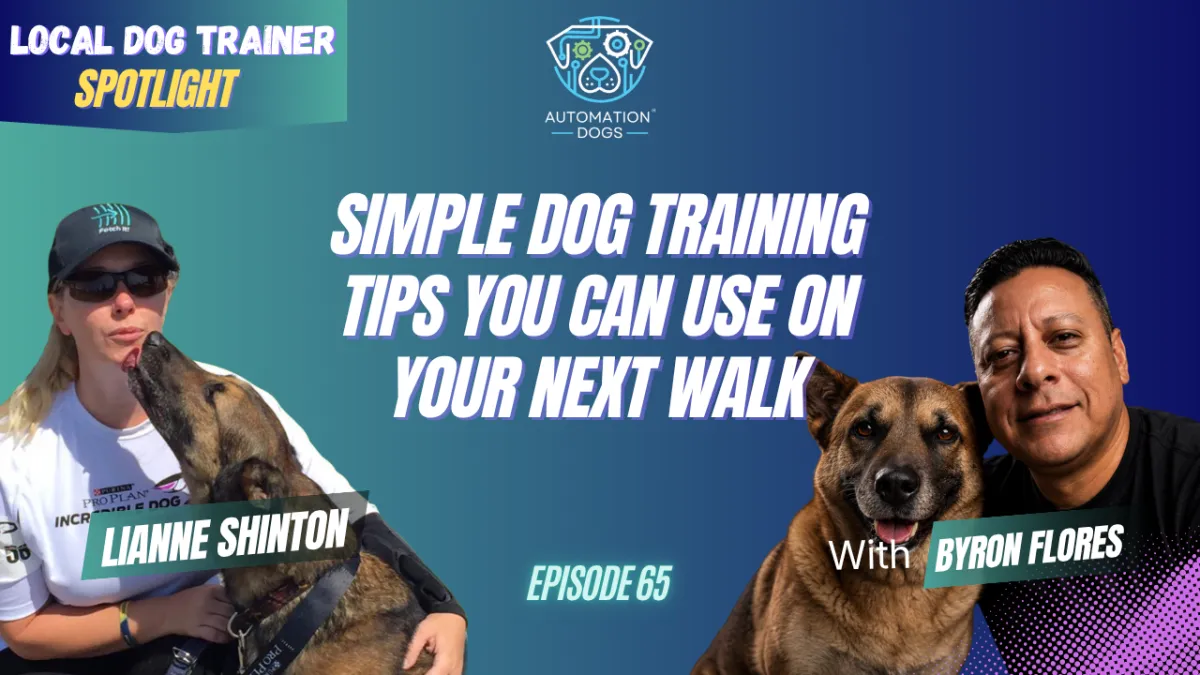
Simple Dog Training Tips You Can Use on Your Next Walk with Byron Flores
June 25, 2026
64 min
Automation Dogs Podcast
About this episode
In this episode of my Local Trainer Spotlight Series on the Automation Dogs Podcast, I sit down with Byron from K9 Training with Byron for a conversation that every dog owner can benefit from. We talk about Byron's journey, his dog training business, and, most importantly, the practical ways he helps people build better relationships with their dogs.
What I really enjoy about Byron is that his focus isn't just on training dogs, it's helping owners understand their dogs and showing them how to make training a natural part of everyday life. His approach is simple, practical, and easy to implement, which makes it much more likely to stick. His passion for both people and dogs comes through in every part of this conversation.
Let’s Build Your Growth Plan
Automation Dogs isn’t just software — it’s a sales growth system backed by strategy, coaching, and support.
On your free Strategy Call, we’ll:
Pinpoint where your leads are slipping through the cracks
Show you how to fix your follow-up and close more clients
Map out a simple, proven plan to grow your business
Every dog training business is different — this call ensures the strategy fits your business, not a generic template.
If it’s a fit, we’ll show you exactly how we’d implement this for you.
If not, you’ll still leave with clarity on what’s holding your sales back.
Full conversation
Transcript
Lianne Shinton (00:01)
Hi everybody, so I'm Leanne Shinton from Automation Dogs. Welcome to my podcast. today I have the privilege of interviewing Byron Flores from Canine Training with Byron. Hi Byron.
Byron Flores (00:14)
Hi, Lin. Hi, hi. It's thank you for having me here. It's a pleasure. It's you're a phenomenal human being in my you know my book. I've gotten to get to know you. We have a few conversations and ⁓ it is a privilege to be on your podcast, Leanne. And I'm really, really grateful for this opportunity to speak with you and also to your audience and to the audience b beyond. ⁓ give you guys some information and help if if anything, the information that ⁓ that I'll give possibly will help a lot of people.
Lianne Shinton (00:43)
Yeah, and that's why I wanted to have you on because when we were talking, you shared some perspectives that I think dog owners can really benefit from, and also some dog trainers too. And and I only have a select few on my podcast, a select few dog trainers. So I'm privileged to have you here joining us. And I think you're gonna bring a lot of value to helping other people.
So maybe before we dig into some tips and ⁓ information to help folks on their dog training, could you share a little bit about how you decided to be a dog trainer?
Byron Flores (01:23)
Absolutely, absolutely. Yeah. So, you know, many of us in our in our in our journey of life, we encounter situations that we don't know where it's gonna take us, right? Things started develop in my end. So I come from a background of ⁓ the pharmaceutical industry, marketing advertising. So I worked there for many years and be previous to that I was in a an academic publishing company that I worked for.
So it kind of set me up to move forward and I got headhunted and I started working in the pharmaceutical industry. However, with a period of time working there and learning a lot of phenomenal things, and ⁓ I understood that there that there's more of me than just to be in these and these big branded pharmaceutical places that I work for. Last position that I held was I I worked for the for the receiving department.
I worked directly with the FDA with F and I worked I was employed by Pfizer. And during that period of time, I I I was dating I had a girlfriend back then and ⁓ she started dog walking and ⁓ she started bringing the dogs over to my place and the dogs are really drawn to me. And I just started helping her walk dogs and being in the industry of ab marketing advertising in the ⁓ pharmaceutical industry is just it gets it burns you out.
So I got burned down and I decided to leave that. And I and me and and my ex-referend Laura, we decided to open up a dog walking business. And during that period of time, I remember National Geographic had Cesar Milan on that. And ⁓ he was very educational, he very opened. ⁓ you know, there's a lot of everybody has their opinion, but I take what it's good for me, you know, and and and the connection that I had and I understood and and I just started it on
Trying to understand what 'cause Lord starting a dog walking business, I wanted to have an understanding a a context. Like I need context. I need to understand what's w you know, 'cause I grew up with dogs, but here in America is way different. So that's where my journey began and we started taking the the the difficult dogs that other dog walkers didn't want to take. So these dogs were reactive or they were dog aggressive or they were nippers. And and you know, and that that that's that's
That's where we came in and we took these dogs. But when I started taking these dogs and started taking them out, you know, I started using a pro started just working with with ⁓ with a slip lead. A lot of these dogs, that's that was my go-to tool that, you know, and it still is like a slip lead. And ⁓ just getting to know the dog, walking the dogs, and then there will be times where the dog owners would be on the app driving by the avenue and they will like slow down and they will see this these this dog that hated other dogs.
With like three or four of the dogs just walking peacefully. They couldn't believe this. And ⁓ so then that's where I think started clicking for me. And I was like, I need to understand a little bit more of the dog world. I need to get educated. And then we had this client that she was volunteering at a sh at a dog shelter locally here in Bloomfield, in Bloomfield, New Jersey. That's where I'm from. I'm from New Jersey. And and she decided to adopt a dog and she already had two staffies.
So she decided to get another dystaffia blue nose and introduced it to her family. And it was just a short period of time that she had sent out ⁓ back then just the the the iPhone just came about and you were able to text and send photos. And then we received this message, and then when the photo of Hank, his name was Hank, popped up, I was like, wow, what a beautiful dog! Because she was a photographer, she took an amazing photo of Hank. And then I said to Laura, hey, you see this dog here? That's gonna be my dog.
Just like that, it came out intuitively. A month later, ⁓ the there was some situations that the dogs got into some serious fights and the dogs ended up in the ER with draining tubes. Very, very there was a lot of things that were done at her wrong done at her end. She didn't know any better, you know? And this isn't not to blame the human. So she put up another she sent out another message if anybody's interested in adopting this dog. So you know, I was I raised my hand and I got in contact with her and I was like, hey.
How you doing? ⁓ just gonna come by and you know, gonna take the dog. I I and ⁓ so the day the night that I went there, they were he she kept them in in her office separate from the rest of the dogs. I got there and then the and Hank was just barking and barking, and she was like, my gosh, you'll let him out. I'm like, Yeah, just let him out, it's not a problem. So when he came out, he she had some some treats on the counter in the kitchen. Before he came to me, he just stopped over. He's like, These are the things that he does.
He countersurfed too, and I'm like, that's okay. You know so he came over and he came over and put his paws on my lap, looked at me, licked my face, and I just said to him, Ready to go home. His tail just wagged. And that's where really, really things really got more serious for me in this journey. And little did I know, ⁓ his background, he was found, I think ⁓ he was backyard bred locally, and ⁓ they starved him.
And he was emanciated really bad. He had a lot of missing of his coat. So he was kind of sick. ⁓ so my journey from there, also because I'm into health and nutrition, I also wanted to t to get into like get an understanding of what really dogs what is the best nutrition value for them and how do I help this dog. So I brought him to Low Covet and ⁓ holistic, and that's where I started learning from Dr. Bukov about
health lo and health and nutrition and supplements for dogs and Hank was the excellent candidate. So that's where I started combining health and nutrition and also with the things just taking out for walks, fulfilling fulfilling the dog, playing playing with him. I just I just didn't we just enjoy ourselves. And that started like really like I I didn't know back then that I was just like playing with him, doing things with him, bringing him along, started introducing him to other dogs and making him part of a pack and my clients
You know, I had this huge pack of dogs that I would go pick him up and he became part of that. And and that's where like literally you start asking yourself, ⁓ what else is there? What else do I do from here? So that's when ⁓ there was I I got an email somehow, I don't remember like where I I dropped my email, then I got I got a reply and ⁓ Caesar was coming to New York City and I got to meet him there and ⁓ spoke to him about my dog.
Lianne Shinton (07:39)
Wow.
Byron Flores (08:03)
And I met his his back then he was married, he has he had his child his kid with him, his youngest, Calvin, and ⁓ he said that he was developing ⁓ a ranch California in LA. And he said, you know, once that's done, I will send you an email so you can come and learn. So in February of twenty thirteen, I went out to his camp and literally ⁓ I went out there and very, very important things for me, this was like learning about my own self.
Lianne Shinton (08:22)
Nice.
Byron Flores (08:33)
And how my mind, my feelings, my my stories that I would tell myself would affect my connection with the dog, would affect me when I'm walking the dog. So it it it started getting really in depth, and it made a lot of sense because when I was back in college, I took a lot of psychology dogs and ⁓ psychology courses, and I was able to relate a lot of you know this the stuff that I had in my background. So with him, I learned a lot about myself, and with Sherry Lucas was there and Brian Agnew.
I learned more about dogs about using tools appropriately, using e-collars, using a slippy properly, ⁓ temperament, how to approach a dog, ⁓ reading body language. So these these were fundamentals that I really, really like I I I've submerged myself in and I started learning a lot of just because I have a dog back home that he needs help and I need to get him into a better state of mind, and I want him to become my helper dog. And that
That's the journey I was ready deep in and and a and continue. And not only that, but then there were other dog trainers that are phenomenal, like and that I went up to upstate New York and that's where I met Josh Moran. He's known as the barefoot dog trainer. ⁓ Blake Rodriguez from New York City and the East Coast, but now he's down in Florida. ⁓ Tyler Tyler ⁓ mu Muto. Yes.
Lianne Shinton (09:51)
Muto, yes.
Byron Flores (09:53)
Him, just phenomenal people that just I just believe God put them in my life, just for me to be able to really grasp and understand if I'm gonna help dogs and people, I need to get a better understanding. So that's what really ⁓ put these tools under on my belt, and this is what really has built me up to be able to be successful and be able to help dogs and most importantly the human, the owners. You know, for me has come down to the point that being a dog trainer, it's mostly him helping the human.
Helping the human understand things with clarity. Most importantly, I like to help them when we start, I like to build a bridge of communication and just shorten that gap, right? Because they don't know any better. So we use the market training system to be able to build these cues, to you know, and and just be able to to to have this conversation with the dog. But most importantly, and it's just like also the tools that you use, it's also a brid it's a bridge of communication because when you put a
a leash collar a a leash and a collar or a slip lead, you know, you're still gonna have these conversations with your dog. And I remember Tyler, he ⁓ put out I remember he put out a video about leash conversation and it was just phenomenal. It's just like, yeah, it's just like everything started to flow, everything to I you know, and these are the things that I like to use when I'm working with a dog and a cu and and the owner.
And that's where everything starts to open up. And most importantly, I like to tap into the owner's conscience, right? I want them to be conscientious with what you're doing with the dog. Most importantly, I you're not allowed to use the phone with me. You gotta put your phone away, you gotta ⁓ put it on like on ⁓ on airplane mode. I want you to focus on me because the things that I start seeing, the things that I start I start pointing out in our surround surrounding when we're doing when when we're doing when we're doing work.
Lianne Shinton (11:23)
Yes.
Byron Flores (11:40)
is very important because when I start tapping in, I start I start tapping into the human, I'm making them self aware and I'm gonna make their life so much easier. Right? Most of and then we drop into leash mechanics. You gotta know how to teach these things to the owner. They gotta know how to posture their body. They know how to gotta know how to communicate appropriately with the leash because that's very important.
You know, then you can move on and scale up into retractable issues, whatever you want to do. But what I know nowadays is a lot of people, you know, they don't know any better. These right it's through perception. And you see them a lot with harnesses. They graduate the dog, they give them this driver's license, but they don't know how to drive. So that's where we come in and we have to be more we have to okay, great. We can use that. That's gonna be the graduation. That's that's for graduation. But let's go through the course first, so then we we're able to give the dog the diploma and you.
and you have a better understanding of how tools really work.
Lianne Shinton (12:37)
Let's dive into one topic there. Cause thank you for sharing. I love that story and how you were open enough to see hey, dogs are gonna be my future. Dogs are cool. I just love that story and how you got to meet Caesar and he invited you out. That's so wonderful. But while you're on the topic of the communication and the phones, let's talk a little bit about some maybe some bad habits that pet owners might be in at home.
right now with their dog when they're out there walking and they're checking their phone.
Byron Flores (13:11)
Yes. So a few days ago I had a lesson and I'm working with this young lady. She's from Georgia City. ⁓ literally like a few miles across the river from Manhattan. She lives over there. And ⁓ she adopted a dog, never owned a dog in her life, but she loves dogs and her family her dad is is a big time dogs. Her mom, she never owned a dog, so but but her I'd say her granddog, as I called her, she w she's
She she now loves the dog, right? Because they they've seen the transformation. So she's who's been doing like about six lessons so far, and she just wants to keep going because she just fell in off, fell in love with the things that we're doing and the transformation. And she she's just really, really opened up. I opened her up to so many things and she doesn't want to stop there. Now we're in the now we're, you know, going into doing some tricks, getting the dog to weep through your legs, calling the dog, putting the dog on a position. ⁓ so
So we she we're moving ahead and she's just having a good time and her dog just has transformed. While we were walking, right? Because when we meet, I want to see them in action. I'm just a stranger there. I want to see how you're doing. So I'm able to get a full picture of your progress and your dog's progress. So like that, I have a more understanding of what we need for the day and what how we're gonna link that new lesson with all the other lessons that are behind. So there was a gentleman coming down on the opposite of us when we were in the park.
And he had a beautiful dog on the harness. He was the dog was walking calmly. But as we were getting closer, right, I noticed that the dog tensed up, started getting tensed. And the gentleman was on his phone, right? And the phone here, and the leash here. And the dog was just guiding him. So some of the looked at me. I'm like, I'm like, yeah, I see that. I'm like, so so you know they do their lessons. I give you good instructions. You know what you got to do.
She's like, but she wasn't sure because she she started getting a little nervous. So okay, I was like, all right. So I was like, here, take my dog. I got let me get your dog. Cher her name is Cherry. So it's a it's a little bully breed mix with black lap. So as he started approaching, we get we started getting closer. I started reading him and her and his dog, and he that the dog started putting closer, pulling and pulling more, and and and I saw that he was getting a little intense.
As I was passing by, he launched at me and and and and Cherry. So Cherry has changed and dropped those bad habits. But Cherry kind of responded, but at the moment that we were using the psychic, just a little pressure, just shut that down really quick. You know, she settled down and we just kept walking, and he just kept walking. But but the owner, she was like, she took a breath, she's like, my God. She's like, she hasn't done that in a while. I was Yeah, I said it's but.
But I said, this is a great lesson. This is perfect. I want to see these are the things that are gonna happen. And with time, it's gonna go away. Even if the dog passes by and launches, the dog is just gonna take a look and just keep moving forward. The thing is, like you can't get tense. You know what you have to do. So that's where the leash mechanics come in handy. That's where the respect and the love comes in when you're paying attention to your dog rather than on your phone. Because he all this could have been avoided at his end, right? If he he already knew, my dog is pulling me.
Lianne Shinton (16:26)
Mm-hmm.
Byron Flores (16:31)
Let me move him on the outside and I stay in the inside. But he didn't even move his dog. Right. But there was a lot of enough space to for people to pass through, even runners and and and joggers and people on on on skateboards. Like people just pass by, zoom by, not a problem. But so that was for me that was so so great to see where we are. And I was just okay, I gotta do a little bit more work with you with the own with the handler. That's a more of a handler situation. I was just like, we can't panic.
Lianne Shinton (16:36)
Yeah.
Byron Flores (16:58)
Because the moment that you panic, also the dog is gonna feel that because dogs feel that, you know, they smelled it right away. So they feel like, okay, you if you don't have this, I don't believe, I truly don't believe you are in control of the situation. So I'm gonna help. We cannot let that get to that point. We have to really, really give the dog context. Because dogs are brilliant, you know, phenomenal. When you give your dog a lot of context, the dog understands. Dog's like, yeah, okay, I got you got this. I'm not probably just gonna keep going.
And that's that's the goal. That's that's the goal. And the more we do this continuously, right over and over, repetitively, guess what? We just cut and paste. We cut the bad behavior and boom, we paste it in the new behavior. This is the new you. The old you is forgotten. And that's where the magic happens.
Lianne Shinton (17:46)
I like how you said that. That was cool. I wish we could do that for like other areas of our life too. Like, don't eat all that food. Go work out. Paste in the new me. ⁓ That was a the cool thing you said. I see it here all the time when I walk my dog and I'm walking around the lake and there's geese and the geese have babies. And I'm looking and I'm like, this is so beautiful. And I see everybody's on their phone with or without their dog. There's just everybody's on their phone nowadays and it's
Just doom scrolling. I I don't know how I could walk and check my phone and walk my dog, like, wow. And the other day we saw some fella and he had the pit bull breed and checking his phone and you could just see the dogs starting to eyeball the geese and the little babies. And you know, he just I we had to go the other way because we were gonna say something, just running these geese out and the guy's just still on his phone getting dragged around. But it's just such a disrespect to the dog.
Byron Flores (18:31)
Well.
Yeah, but so let's let's let's let's let's let's let's use this analogy. So can you imagine if you are out walking in a beautiful day with your date and all of a sudden you decide to pop up your phone because later on you're gonna go you're gonna go watch the Knicks and the Spurs and the Spurs play the pla in the finals and your friends are texting you, hey, psyching you out, and you're holding hands with your date.
Lianne Shinton (18:45)
And that
Byron Flores (19:15)
And all of a sudden it's just like, man, I need to get to that bar soon. You start dragging your date. Your date's gonna pull her hand off and probably yell and you be like, Hey, you are so disrespectful. Why are you on your phone? Why are you stopped talking to me? And all of a sudden you're all about your phone. So yeah, it's like this is us, this is the us time. This is the time that we we talk about things, we put things in perspective.
Lianne Shinton (19:35)
Yeah, this is your time together.
Byron Flores (19:44)
We have plans to move in together. And this right here is making me think that I don't know if you're really ready because you're ignoring me. You're I I have to be your priority. The priority when we're handling our dogs, that's our time. That's their time. It's our time. And that's that's where you really grow and where you really develop. You know, and literally when you get dogs with issues, and when we start working on a professional dog trainer and they start helping you and you start putting in the work.
Lianne Shinton (19:58)
Mm-hmm. Yes.
Byron Flores (20:12)
You s that's the magical that's the magical kingdom that you're walking into. That's where things get erased. That's when things start really happening, you know. And then you're just gonna come home so psyched and you're gonna text your your your doctor, Hey, I it was such a great walk. I did what you told me and and I was paying attention to my dog. I was so aware of my surroundings, I was aware of the people walking their dogs, and and then and that's that's that that's really our then you did your job, right? That's when we're like, Yeah, did my job. I'm so happy. She's
Lianne Shinton (20:40)
Yeah.
Byron Flores (20:42)
Things are clicking. And really that's what puts you ahead of the game. And that's what really I think you get those recommendations because you make people feel safe. You you empowered. You are coaching. That's our job, right? Clear communication, examples, samples. Show them the body language, show them how to handle the leash. Call it out when they're not really focused on the lead, they're not focusing on the leash handle.
Right, because we at first like handling a leash is like riding a bicycle and we have to show them how hold the leash. You know, once these things start disappearing, then you can just one hand walk, a lot of slack. You're and the dog is making contact with you, walking happy. Hey, this is great. I'm feeling good. You're feeling good. Yeah, me too. Yeah. And that's that's literally that's what we want on the walks. You know, that's what we really want. We want to enjoy that moment because dogs don't have a long lifespan.
Lianne Shinton (21:34)
Yes.
Byron Flores (21:39)
And the period of time that they're here to help us and to be partners with us and to be our best friend, it's not that long. It flies by, time flies r by and and and all you're gonna have left are memories.
Lianne Shinton (21:52)
Yeah, it it's kind of making me think too, because you mentioned, you know, you're into health and things like that. Like if you're at the gym and you're working out, but you're really just checking your phone, those repetitions are basically useless. And every time you walk your dog, you're getting out there, you're getting in this repetition, this walk with your dog, but you you're not putting in 10% maybe effort to just hold the leash.
You're missing all those little things like the ears come up, the body changes. You missed it because you're over here on your phone and it's it's just not good quality work.
Byron Flores (22:27)
Yeah, and I think that also kind of like builds frustration because the handler gets frustrated. ⁓ you're doing this, this again, it's just like, well, well, you're not paying attention to me. I'm in my own world, you're in your own world, and and this is this is the result. You know, and that's why also it's very important, like the things that we do outside, it always has to have a context, and the context is indoors, right? When I go in people's homes, there's gonna be times that I'm gonna ask you to tether your dog.
Lianne Shinton (22:39)
Yeah.
Byron Flores (22:55)
Because it's just much easier to help your dog. Right? We gotta give them context. Like if you're working on your dog and we're using the place cue or we're just holding it there. You know, but we want the dog to have freedom. It's not about imprisoning. Many people use the the place command ⁓ in like an imprisonment, an encampment, like you don't move from there. Like, no, the dog's allowed to move. It's just like you just gotta let them know if he's if my wife if I had a wife and she was cooking and all of a sudden
I'm just where we just came back from a walk and and then he wants to go sneak over there and start like, you know, because dogs are very smart. They'll come and they'll push their cold nose into you and be like, Hey, you got anything for me? And and then and then you're f you're you're using the stir fry. You're like, Hey Byron, can you can you handle this? And I'm like, and then that's when you just call your dog, Hey, like, hey, Kahlua, over here, go to place, stay down, girlfriend. You know what I mean? So it's just like we ha everything that we do with dogs, it has to be done in a way that it makes sense.
It's not restriction. It's not boot camp. It's part of life, but we have to show the dogs. We can't just have an expectation that, ⁓ he'll figure it out, she'll figure it out. It doesn't work like that.
Lianne Shinton (24:05)
And like you said earlier, you take away one behavior, we're replace it with another good behavior. For you know, the situation that you just described in the kitchen, we're gonna take away the bad behavior, we're gonna replace it with the good behavior of putting them on their place. Maybe the humans also need to take away that behavior of scrolling on my phone while I'm walking my dog, ⁓ or driving my car and
create a new behavior of I put my phone in my pocket and I don't touch it while we're on that walk and I focus on my dog or focus on my driving, for example.
Byron Flores (24:42)
Yeah, and and and it's be you know the thing about I'm glad that you mentioned that because when we start working on the out on the outside, I usually ask them, I'm like, okay, so here are the rules. I give the human the rules, right? Rule number one, no phone, no communication. Unless you're a doctor ⁓ and you got a nine one one call from the hospital, that's an exception. Unless you have some kind of you gotta put out some fires or something. But you know, it's our time of I want you to develop. I want us to be successful. The goals that we have that we place that you have
And we're working together to making these goals happen. Let's make them happen and but let's do it the right way. So that's where like no phone, pay attention and and it's like the only phone that I probably that that's gonna be used is gonna be my home because I'm probably gonna be recording it and I'm gonna send you the video of what you're doing. So you you keep this in mind how beautiful the work that we're doing. So you look at this, you inspire yourself before you go on a walk and and and and and you start seeing the changes. And that's why for me personally it's like I need to tap into the human.
Right? Because w those habits that you you have, you they're gonna start going away with me. I'm gonna I'm gonna I'm gonna be like, hey, remember, this is what we're doing. This is what we're doing. You know, you have to be mindful of yourself. And that's the the that's that's that's part that's part of coaching. That's part of coaching. It's just not the the you know, the the markers and the cues and the practice and this and no, it's more so the humans more important because they're the driver behind that.
Lianne Shinton (25:49)
Mm.
Byron Flores (26:10)
You know, and we need to have power steering. We gotta know how to use power steering correctly, smoothly, be able to make a turn, be able to bubble out of situations. If the if you see the dog, your dog is getting a high stress and you start feeling distressed because there's a group of people and they're all walking their little yappers and they're all yuck and they're all barking and barking and barking and nothing's being done because the people are just talking and their dogs are doing their own thing. So what you gotta do? We have to be very smart. We have to be in this this situation. What I would do and I do it.
I just bubble out of that situation, give them space, give myself space, bring down the intensity, the level, the cortisol level, don't let it escalate. Rather, I want the dopamine. I want to change, you know, that I want to I want it to be fun. I want it to be good. I want the dog to feel good. You know, I don't want my dog to be under that hormone stressor, that ⁓ no, we're just have these that's where we come in. That this is where we come and teach. Learn to bubble out of the situation and come back in. Just give yourself space, give them space.
You know, it's just like there's no need for me to be, hey, ⁓ pay attention to the dogs. No, I'm not there to be for I'm not there for that. I'm here for you. I'm here for my dog, and I'm just gonna be the wise, you know, the the person that's more intelligent and just s go around. That's it. Simple things like that give you give gives also the dog a better context, a better perspective of how things are done, and the es you the escalating and you giving the dog a better choice, right? And and at some point.
Lianne Shinton (27:13)
Yeah.
Byron Flores (27:37)
When you run into a situation like that again, the dog is gonna do one of these. Like, hey, you you already see that over there, you know what we gotta do, right? And that's the communication, that's being that's what I like to tap into the human. Hey, this is being conscious. Now, watch how your dog starts reading you. Next, the beautiful thing now is like when you s the dog starts walking in, now it's always checking in with you. It's always like, Are we doing good? Yeah. And that's that's the beauty of really when you give good instruction to the human, good teaching.
Lianne Shinton (27:45)
Yeah.
Byron Flores (28:07)
And also you handling the dog, me doing it hands-on first, then giving it to you, and we and that's through practice. And and and really the practice is what's gonna help the human because we're not trying to convert a hu a dog owner into becoming a dog trainer. No, we're there to make the life, the life of the dog, the life of the human pleasant. The goal is pleasant, happy, and joyful. You know, they go out happy, they come back home happy rather than going out.
Making this a frustrating situation and coming home pissed off.
Lianne Shinton (28:39)
And I like that you you use the word de-escalating. And I have to encounter other dogs all the time where I just don't like the way they're looking at my my flirty. And you know, I don't want her in that situation. I'm fine to give a little bit of space, but I'm also thinking 10 steps ahead. Is that dog going to slip that harness and be loose and come after my precious angel? And now what do I do? And I'm thinking those 10 steps ahead.
I'd rather just de-escalate, give everybody some space, get out of their threshold, and ⁓ yeah, set everybody up for a as much of a positive experience as it can be, because we can't control those other people and their dogs.
Byron Flores (29:22)
Yes,
a hundred percent. And you know the thing about that you just mentioned it's so important is that ⁓ using backup backup collars, whether it's on a slip, whether it's just on a flat collar or whatever or a pinch collar or even if your dog is on a harness, you need to back that up. Because anything can happen. Anything. It's a catch twenty two, you know, and ⁓ dog your dog get hit by a car. If it slips out of that, freaks out of noise.
Lianne Shinton (29:31)
Mm-hmm.
Byron Flores (29:51)
Or something happens or the dog slips out and go out goes and wants to chew on another dog. And you know, those the we don't want to go on that route. So therefore for me, I also like to very important for me as as a precaution and also a safety ha habit that I like to let them know is like I I introduced back up a backup. Just back it up to your flat collar. Whatever you just back it up because dogs if especially if you're working with a reactive dog and then and depending on the intensity.
they also try they shake their head, they try to get out of that that they don't want to be in control and they want to do their thing and that's where we have to at times use a little bit of defensive handling just to s a de escalate that and bring the dog back into calmness. You know? So but there are times that ⁓ people have lost their pets also, have taken off because of a loud sound. They've no backup came off the harness and see ya. You know, and that's very detrimental.
Lianne Shinton (30:46)
Yeah, I used to work in emergency, animal emergency and July fourth, the next day, like that night, and the next day it was just people bringing in these stray dogs that hopped a fence or whatnot, because they behave differently in a fear state. Just like I would behave differently in a fear state. Like when I have to deal with heights, I'm like I I can't even barely walk. Like my legs just turn into jello and like things are different ⁓ than normal state. So I I really think that's such great advice.
And maybe folks may think, well, my dog's never pulled out of the harness. ⁓ but maybe just pointing that question at yourself, can you ever think of a time where they would have pulled out of the harness if they could have or they tried to? And if that is something that's ever happened, it could happen. They could get away, have that extra safety. Maybe it's a slip leash, or they have clips where you could clip the harness to the flat collar.
So you have something else in place there.
Byron Flores (31:46)
Yeah.
Yeah, yeah, it's that's that's very, very ⁓ I think is a safe safety precaution. Like, my dog's never gonna do that. We can't never don't say never. There's always a chance that that can happen. You know, a loud noise, a loud bang, you're walking, and you know, you're walking, all of a sudden maybe ⁓ s somebody's pulling out that's parking, somebody's not is on their phone and crashes into the car that's pulling out, that's a loud bang.
You you know, you're gonna jump like you're gonna jump from like you're gonna get startled, your dog is gonna get startled. And that's might be the opportunity the dog takes off. And maybe I know a lot of people that they use flat colours when they're walking their dog as well, and I and they're not really fitted really well. You can see them hanging and it's just like that concern that's concerning. 'Cause them like I I I I know people have lost dogs for days and eventually have found them and thank god that they got that lucky, but not many people are that lucky. They when your dog is gone.
It's gone. ⁓ you know, and and another thing is just what people have the bad habit is leaving dogs unattended and in in their backyard. And you know, in your backyard you have birds, you have squirrels that come by and they want to entertain themselves, maybe they want to chase it. And and if you have a a a young dog, and depending on the breeding, I know man many dogs love squirrels. They kind of squirrels are very smart, they entice, they communicate to them, you know, and it's just like and I've seen dogs, like you said, jump a fence.
end up down the road, you know, like or in somebody's backyard. And ⁓ and I had a client that Bu his n the dog was a chocolate lab. His name was Buzz. And she also had ⁓ she had the electric fence and she used to leave the dog unattended. And I used to tell her I used to be like don't leave your dog unattended because Buzz loves birds and he wants to retrieve them wherever they go and he wants to chase squirrels. And you know, little you know one day I was in her area
I was actually walking one of her neighbors' dogs and and I came out and all of a sudden I hear something but behind the bushes. I'm like, is that a dog? And then Buzz comes out. I'm like, Buzz, what are you doing here? I'm like, my God. And he had his c I'm like, ⁓ man. And I and I was just I I I brought him back home and I was like, ⁓ ding done. ⁓ we did talk about this. I just found your dog by the park. It came out of the bushes.
I'm like, you know, something can happen to him. You could get bit by a car. Yeah, you could you're on a main road. So she was like, my gosh, I'm so embarrassed by her. I'm like, Well, just you know, this is a bad habit. I said, Don't leave him on attendant, because you know, and ⁓ but that was a learning experience for me. But it was it was kind of a funny thing just to see Buzz because he was a really goofy, funny dog, like in the sense of like he was such a sweet dog, very intelligent, but he had this thing, he was escape artist. And
Lianne Shinton (34:13)
Yeah.
Byron Flores (34:38)
Her fence wasn't high enough and the electron fence he he and he had the electric the electric shot collar on them. He just blew right through that. And and you know, and I found them and I was like, Wow. So
Lianne Shinton (34:47)
Yeah.
Wow, lucky
you were there. And you know, I I've had had this advice before when us as dog trainers ask clients, potential clients, like, hey, has your dog ever escaped before? They may think, No, no, no, he's never escaped. But if you ask the question a little bit differently, can you think of a time where your dog almost escaped or escaped? Because maybe the dog ran out that front door.
And you tackled him and you got him back in. So he didn't technically escape. So it might not come to mind. But just as dog trainers asking, hey, can you think of a time where your dog almost escaped or where you were out with your dog and you thought, hey, if he got away right now, he probably wouldn't come back. Maybe the thunder or the loud noises. And I think it's good for dog trainers to ask those types of questions, but also for owners that might be listening to turn that question on themselves.
And make sure they share that information. Like when I drop my Belgian Malinois Extreme Vertical World Champion off at the vet, I tell him he can hop right out of your kennels. no, our kennels are 12 feet high. No problem. He can hop right out of your kennels and he will just meet you in the front office while you're having your lunch. And sure enough, they call me to tell me that. I'm like, I told you to put a lid on it, but make sure you disclose this information to the poor people who are watching your dog.
like buzz so that the the pet sitter, the dog walker, the vet knows and then you don't end up in a sticky situation like that where something bad could happen.
Byron Flores (36:25)
Yeah. And it's funny because ⁓ her neighbor when they told me a story that she found Buzz by the pond swimming. Like going It's like she's like, is that Buzz? I was like and she called Buzz and 'cause Buzz has such a great recall. He was literally you know, he was retreat he wanted to retrieve some bird from the pond.
You know, and she called them and she had to place that call and she's like, Hey, I got your dog here, he's at the pond swimming. Like, ⁓ buzz again. But you know, this is bef this is that was that time, this is before I found him again. Like by the bushes, he just popped out and with a smile, you know. He we you know dogs, they come at like with a cool smile. I was like, Well, he's and he's smiling at me, I'm like, Hey Buzz, that's you. It was so funny, you know, but these are the kind of things and thank God like
Lianne Shinton (36:58)
That's a question.
Ha ha ha.
Byron Flores (37:19)
These are experiences versus, you know, you find your dead dog on on the side of the road. You know, and ⁓ and that's why you have to be careful kinda the dog the kind of dogs that you get as well. And, you know, if you're gonna get a retriever, they're smart dogs and you know, they always want to dogs have their own in their own mind. They want to experience the world their their way. That's why it's so important for us to experience it with them and show them. Give the context, give it to them, create those thresholds for them, create the you know, it's like
How far you can go? How if you if you want to run them off leash, you know, get an e-collar. That's that's that's your insurance policy. An e-collar is your insurance policy. Make sure you know how to use it properly. It's not to light up a dog. That's that's you know, that's one of the things that I don't advertise. It's just because ⁓ I get calls and people just wanna ⁓ use e I was like, I have my dog a knee collar and it's very s you know, my dog has anxiety and I've been using knee collar. I'm like, how do you think, how is that helping the dog out? I said,
Do me a favor, take that off. Don't use that. That's not that's not for a situation of str stress, for anxiety that your dog is going through. So there's something going on that maybe your dog doesn't need that. We can use more, something better. Maybe I I can help you I can help you. I could do a consultation. Come and look at your dog and see what's going on. So, you know, and it that's that's one thing is just like ⁓ the way I remember ⁓ and and I think some of these big platforms, these stores that they sell
like Amazon and and ⁓ and and these other big platforms are selling these collars and it's just like those are na those are they they come they're they're they come from China and no you don't want to use that and first of all that's a language that needs to be layered that's not you just don't put a collar on and start zapping a dog. No no no no that's a language we have to teach the dog. We have to you know transfer everything from s from from from a regular collar whatever you've been using it has to be layered into the dog.
Everything is a process. You you can't just have the expectation, I can use this tool and the dog the dog the dog gets it. Really? Yeah, the dog will get it, but you have to teach them step A, B, C, D, E, and you keep going down. And and then when you get to the final lesson, it's like then you will see the results. So so for me, yeah, definitely. I love I love e-collars, they're great. You gotta know how to use them properly, humanely, with with kindness. And you also have to that's another language that you have to teach that to the to the handler, right?
'Cause they're they're fantastic tools. You people love going on hikes, especially summers here. People want to take their dogs for hikes. But also when you take your dogs for hikes, well remember there's a lot of there's a lot of wildlife out there as well and something might come around, a beaver or, you know, deer and they wanna go and and chase it. They wanna have a little fun and and have, you know, you might wanna let your dog go. That's l as far as you I can see, but then recall your dog back.
You know, and just a little tap tap, come back, and then it's just like, okay, coming back. I know what that means. Right. So then then you create your threshold. It's it's ⁓ it's easy stuff, but you have to put in the time and you really, really like lift you have to do it. If you want this success, I like to work with people that totally are 200% down to do the work and they have fun in doing it. It's not something boring and it's not something that
You know that many people look at it a as as you be it's it's not a boot camp. It's not. It's like people call, do you offer any boot camps? I'm like, Well yeah, for humans but not for dogs.
Lianne Shinton (40:46)
Yeah,
and you mentioned too, you're you're you're getting success by putting the work in. Also, if someone's out there with their dog and they're getting those negative repetitions of he's just running after squirrels, I'm calling him, he's not listening at all. It's just reinforcing that behavior. So it makes it so that you have to work a lot harder when you're trying to change things because they've
Created this pattern of I do this, I'm addicted to this behavior. And now it's going to be even longer to get that success. So the sooner you can get started with a consultation, I think with Byron, that way you could start moving away from that like negative behavior and into closer to that success.
Byron Flores (41:35)
A hundred percent, yes. And and everything, you know, starts in a quiet place. Everything that we start because you the owner has to learn to communicate. And we have to start indoors, quietly, practicing the the the things that we want to set the dog up for success and the owner, you know, with through repetitions, through repetitions over and over, and it's not boring, and then then we take the dogs out to the big leagues and we start testing it out.
And that's where we get that constant context from them. Okay, I still need to work a little bit more in this. I need to work a little bit more on that. And then you just go back into the lab and you start doing it again, the more repetitions over and over. And then if your dog has ⁓ wants to chase squirrels, this will be the great opportunity because if you if you're 200% with your dog on the recall, as soon as you let the dog chase a little bit, right, and the the squirrel runs up the tree and it's like 300 yards from you, then you just call your dog back. The dog is like, okay, I'm coming back.
But you can also, but then you you're you you now you have the now that you're paying attention, now that the dog understands, now that your relationship with the dog is amazing and the dog believes everything that you tell your dog because you have created this relationship of kindness, of love and and and respect with the dog. That's what really for me, these are the important ingredients that we as dog trainers have to teach the owners that it's not much different than when you're hand when you're teaching your toddler things to the how to eat with a fork.
You know, how to dr how to how to how to how to use a cup, a sippy cup the right way. You know, it's it's just the same. You just have to be very patient. Don't have that expectation like the dog doesn't speak our language. There's a different species. But with patience, patience will take you very far and repetition. And and and then you have to have somebody that understands this really well, a dog trainer that's really gonna help you understand these concepts and and walk you through this journey.
And and and you're gonna enjoy doing that, that you're just gonna st be like, Wow, I I wanna hang out with you more. When when are you going out with dogs? Like, I wanna bring my dog out. Can you bring your dog? Let's go for a walk. Right? We we wanna create that environment where it's just like they're calling you, hey fire now, I'm gonna be at the park, you're gonna be around, like I wanna I wanna go ahead and go on a nice walk and I want I want you to see what we've been working on, I wanna see the progress, I want you to see like that's that's
Lianne Shinton (43:49)
Love it.
Byron Flores (43:52)
That's a beautiful thing because yeah, I you know, I I want to take my dog out as well. I want her to enjoy the outdoors too. And she not only that, she gets to meet these dogs and she knows them, you know, right away. And I also one thing that I love to use my dog at times is just with these reactive dogs because she knows how to communicate with me when the dog is is is getting better. Whenever she sees a dog that we're working and he's in a bad state of mind, my dog gives the dog space, she moves away. If he tries to get close,
She starts moving away from the dog. And I'm like, okay, you know, and then when we start working and we start going through these lessons, she's just like, you know, kids up close, they they kiss each other on the nose, and that kind of that they build that respect. And the owner's like, my God. I'm just like, yeah, I'm like, you know, and and and that's how it is in there when a dog is a little, when the dog is a little bit too much, too hyper, and the dog wants to say hello, and the breath coming into the into my dog's face, my dog is just like, no, I'm moving away. I don't like that.
And and then then she looks at me and she's Hey man, you gotta handle that. I don't like that. And it's just like, Okay, okay, I got it, you know. So it that's why we have our dogs too, because they're they're they're helpers, right? They they know what we're doing. They they they're riding this this this they're they're part of the journey. They're riding this this this this ride with us. And for me personally, I could speak for myself. I don't know anybody else, but this I love using my dog for certain things, especially when we're going out and use her as that thermometer for
for for for for for the that reactivity or for that aggression that is starting to to disappear on my client's dog. You know, she she would just move away. She's like, Nope, uhuh, I I don't trust him.
Lianne Shinton (45:29)
Smart dog, smart dog. Now I wanted to pivot a little bit because we have about 15 minutes left and I I know that you work with shelters and you've worked a lot with fostering dogs to place them in the right home. Could you share a little bit about that stuff?
Byron Flores (45:41)
Yes.
Whoa, a hundred percent. ⁓ man. So I worked with ⁓ the Clifton Shelter. It's a local shelter in Clifton. I worked with them. I've worked with Brick City Rescue. They're they're really well known. ⁓ for they they like to rescue bullies. Bully the bully breed from ⁓ the big shelter in Newark is one of the big shelters with this is where the dogs come from, the south, ⁓ southwest. They all they all come and get loaded there, and that's where the rest of the
small shelters go and get dogs and bring them to their shelter. So they also go and pull dogs out of that shelter. And what happens is just that ⁓ been working them with with them for years and I've been able to help a lot of the adoptees that they the adopters that adopt these dogs. And ⁓ but there's also times where I have taken dogs that have been a little bit difficult that they really cannot go into a home until I reset the dog, until I get to know the dog really well.
So I you know, I want to get as much as information and the dog comes and lives with me. So I foster the dog. So while the dog is in training, I'm also gonna have take dogs and I've kept dogs for three months at times, you know, until we find the right home. And for me that's very important because remember the dog is coming out of a shelter. We don't want the dog going back to to any shelter or the dog return. So cases like that.
Where the dog has been difficult, or ⁓ a case not so long ago, two cases that the dogs were deaf. And these dogs have spent like nine months in a shelter and nobody knew that the dog was deaf until I got to see the dog. And I'm just like, well, he's not responding. Like I think there's something not right with his hearing. So then the then they will send them to a specialist to just get tested to the veterinarian and
Make sure that the dog is deaf. And yeah, they confirmed, yeah, the dog is deaf. So for me at that time, it kind of like frustrated me and said, I'm like, how can you not know that this dog is deaf? And this beast was there, and the dog is not there when you spent with you nine months, and the dog is over a year old. And out of out of being like 12 months, nine of those months, the dog you picked them up from the street, and you didn't realize the dog was deaf. You know, and this is where like these and I and I and I tip my hat to these people that ⁓ these groups of people that take these dogs from shelters.
and try to do right. But we we need we need more fosterers, you know, people to foster these dogs. We need that. The the the shelters are full and I have a big heart. And and and not only that, it it it it it's just that the experience that these these dogs come from the shelter that they give you personally. They are so grateful. After you know after this few three days and this three weeks and then three months with you and it's just like this dog is completely transformed. We went from how he was to how he is now and
And and I and then we find them the right home and I I it's just so fulfilling for me internally. It gives me so much peace and it just gives me a lot of joy internally because it's just I feel so bad. I don't know if many people have been inside these shelters. They're they're they're overcrowded, very loud. A lot of these shelters don't offer vetting for the dogs, so you don't really know what some what's wrong with some of these dogs are sick, you know, so that
Lianne Shinton (48:53)
Mm-hmm.
Byron Flores (49:01)
And you get to find out only when you pull some of these dogs out of there. And you know, and then there's so much that these small groups that can do, like Brick City, Brick Brick City Rescues. There's so many dogs that they've done that I mean they have done phenomenal work and and and and I love working with them because they're so so about the dog. They want the best for the dog. And you know how they raise money to pay for the vet bills. You know, that's not cheap. It comes out of them. It's it's a non for profit. The people are they're not profiting from this. They're they're they're trying to make
Profit to pay for the bill. You should sheet that $10,000, $20. There were at one point like $40,000 in debt and vet bills. You know, so that for me is just like, I'm gonna pitch in, I'm gonna do me, and I'm like, I got that dog. Let me get I'll foster it. I'll do my training, I I'll work with the dog, I do my thing, and then I start posting things up with the dog. This dog is it's is it's for adoption. And then you think, and then people, you know, start calling, they get interested, and they they get in contact with the organization. Environment is like, hey.
They're gonna call you, let me know what you think. ⁓ I'm like, okay, I'm gonna let them know to come and check out the dog. So I wanna feel the person out and person out by the phone. So we you know, they come and check out, and then next thing you know, it's like ⁓ I had that experience with this deaf dog, Marco, like his whole family. I'm talking about mother, father, son, daughter, grandma, and grandpa came to check the dog out. I was I was like, wow. When when I got a call from concierge downstairs, like Byron, you have some visitors, and I'm like, okay, I'll be right down.
Lianne Shinton (50:20)
Nice.
Byron Flores (50:26)
already knew who they were. So I brought down the dog and I was like, my God. I was just like, which which one of you is adopting the dog? And then, you know, introduced myself. And it was like, it's me and my husband. These are my kids. This is ⁓ this is my mom. This is my dad. And it's just like right away and it's because these these these are people who love dogs. And once they hear the story behind with Marco being deaf and being at a shelter that for nine months and nobody knew that he was deaf until he was pulled out.
You know, and i it it's just beautiful, be beautiful stories that they start negative but it ha they have a happy ending and and and and a forever home for the dog. And these dogs thrive. And for me, working with these deaf dogs, you know, the the now this is a little bit more and more of of a case where now I gotta teach, you know, body language, sign language that I use with dogs to communicate with them.
You know, many people that they go into an e-collar right away and they start using, you know, not not the stem, but they start using the ⁓ the ⁓ the vibration. But I like to start first, like I always say, like for me it's always like let me just use the slip lead, let me start with these things that I know that I want to connect with the dog first. I want him to open up to me. I want him to trust me first. These are this is very important. And even when dogs go from my home to another home, I'm just like, hey, give the dog like seventy-two hours to settle in. We have to educate.
Lianne Shinton (51:26)
Vibration.
Byron Flores (51:48)
the the owners and it's like the dog might not feel comfortable at first but just just i he's gonna he's gonna he's gonna start feeling comfortable he's and certain certain dogs just go and they're like okay I know this is my home and I'm staying here and not even not even 24 hours and they're sending you a video my god look what he's doing he's hanging out with us here he's eating his food he we're enjoying the dog we're walk he walks nicely on a s on a on a on a leash he doesn't pull we love what you know and then I'm like great
You know, I'm like I I'm looking forward to doing our lesson on the weekend. And and and and that's that's the beauty about this this this career, you know, when w as a the true dog training career is just like you get to meet amazing, beautiful dogs. They have some of them that come from shelters have this horrendous story, but that's the past. We stay in the present moment. He's in safe hands. Now he has some good food, some some you know, filter water to drink. He's hanging out now with other dogs, he's in a nice place.
And and the transformation, that's what we need to do, right? The transformation of dogs, the transformation of humans. It's just that it goes hand in hand. So that's that's that's the work that I like that I do that I've learned, you know. And for me to get to this point, it's just you you you develop this by learning and learning from your mistakes. Because we make mistakes, okay? We all make mistakes and we learn from them. No matter how of an expert you are, you will make a mistake here and there and over there. But those mistakes.
Are are are valuable because that mistake is not going to happen with the other dogs that are coming in down the road. Right. But but that's part of the lesson. It's like me as a dog trainer, yeah, I I'm open to always to learn, you know, because I don't have all the answers. But I will get those answers and I will be able to deliver those answers.
Lianne Shinton (53:35)
Now, in working with the shelter and working with the the rescue, it would definitely be such a value to someone to get a dog that you've fostered because you've done the training and you really know that dog. ⁓ would you recommend if somebody is looking for to rescue a dog, that they maybe reach out to a rescue that sounds like they might know more?
About the dog versus the shelter.
Byron Flores (54:07)
Yes. ⁓ I think if some if you're looking for a dog and you go to you have to go to a really a reputable dog shelter 'cause some of these dog shelters do hire dog trainers that come and work during the day with the dogs and help them. Right. But then also you have ⁓ rescue groups that really put work in and and and and money into the dog and ⁓ and they will be able to like
to tell you to give you more of a context and understanding of what the dog wa how the dog was and how the dog is and what the dog really is all about. Right? But there's certain dogs that for some reason, ⁓ from backyard breeding, they're always get these the five weeks, they get pulled, they don't have that full that that that full socialization and and nurturing from the mom and and and the siblings that are in that, you know, they it creates an issue, behavior issues down the road that
Yeah, the dog is gonna be comfortable. And those dogs from my personal experience that have cannot be around other dogs just because they could be around humans or a cat, but with other dogs, it's just they get very uncomfortable, right? It's a fearful, it's a fear thing because they never ex had that upper experience that as and it so comes down to genetics at that point. So ⁓ but I've also seen that those dogs can hang out with a calm dog. And sometimes I've
I've seen dogs like that that have thrived and a at a home where the senior dog is a senior and it's is really calm and that dog really has has become best buddies with the dog. Like even though this dog couldn't stand other dogs, it becomes good friends with that other dog. But but it takes ⁓ a an experienced dog trainer to help you with situations like that. But for me personally, I think that to go yeah, go with with with ⁓ with a with a rescue group.
Lianne Shinton (55:51)
Definitely.
Byron Flores (55:58)
Because they will be able to give you more of a of context. And the shelter, remember, the dog is in the, you know, he's in a kennel, they take him off for walks. Some trainers will work with them, but you're not really getting that full context, that full understanding of their personality, how they really are. You know, so when they they ask, are they good with cats? We don't know. You know, we don't know if they're good with cats. Because because I have a cat in my house and I I I'm a I'm a dog person, but I
But my husband loves cats too and and I've and ⁓ now all of a sudden I love cats too. But we want to bring a dog into the house and it's just like, Hey, yeah, ⁓ I can help you with that. We c and and then the the thing about that is through training, teaching the dog, giving the dog contacts, asking you know, just teaching you have to create thresholds in your home. And eventually I've seen dogs and cats hanging out down the road. It's not a twenty four hour, forty eight hour
Think that that's going to happen like that within two days. No. It takes a little bit of time and it comes from us. I teach you the things that you need to do. You follow the protocol, you stay on the protocol, you don't experiment, don't get out of the protocol. And you will see that next thing you know, all of you are watching a movie together. The cats right there, the dogs right there, and you're all hanging out together, right? Because you did things right.
But if you're gonna go and experiment, try to do this and that, you know, now you created more work and then we'll we'll now in order for us to get to that point, we're gonna have to do more work. But it's doable. A hundred percent it's doable.
Lianne Shinton (57:33)
And I like your advice that you folks could go to a rescue and get more data about the dog. Not that you don't want to help them all, but I definitely think there is a layer of compatibility. Just like if I'm looking for a spouse, ⁓ you know, there's just certain things that are gonna match up better than maybe another. So having more data to make sure you're gonna the dog's gonna be compatible.
with your lifestyle, your family, kids, cats, all of those different variables, just to make sure it's like the perfect match. I think having more data can always help.
Byron Flores (58:15)
Hundred per yes, a hundred percent. That's why like now I realize that Marco being deaf and the whole entire family came and the whole family fell in love with him just because he's such a great normal dog, except that he was deaf. Right. But they even loved him more because of that. They were drawn to him even more because they were to see the sweetness and when I communicated with the sign language, giving him commands with through sign language.
Lianne Shinton (58:35)
Ha ha ha.
Byron Flores (58:42)
And they were like, my God, my God, you know, and it's just like, Hey, they were like, that's so easy. I'm like, Yeah. I said, It's just you're just using some signs and he understands, and this is what we worked, and you're opening the doors to his home, and he and he lives a wonderful life, you know. So he's they love him. ⁓ you know, and things come up down the road, and ⁓ I will show up at their home and then we'll just tackle a little situation here and there, and they're like, my god, we never thought about that, Byron. And I'm like, Yeah.
It's you know, it's something simple, simple simple little thing sometimes. But there you go. They're not dog trainers, right? They're dog owners, and that's why they call the the professional to help. And that's where we come and just you know, make that they happy for I I I make them happy. Yeah, yeah, here you go. This is this is what we have to do. This is it, not a problem. I'm here to help you. And and we tackle the situation and that's and and at the end of the day everyone is happy and the dog it's good.
Lianne Shinton (59:37)
Yeah, and it's simple too. I like that. Keep it simple, stupid the kiss method. And sometimes people overthink it or they just don't realize, you know, 'cause they got other stuff going on with their life. They're in chaos with taking care of the kids and everything. But hire an expert 'cause maybe, you know, someone like Byron, you can come in and just simply just resolve the situation that they didn't even think.
Byron Flores (1:00:01)
Yeah, absolutely. You know, and if any any anyone that ⁓ wanna has some goals that they want to ⁓ help their dog have a better a better relationship, you can always reach out to me through my website. It's letter K number nine. T it's all one whole word, letter K number nine, training with Byron dot com. ⁓ just reach out to me and I'll be more than happy to help you out. And you know, we c if you want to ⁓ learn how to run your dog off leash, I'm here to help you.
You want a better relationship between your dog and your cat. I'm here to help you. If you want to get your your walks better, I'm here to help you with that. Your dog is reactive. I'm here to help you with that. Your dog is human aggressive, dog aggressive, I'm here to help you with that. We we we will be able to I'll be able to help you with these situations and just get your dog into a better state of mind and and and and make them see the world differently than how the dog is the dog is seeing that world right now. We could change that up.
Lianne Shinton (1:00:56)
Awesome. Thank you for sharing that. Is there any other things you'd like to share today before we wrap up?
Byron Flores (1:01:02)
Well no, I yeah, you know, I just wanna say I wanna share with you guys that ⁓ you know, for me, I I've never owned a dog from a breeder, but the dogs that I have rescued that are my dogs have been phenomenal. Just phenomenal. They just have given me a beautiful life, you know, just how they are and and how they bec how how grateful they are. So don't be afraid to to to get in getting a dog from a shelter. You know, you're doing you you're doing a great deed, you know, but if you prefer
to get a dog from a breeder because you because you care about the genetics, make sure you find yourself a reputable a re a reputable breeder. You make making sure it's not a backyard breeder because there's a lot of that going on right now and it's hurting ⁓ the shelters. They end up in the shelter. We don't want dogs end up and ending up in the shelter. You know, so just be conscientious of that when when you want them when you're ready. And if you want me to help you find a dog
Reach out to me again. I'll be more than happy to help you find the dog that you need. Not the dog that you want, the dog that you really need for that's gonna fit your lot of stuff.
Lianne Shinton (1:02:01)
Ooh.
Yeah, well said. The dog the dog that you need, not necessarily the dog that you want. Well said.
Byron Flores (1:02:11)
Yeah. So I wanna thank you from the bottom of my heart for having me on your podcast today. Really, really grateful for this opportunity to be able to talk to you and to be able to share a little bit about who I am and the the work that I do and how I do it and and and I welcome everybody, you know, that I ⁓ I'm not racist. There's a lot of that out there. I I welcome everybody, you know, that I'm a dog person, that's our common ground right there. I love dogs, I love humans, I love helping humans.
You know, I like to service myself to others and that's what I'm here for.
Lianne Shinton (1:02:44)
Awesome. Awesome. Well, thank you so much, Byron, for joining us again, everybody. So it's canine training with Byron. Thank you, Byron. That was just such a wonderful conversation. I'm sure it will help people.
Byron Flores (1:02:56)
Thank you so much for having me. I really appreciate this. And I hope yeah, I hope this helps anybody that's that's struggling with their dog that something that you might hear here might my might hit home, you know.
Lianne Shinton (1:03:07)
Yeah.
Well, thank you everybody too for listening. Again, I'm Leanne Shinton from Automation Dogs and have a fantastic day.
Byron Flores (1:03:15)
Thank you. Have a great day.
Adam G. Katz
33:48
Yeah, so this is really cool. Copywriting, not copyright in terms of like, you know, when you write a piece of music and then you copyright the music, but writing copy is the art of writing persuasive text that persuasive words that get people to take action. And so the whole concept behind copywriting and advertising in general is that you can A -B test different words, right, to figure out what gives you the best response. So if I write one ad, as we call that, the A, and I use the word, the phrase, invest in your dog's happiness. And then I take the exact same ad with the exact same image and everything's the same, but I just changed the headline and I changed it to we can train any dog. So a recent test that I did, you know, you can run those two ads with Facebook or with Google, whatever you're using, and you can find which one gets the most clicks, which one gets the most sales just by changing. the words in one line of text, you can get three times the amount of sales or more from one versus the other. And so to me, it's still like magic. It's like, wow, I can figure this, I can figure out what words work better than other words and just by changing the words, I can make more money or I can reach more people or I can help more dog owners. It's crazy, it's like magic, right? So especially with Google Ads over the years, we were able to test and figure out and the sales letter that we used for dogproblems .com to sell the membership site, we did extensive testing with that. And so we figured out, you know, what are the money keywords? What are the keywords that get people to click and to take action? And so, and Facebook's an amazing platform for that because you can get so detailed. So it's minuscule detail. about what works and what doesn't work. So it's really pretty cool. The more you can study in master language, the better the communicator you're going to be and the better communicator you can be means that you can... You have more success with your clients, you can have more success with your love life, you can have more success with your business, with your family, with your kids. It affects everything. Like the words that you use, you know, changing, sometimes just one word can have a dramatic effect on the results that you get. And so for me, I'm very passionate about that.
Lianne Shinton
36:29
You're very passionate about this topic and I think it's something that most of us don't even think about. And nowadays I just use chat GPT and I think it's actually making me dumber. But I guess one question I had as we were starting to think about like text that's going to attract people to your business is, you know, knowing in the news, like they say, don't watch the news because the news.
Adam G. Katz
36:40
Hehehe.
Lianne Shinton
36:55
makes everybody negative. It's kind of falsified. And there's been studies that show that there's like a 63 percent higher click through rate and this and that if you're publishing negative news, if you're making people worried and stressed about tornadoes and terrorism and all that kind of stuff, people are going to watch. They're going to tune in. So I wonder. and you would probably be a good one to answer this, is there some way we could use that when we're trying to attract people without being too crass? But if we talked about like, hey, dog's getting hit by cars, you get training and you can avoid some of those things, dogs having foreign body surgery, is there something we could do kind of in the negative that would attract more people or would that maybe? get all the Karens upset and like unfollowing because we're talking about scary stuff.
Adam G. Katz
37:57
The answer is it depends. It depends on the context. So if I'm writing long copy, which is like, for example, if I push somebody to a landing page or maybe I give them a brochure, I want them to take something home and read about me or. If I'm being interviewed, like if I send out a press release, then yeah, I mean, conflict works great to get eyeballs. That's why you see so many of these Twitter threads just blow up because it's all about conflict, right? And the news, the news media loves conflict. So anytime that you can create conflict, that's a good thing for... in a certain context, right? So it depends. If I'm sending out a press release, maybe I'll invent, or not necessarily invent, but amplify or magnify a conflict that already exists. So for example, I've always been a balanced trainer, so I use tools to train dogs. I use prong collars, I use remote collars, I use choke chains, et cetera, et cetera. I use a crate. And the enemy to that are the purely positive trainers, and these are trainers who don't use any of those tools. They take a different approach, and I think that, I legitimately think it's... 90 % kind of a bullshit approach. There's maybe 10 % that is good. If you... put it in the right context, you know, puppy training stuff or certain types of temperaments, but in general, I think there's a lot of politics in dog training. And so what I'll do is I'll amplify that in the context of, you know, coming out as a white knight in my pressure releases to position myself as the person that's bringing you the real information, the actual dog training approach that's, you know, used by police dog trainers and search and rescue dog trainers and handicapped. dog trainers and stuff and isn't trying to sell you something to take advantage of you and rob you of your money, right? So there's, you're setting up a conflict there and the media loves that. The media loves if you come out and you've got an issue and you're angry about it and you're challenging about that. But I will say that in the context of your, for example, the copy, which is again the text on your website, I think there's a better approach and the better approach is simply, looking at how do you push their emotional hot buttons and talk to them in the language that they understand basically what we call enter the conversation in their mind, right? So... If you ask most of your dog training clients, before they're your dog training clients, they're just a prospect and they come to you and you say, what is it that you're looking for? And they usually have like one issue, like, he jumps up on me or he doesn't come when I call. So, okay, that's easy to fix. In general though, in addition to that, what else would really help you? And everyone pretty much says the same thing. They say, well, I just kind of want my dog to listen to me. I just want to get my dog to listen to me. Okay, so that's actually a headline that I've used. I listened to what people were saying and I used that as one of my headlines and it worked great. It's almost easy to a certain extent because what you're doing is you're listening to the language that they're using and you're entering the conversation in their head and I just want to get my dog to listen to me. And so you slap that headline on the top of your website. Here's how to get your attention. Nashville dog owners, here's how to get your dog to listen to you anywhere you go, right? And boom, it connects, they understand, you've just pushed their emotional hot button. And then the next process, of course, is using different tactics, like features and benefits, not just listing features, but also listing benefits. So the feature is you get to teach your dog to come on command. The benefit is that you never embarrass at the dog park again. You know, the feature is you get to teach the dog to lie down and stay down. The benefit is that you can take your dog with you to Starbucks and have him lie down. And when you go in to get a napkin or another bagel or something, you can come out, he's still going to be there, right? So, so features and benefits make your website more persuasive, make your advertising more persuasive. Testimonials written the right way, not the wrong way. The wrong way is, hey, Lianne's an amazing dog trainer, dot, dot, dot, Susan. L, right? And it's a picture of a dog that looks like you bought the picture from istockphoto .com. It's not credible. It doesn't persuade anybody, even if it's true, right? So what we do, we do a done for you dog training business website where we take care of all this stuff so you, the dog trainer, doesn't have to figure it out on your own. I've already A -B tested all this stuff and so we basically plugged your name and your photo and your services into my template that I've created and A -B tested and it works like gangbusters. So when you write testimonials, you want to have a picture of the owner and the dog so they can see that it's a real person and the client's first name and last name and the city and the state which... lends to credibility. It says, Hey, this is somebody that's actually in my, maybe in my neighborhood, definitely in my community. It's a real person. It's not just something that this dog trainer made up. This is completely not credible. Right? So you do testimonials the right way, not the wrong way. You incorporate social proof, you know, as seen on. XYZ magazine as seen in the something, the Beach Reporter, the XYZ Bulletin, voted number one dog trainer in Boise, Idaho for five years in a row. You put that on your website and that's social proof. It says to people, hey, it's not just. Adam saying, I'm the best dog trainer, you should come work with me. It's somebody else saying it. And so, for example, if you're walking down, you know, down a road and you end up walking behind two women and you kind of overhear the conversation and they happen to be talking about the best auto mechanic in Nashville. And they're like, this guy's incredible. And not only that, he's super cheap and he's super nice and I never have to wait. And they've got coffee in the lobby. They're just great, right? And I overhear them saying that, because they're not trying to sell me anything. Like they're not compromised. I'm like, hell yeah. If I need a mechanic, I'm going to go check out the guy that they were talking about, Jim Bob, right? But. If Jim Bob walks up to me on the street and says, hey, I'm a mechanic and I'm the best mechanic and blah, blah, blah, blah, blah. I professional dog trainer knows all of this stuff. Like if I pull on the leash at a certain time, the dog's gonna react this way instead of that way. Well, when it comes to marketing and advertising and copywriting, there are all these shortcuts and hacks you can use to get better results from your website and your advertisement and all of that. So the whole goal is that instead of having to spend a bunch of time and energy and money and you get 100 people who end up on your website and then one out of 100 calls you, what if you could just change what you have on the website, like the words and how you phrase things and go from like one in a hundred to like one in ten or maybe one in five. Where you've just 100 extra revenue without having to even spend any more money. So this copywriting stuff, strongly recommend that you look into and learn it because it's an applicable skill that will help all aspects of your life, but specifically your dog training business.
Lianne Shinton
46:17
Yeah, I've definitely experienced using content that my clients could relate to. I've done it wrong, where I say the word recall or reactivity and things like that, where my clients are like, what's a recall? And I'm like, yeah, of course they don't know what that is. You know, it's the come command. But how simple is that? But lesson learned.
Adam G. Katz
46:40
Absolutely. Yeah, yeah, you never want to use industry jargon. to non -industry people. It's like an in -group, out -group thing that industry jargon was kind of designed to help people in the group differentiate themselves from people outside the group. But when it comes to marketing and advertising, and that's fine when you're talking to other dog trainers, but when it comes to marketing and advertising, you want to speak the language of the client, of the average dog owner. And let's be honest, even when you're talking to other professional dog trainers, half the time, they don't know what those words mean anything, or they have different, different definitions than you do. So it's like, you know, you clear communication is so important and specifically words that push their emotional hot buttons so that, you know, you can get them to pick up the phone or text you or whatever means of contact that you're using. You can get them to take action. And so I've got a couple of books that I typically recommend to people who are just getting into it. Now, I'll give you a fair warning. Copywriting like anything else is a skill and it could take years to do. it really, really well. But at least if you know what good copy is, either you could, you know, make some improvements yourself or if you do hire a professional copywriter, at least you'll be able to see kind of what is good copy and what's not good copy. So one of the books I recommend is called Copywriting Secrets by a guy named Jim Edwards. You can get the book on Amazon .com. It's a really good book for people that don't know anything about copywriting. It'll really cover a lot of the basics. And the other one is called Cashvertising by a guy named Drew Eric Whitman. cash and advertising, cash for tizing. Also a really, really good book and that one's super easy to read. You could read it probably in a couple hours and knock that one out and at least get a basic understanding of what this copywriting stuff is. The number one mistake that new copywriters, specifically dog trainers make that I see when they try to improve the copy, the words on their website and their advertisement is that they write stuff that sounds like a spam email, right? It's like got a hundred exclamation points and it's this is the greatest thing you ever you know and it's too hypey so you have to learn how to to moderate to push their emotional hot buns without sounding like the guy that's coming out and screaming and yelling about how great your thing is because that doesn't actually sell anybody.
Lianne Shinton
49:13
It's fascinating. I'm more of an audiobook person, so I'm gonna have to look and see if I can just listen to those books, because I probably haven't read a book in like 70 years. So, yeah.
Adam G. Katz
49:22
Yeah, no, do it, do it. Especially the one by, I'm pretty sure the one by Jim Edwards is available as an audiobook. It's psychology. So I mean, if you like dog psychology, you probably like human psychology. And the more you learn about how the mind works and how you can influence people, the better marketer you're gonna be, the better business person you're gonna be. I'll give you another quick example. The law of reciprocity. There's another book called Influence by a guy named Robert Ciodini who was a researcher in the, I want to say late 80s and he found that there are seven core principles that you can use to influence people. One of them is the law of reciprocity and we're hardwired to kind of feel certain ways. Like for example, if I give you something, you're going to feel obligated to do something for me in return. or give me something in return. Like it's very hard to receive a gift and not want to actually. return the favor and give somebody else a gift or if somebody does a favor for you, it's hard to not then, you know, feel like you're kind of obligated to do a favor in return, unless you're a sociopath. But for most people, there's this law of reciprocity. And what these researchers found out was that not only is there a law of reciprocity, but you can do something small for somebody and then they can feel compelled to do something big. back for you. So the example that they gave in the book, they looked at this cult that used to be in all the airports in America. and the Colton members would go out in front of the airport and they would pick wild flowers. And they'd walk up to people in the airport and they'd gift them a flower and then they'd follow it up and say, and by the way, if you wouldn't mind donating to our church, we would really appreciate it. And they found that just doing that, giving them a little free gift, increased their donations by something like 400%. I mean, it was something really, really extraordinary how much more donations they got just by doing that. one little thing. So how do you use that as a dog trainer? One of the ways that I used it was people would come to our free consultation and it'd be hot outside and they'd walk into my little area and the first thing I'd do is I would offer them a free bottle of water. You know, it's hot outside, would you like a bottle of water? thank you so much. They go, they sit down, they enjoy the bottle of water. Well, what happens is I've just gifted them something. Now you've got that law for a supprocity working in your favor. Doesn't mean you're going to sign every client, but when it's like the difference between yes or no, just a little bit this way or a little bit that way, I want every little thing I can use to be working in my favor. So there's a lot of benefit to sitting human psychology in addition to dog psychology. I know everyone's a, you know, every pro dog trainer in their heart is a hobbyist and they want to spend all of their free time studying dog behavior. My advice is if you want to have a successful dog training business, it also requires studying human psychology as well because as you know, 90 % of this business is training the owner, not training the dog.
Lianne Shinton
52:42
Yes, absolutely it is. And yeah, it's like a bait word for me as a dog trainer. Like when you mentioned like, well, if you like dog psychology, you might like human psychology, you might like this book. I'm like, I'm totally getting that book now. Like, you know, I'm just, it's just fascinating to me. It's interesting to me. I always want to learn about stuff like that. So, and I think that we could probably start a cult too, just as a side business, because you keep mentioning this and I'm like, I feel like maybe this is like an aha moment.
Adam G. Katz
52:55
Yeah. This could be your next business, Lee.
Lianne Shinton
53:13
Well, I could keep it organized with our CRM and everything, like make sure we capture all those leads, put them in nurture and give them a flower. So.
Adam G. Katz
53:19
I'm a free flower I got from the back of my house. The other thing that I like is that I'm a very value oriented individual. I don't want to spend a dollar and get $1 of value. I want to spend a dollar and get $3 worth of value back. And in all my, every aspect of my life I'm like that, right? Like I only buy previously owned vehicles, cars, because I feel like, you know, let somebody else take the depreciation hit, you know, and then I could still get 90 % of the car's life and I'm getting it at a 30 % discount or a 50 % discount or whatever. So I like the value play. And that's what all this stuff kind of is, is it's saying like, okay, if I'm gonna invest whatever it is, a thousand bucks a month in my business, 2 ,000, 3 ,000 bucks a month. off, like how can I increase the value of the dollars that I'm spending to get back more value for my money? And that's what studying human psychology, specifically marketing and advertising does for you. It allows you to get more value for your money. And I love that.
Lianne Shinton
54:27
Yeah, you're definitely a numbers guy. See, I'm not a numbers guy, but it's nice to have you as part of our team, you know, supporting our dog training through the free Facebook group, through using, you know, Google ads, Facebook ads, your website development. It's great because you can look at things from a different perspective than I, because I'm like not a numbers guy, but everything I hear from you is you're definitely a numbers guy. No? OK.
Adam G. Katz
54:52
I'm not a numbers guy though, I'm a psychology guy. I mean, the numbers, they're important, right? I mean, you need to know some basic numbers, otherwise, you know, the money's gonna go out and you're gonna be left broke. But I'm very much more of a, I guess, psychology guy than I am a, like there's guys out there. You're probably more of a numbers person than you are, or an organization person.
Lianne Shinton
54:58
Yeah.
Adam G. Katz
55:16
then you're letting on. I mean, in order to run the type of software and business that you do, I would imagine you're very, very organized with columns and follow -up series and all that kind of stuff. And that is super important as well. And that's not really my strong point. So I think that what you're offering, because it automates so much of this stuff for the average dog training business owner, is a real gift because if you had to do that kind of stuff, and I don't have the temperament to do that kind of stuff, like I can write a follow -up series, but in terms of setting up the technical part of how to put that into play, I wanna work with someone like you who could do that for me, and specifically a system that we can put in place that will automate that process, and that's a huge part of this whole thing too, because if all you're doing is just trying to bring in a new lead, but you're not, not working the lead consistently, you're leaving 90 % of your money on the table. Meaning, if I get a lead and I call that lead back once and they don't answer the phone and I hang up and then I go on to the next lead and I never follow up with that first lead, I'm leaving a ton of money on the table. And so with your program, with your system and your software, you're able to automate so much of that follow -up sequence so that... I'm not having to kind of like keep everything super organized myself and do a lot of, the follow -up can be automated through text and through email and stuff. And so it's, what you're offering is a huge part of the marketing puzzle that dog trainers can use to... to make more money and to help more dog owners and to really reach their goal and to make running a business much easier. I mean if I had this when I was, you know, when I had my in -person dog training businesses, it would have made my life so much easier and it would have made all the marketing stuff that I'm talking about so much more effective too because you've got, you know, a back end and you're organized and all of it. So I think it's, I think what you're doing is great. I think it's a necessary component to every dog trainer's business.
Lianne Shinton
57:31
Yeah, in the past, you know, I ran Google ads with you and they were fantastic. I was getting so many leads, but I wasn't answering my phone. And so eventually I ended up building out a CRM that could help with that. So yeah, lead follow up, cause you can't just pay for leads and they come in and then you're like not converting them because it could be, you need sales training too, but it could also be that those leads are basically just going in the garbage. So that's definitely important.
Adam G. Katz
57:50
Yeah.
Lianne Shinton
58:00
I wanted to ask more about the Dog Trainer Toolbox and like where people can get started. You know, maybe they already have a website or maybe they don't. Maybe they're interested in Facebook ads. Maybe talk a little bit about that.
Adam G. Katz
58:12
Sure. So if you go to dogtrainertoolbox .com, you'll notice that there's a number of different services as well as information products. So for example, if you're just getting into the business and you don't know how to sell yourself on the phone or you don't know how to run an in -person consultation, or maybe you do, but you just want to be better at it, we've got information products you can purchase and then download and go through those. And a lot of those have actual real -life recordings of clients calling dog trainers. can hear other dog trainers like what they're doing right and what they're doing wrong. So it's pretty cool stuff to kind of get you on the right path because if... Again, if you pay for leads but then the leads come in and you answer the phone, hello, or you don't know how to talk to clients, you're not going to make sales. So we've got the info products. We've also got a number of services, some of which I offer myself and others that I refer you to because they're people that I've worked with or my friends or clients have worked with them and said, hey, we've got a really good result. So for example, I'm not currently running Google Ads, but if you go to dogtrainertoolbox .com, you can click on the link. box that says Google Ads and I'll send you, you put your email in and I'll send you, I'll connect you to the guy that I do recommend who is running Google Ads and does a really good job. As far as where to get started, really I think the foundation for everything is your website because if you're running Google Ads, if you're running Facebook Ads, if you're doing... veterinary clinic networking, if you're doing cold walk -ups or if you're doing on the street side training and people are rolling down their window and you're giving them your business card, eventually they always end up on your website. So the better your website converts, the more money you're going to make, the more consultations you're going to book. It just makes everything else that you're doing work better. I get people who are like, well, can't I just like copy your demo site and I'll change it a little bit? I mean, in theory you could, but every single time that I've looked at the people who do that. They're really, they don't understand like the why behind why it works and they miss that when they try and copy it. And then also typically like the spacing's all wrong and just doesn't end up looking like a professional business website. So we've got that, we've got that offer, the Done For Your Dog Training Business website so that you get up and running from day one and everything on the website's already been A, B tested to get you the best response possible. And it's almost like having an unfair advantage. over a lot of the other dog training businesses in your market because if they spend a dollar to bring traffic and you spend a dollar to bring traffic to your website, your website is gonna be converting so much better than theirs is. So that's for starters. Google Ads is great. Google Ads, you're getting really high quality traffic. You're getting people who are actively looking for what it is that you have to sell, who are clicking on a link and coming to your website, and then hopefully your website persuades them. So Google Ads is great. The downside to Google Ads at this point in time is that literally every dog trainer is using it, and it's super expensive. So even back when I was running the Google Ads, you're paying an average of $2 to $6 per click, and I know in a lot of markets, It's now it's even more expensive than that. So you know you think about it like somebody clicks and that's like that could be dinner for you and your wife at Taco Bell, you know, that's which isn't cheap anymore either but right so, you know some markets like Las Vegas you could easily spend 12 to 14 bucks per click for the money keywords and those are the ones that you want right? Those are the ones that really move your needle. You don't want to advertise, you know for a keyword that's like a Filipina dog trainer who wears red tennis shoes and trains. at the Main Street Park because you're gonna get like, you know, one click a year and yeah, you're gonna get it for a nickel but it's probably not gonna convert. You wanna go after those money keywords, the ones that really, really move the needle. Like... dog trainer near me, dog obedience training near me, dog training, dog trainer, those types of keywords. And there's a lot of them, right, that you want to focus on. And so because they work so well, and it's basically an auction, you're bidding against all the other people who are bidding on those keywords too. And so it could become very, very expensive just to run the ads. And if you don't know what you're doing, you're going up against people who are professional ad managers who do know what they're doing. And so, for example, if you've been on the keyword dog training, right, Google has a high likelihood of showing your ad when somebody types in dog training book or dog training leash or whatever, right? And you're not selling a dog training book, you're selling dog training, you know. services, right? And so the professional ad manager, he knows how to run a negative keyword list and make it so that if somebody types in dog training book, your ad doesn't show and you're not wasting the four to six dollars per click on that, you know, having that ad show for that. So there's a real benefit in working with a professional. Same thing with Facebook ads. So what I like about Facebook ads is that click for click, you can buy clicks, you can buy leads for about 30 to 70 % less than you can with Google Ads. So for example, Google Ads in a certain market you might be spending six, eight dollars per click. In the same market, you might be spending anywhere from 40 to 70 cents per click. So it's significantly less expensive. That being said, people go to Facebook to look at kitty videos and to screw around with their friends and argue about politics. They're not going to actively look for what you have to sell. They're not going to Facebook for that and that's why you need to use the right... the right words in your advertisement to actually hook something. So it's kind of like a school of fish swimming by and you need to use your ad to hook those and pull those in. But you can pull those in for much cheaper than you can with Google. So on average with Google we're seeing a cost per lead of anywhere from $40 to $60. Again, depends on the market, depends on the... the keywords that you're targeting, but in general $40 to $60 per lead. With Facebook we're seeing an average of about $10 per lead. So it's significantly more affordable. And so there's a lot of opportunity there. Now that has to, what also has, you have to weigh is that the quality of the leads with Google is typically better. which, you know, again, but you're paying for that. So there's a little bit of a difference there per lead, but the leads are so much cheaper that you end up coming out ahead. And we have several clients now who've completely stopped running their Google ad campaigns. and are only running Facebook campaigns because it's working so well for them. Now, do I recommend that? No, I think that if you have the staff, if you can handle the volume of leads, do both. You know, as long as you're getting a good return on investment, you know, if you're spending a dollar and you're getting $3 back, or if you're spending a dollar and you're getting $10 back, keep doing that. Don't stop doing that, right? But what I am saying is that it's a really good idea to not have all your eggs in the Google basket and to at least test and diversify getting leads from different sources. And Facebook is one of those that I found right now is working really well. You know, next year it might be TikTok, it might be something else that comes up. It might be Twitter, who knows what. But for right now we're getting really good results with Facebook ads. So if you're interested in that, go to dogtrainertoolbox .com, click on the box that says Facebook ads, and you can test it for really pretty cheap. And the other thing is the way that I do it, which is different from a lot of other people, because I've been a dog trainer myself, I don't do any long -term contracts because I know that all marketing all advertising is always a test and so you can run it for a month very inexpensively compared to Google Ads And see if it works, right? And if it works it gets a good return on investment It typically continues to work month over month If it doesn't work you shut it off and then deploy the money elsewhere in testing something else So what you're doing is a business owners as a doctoring business owner. You're constantly collecting different things that that feed you leads right so that you're not dependent upon any one lead source because any one lead source can dry up you know typically over a period of months but can dry up at any time or maybe your ad account gets banned because Google just arbitrarily decides that you did something wrong even though you didn't that happens so it's really really a good idea to to not have all your eggs in one basket and diversify your lead inflow.
Lianne Shinton
1:07:23
Yeah, and as you say that, that you don't have the contract, you know, you can go month to month. I think for dog trainers out there, if you're doing well right now, everything's going good, you're very happy with the income you're making, it might be a good time to explore doing some Facebook ads so that if there is that ebb and flow that tends to happen in the dog trainer world, you can contact Adam and say, turn my Facebook ads on, I need them right now. or I wanna grow, I wanna have more staff, you know, I really wanna turn my receptionist wants to be a trainer, like I wanna double my training clients. So you'd be able to just turn those ads on and off kind of, I assume.
Adam G. Katz
1:08:04
Yeah, to some extent, I mean, you're always, what's gonna happen is you're gonna... If you work with someone like me, you don't have the month -in -month contract, but if you have a campaign that works, you probably want to continue to have it running even if you dial down the ad spend because you're paying to hold the territory. So, for example, I only take one client per market. I was thinking about not doing that for Facebook ads because in theory you can run several different clients in the same market and it shouldn't matter so much, but... I've A, B tested one specific set of ads that work really, really well. And so to bring on additional dog training clients, sorry, that came out funny, additional dog training clients in the same market. it becomes a little bit of a problem because it's like now I need two sets of ads that work equally well otherwise one is getting more of an advantage than the other client. So really what I've decided to do is just take on one client per market and so once you hire me for markets like a city typically or a territory like a part of a city if it's a mega city like a Dallas or Los Angeles maybe you get the part of the city that you can reliably service. reliably cover. and then somebody else can take the other part of the city. So for example, if you're in the South Bay and somebody else is in the North Bay, then that doesn't matter. But for medium to smaller size cities, typically you're gonna have one dog trainer per market. And so because of that, you're paying not only for the ads, but also the management fee goes towards locking up your territory. So once you have me or whoever you're working with that's good, you wanna hold onto them so that your competition doesn't end up using that person. And then, And when you're ready to turn it back on, you're like, hey, sorry, this guy's been paying me and I can't just turn him off because he's been paying me and go back to working with you. So if you find somebody, my advice is at least continue to run the campaign enough to cover the costs of keeping that person because there's a lot of people advertising now to the dog trading industry. And I see people coming in every week because what happens is these marketing gurus, they use dog training as a good example. They're like, here's an industry that's great for becoming an agency. And you see these guys that they go to a weekend seminar and then suddenly they're a dog training marketing professional, right? And they're offering their services for Google Ads and for SEO and for all this stuff. And they're learning on your dime. They really don't know what the hell they're doing, right? And so you get a lot of these people come in and typically those guys want to lock you into a long -term contract because there should be is it just takes some time for it to work and it really doesn't. I mean within 30 days you should pretty much know I mean sometimes there'll be a campaign that's kind of like it's kind of iffy it's kind of on the borderline let's maybe run it for an additional month and see how it does see if we can kind of get it together and dial it in to get it to work even better but for the most part like if it's just dead and you're not getting If you work with me, you're gonna get leads. The question is how many leads do you get and how much profit do you make from those leads? But generally speaking, you're gonna know by the end of the first 30 days, does it make sense to continue this or should I turn it off and deploy the money somewhere else? So if it works well, in my opinion, you should... keep that stuff in place and continue to use that ad manager even if it just means turning it down and you're paying to just kind of cover the cost of the campaign in order to hold that territory. Otherwise your competition is going to be using them.
Lianne Shinton
1:11:53
Yeah, that's pretty exciting that you can get results in 30 days. That's fantastic.
Adam G. Katz
1:12:00
Yeah, if it works, you start getting leads within the first couple of days. And sometimes there's some tweaking, but usually by the end of the first 30 days, you kind of know like, okay, does this work or does this not work? By the way, also, I've been finding success with two types of Facebook ad campaigns. One of them is called lead campaigns, where...
Lianne Shinton
1:12:06
Adam G. Katz
1:12:22
Basically the person clicks on the ad and then there's a form that pops up and they enter their information or in some cases Facebook pre -populates their information which is kind of tricky but it pre -populates their information and then we have them enter, excuse me, we have them enter a couple of... personal details like what's your dog's name, that type of thing, just to make sure that they're awake and they're a real person, not a bot. And then they fill that out and then they press send and then Facebook basically sends you the lead, right? And so they never actually hit your website. So that's the first way that we run these campaigns. And then the second way that we run the campaigns is just a strict traffic campaign where they click on the ad on Facebook. and then it takes them to your website and then your website closes them. And I found that both work and both don't work. So typically what we'll do is we'll start out depending on the qualities of the different market and the individual dog trainer, whether or not they have a dog training website that converts traffic really well, like our Done For You dog training business website does, or not. So if they do have a good website, typically I'll start off by sending the traffic to their homepage. But other clients, maybe I try it with the lead ads first and if that doesn't work then we switch it over to the traffic campaign. So they both work and they both don't work depending on the market and the individual dog trainer.
Lianne Shinton
1:13:49
That's fantastic information. So we are almost getting to the hour here and there's one thing I wanted to ask you because you're funny and I remember you telling me this story once and I wanted to see if you could share like a funny story from your experience as a dog trainer, but I do have one that comes to mind. So I'm hoping it's that one that you're going to share, but if you've got another one, I'm totally excited to hear it.
Adam G. Katz
1:14:01
Funny looking. Huh? Okay, well give me a hand. I'm not sure which one you're...
Lianne Shinton
1:14:21
There was a Chihuahua in a park with a cup and a Dasani water.
Adam G. Katz
1:14:27
Yeah, yeah, yeah, I got it. So a very frou -frou woman shows up at the park. I was running one -on -one private dog training lessons from a local park in Los Angeles. And she shows up and she's got this little chihuahua or some little dog, I can't remember. And she shows up and she was like this classic stereotype of this. uppity white woman, I hate saying that but let's be honest, uppity white woman who's uptight and stuff and she's got her little goosey bag and she's got the dog's, I don't know, the dog had a little outfit on or some bullshit and she's got her Evian water bottle and she's got the little cup, you know, just in case the dog gets thirsty, you know, for our, during our one hour session, you know, if the dog gets thirsty or something she's got this and she's got the bag over her shoulder and the leash and and the husband in tow and the husband is completely disinterested. He's playing with his, I don't remember if he was playing with his phone or playing with something, right? Completely not paying attention, just yes dear, yes, no dear, yes dear, following us around. And so we're in the middle of the park and of course the dog defecates, right? And she like, and then she keeps walking and I'm like. You know, you need to clean that up. This is like my office. We don't want somebody stepping in it. And she gets so flustered and she's so nervous. I don't know why, because I don't think like I'm a super intimidating guy or something, but she gets so flustered and so nervous. She goes, and she says, well, I didn't bring a bag. And so like, I'm like, well, like. maybe use the cup like the water that you've got the Evian bottle water, the Evian water and the cup, dump the water out of the cup. And in my mind, I'm thinking dump the water out of the cup and use the cup as a shovel, right? To pick out the poop and then throw the cup away. So she says, yeah, good idea. So she dumps the water out of the cup and sets the water bottle down and reaches down with her bare hands and picks up the poop and proceeds to put it into the cup. And I react, right? Now, the husband's not paying attention at this point, right? Or maybe that's just normal for them. And I'm like, my God, that's, what are you doing? What are you doing? And she gets super defensive and she goes, what, what? I'm like, use the cup as a shovel, you idiot. Don't use your bare hands. That's disgusting. And so the husband who now doesn't want to seem like he's, Also an idiot says, honey, what are you doing, what are you doing? So then she redirects and gets defensive towards him and she says, what, what, what do you think is gonna happen once we have kids? You don't think there's gonna be like poop on the floor and you're gonna have to pick it up with your bare hands? And I was like, my God, I need to start a mail order company so I can get away from working with these kind of people. Gonna start something up with this new internet thing. Gonna make myself six million dollars. Never have to deal with dog owners again because these people, as you know, don't tell me you don't know, these people are fucking crazy because you're dealing with the general public just like you would in any retail business. You have some amazing, wonderful people, but you also have people that are just fucking nuts. And that's just the way that is. So that was one. I mean, really, I had so many colorful characters. I had a woman who, I didn't realize it at the time, but she was like one of the top porn stars. come and be like my client and apparently she had a crush on me and she took me out to dinner and I just thought it was like, hey, take a dog trainer out to dinner kind of thing. And then I come to find out she's like this porn star and stuff. She didn't look like it. Like, you know, she dressed down, you know, wore like the glasses and stuff and you know, and so I, you know, I was this innocent kid. So I had a guy that was like the captain of the Kings, the hockey team. and his like Jerry Maguire like agent and just all kinds of interesting people. I had one guy that had been like a professional pool player and gambler and he had some kind of condition and he had like large chunks of skin falling off his arms. And I had another couple, they came to me like on a Friday, paid for the program, young couple, good looking couple. being a little bit rough around the edges, but nothing abnormal. And they go home, they finish the lesson on Friday, they go home on Saturday night, or they go home after the lesson, and then on Saturday night, they get into an argument, he pulls out a gun, shoots her in the head, puts the gun in his mouth, swallows the bullet, kills himself. And then the weirdest thing is that the following Tuesday, The brother who was a truck driver, like a long haul truck driver who lived with them, calls me on the phone and wants to know if he can get the money back for the unused dog training lessons. And it wasn't that much, it was like 600 bucks maybe. And I was like, how far down the list does the dog trainer have to, your brother and his wife just killed themselves in your house. And how far down the list does the dog trainer have to be of money? And I just told him like, You know, you can use the credit and bring the dog in, but no, we don't offer refunds. And he was like, okay, well, I'm pretty good with dogs anyways, so I think I'll just train it myself. Thank you. And I was in such shock, I thought this must be some scam just to get their money back or something. But no, I called the Toronto Police Department, confirmed the whole story. It was as reported and just, just weird, weird stuff. So I had my limit around year seven. For me, that was like as much as I could take of dealing with the general public. Because I'm an extroverted introvert and I really don't like people so much unless, not like you obviously, but like the general public, I don't like being around the general public. Pretty happy just being in my little cave here and doing what I do best. So to those of you who love working with people, I salute you. My hat's off to you. You're doing the Lord's work.
Lianne Shinton
1:20:53
Yeah. I think you have a bit more of a wild ride than some of the rest of us. I gotta say though that the Sony poop cup story, I've kinda like told a few people that as if it's my own because it's so funny. Like how you recoiled in disgust when she like scooped it up and put it in the cup. That's what we do.
Adam G. Katz
1:21:16
Yeah, and then the husband like, keyed off me, right? Like the husband probably would have just ignored it and was like, yeah, she's doing crazy shit like this all the time. But like when he realized that I was like recoiling in horror, he wanted to be kind of like on my side of the issue, not on hers, which big mistake to those of you who are married, big mistake, always side with your wife. But.
Lianne Shinton
1:21:23
shit. I can't. Yeah. Yeah. Hahaha! Yeah, that one's fantastic. Yeah. Awesome.
Adam G. Katz
1:21:41
Yeah, so, anyways, hopefully this has been helpful and like I said, anybody who's interested in growing their dog training business, check out dogtrainingtoolbox .com and definitely follow up with Lianne if you haven't already because I think her programs, her software, her offer is really a winner in helping you really manage and grow your dog training business as well.
Lianne Shinton
1:22:04
And what's that free group again? The Doc Trainer in Marketing.
Adam G. Katz
1:22:07
If you go to Facebook, it's the Dog Trainer Marketing Group. You'll see a picture of me with the Dutch Shepherd. And all you gotta do is click join. It'll ask you a couple of questions to make sure you're not a bot. And it's free and it's a super resource because we've got some members that are doing well over a million dollars. Some of them are doing two million dollars a year. And it's just awesome to be able to, especially if you're new, to get in there and get answers from.
Lianne Shinton
1:22:21
It is.
Adam G. Katz
1:22:33
not only myself but other people who are currently doing it with their dog training business. So super resource and the best part it's free. Also if you haven't yet check out Katz on Marketing, K -A -T -Z, Katz on Marketing on YouTube, that's my YouTube channel. I've got over 300 videos at this point on the art and science of starting and growing a dog training business. And again you can watch it in your living room, it's completely free. And it's, if I do say so myself, it's a wealth of information.
Lianne Shinton
1:22:39
Yeah, just the other. Yeah, absolutely. And just the other day, like you're very interactive on that Facebook group. And I love like, I think it was Mike Joseph posted something about like how to deal with the objection of like, I got to talk to my husband and you, I think you made a video like to help. And that's the thing. You're not just like using chat GPT to respond to us and try to help us. You're getting out there and helping us with real words and you know, real responses and video responses as well. So that's really appreciated. Yeah.
Adam G. Katz
1:23:28
I'm the best, yeah.
Lianne Shinton
1:23:30
Well, thanks everybody for watching. I'm again, Lianne Shinton, the host and owner of Pet Biz Experts CRM. And thank you, Adam, so much from the Dog Trainer Toolbox. Awesome.
Adam G. Katz
1:23:39
My pleasure. Thanks, guys.
Ready to Grow Your Dog Training Business?
Stop piecing it together alone. Let our software & coaching give you
the tools and support to build a thriving business.

Explore
Automation Dogs
Let's Talk
© Copyright 2026. Automation Dogs - Flagler Beach, Florida, USA. All rights reserved.